
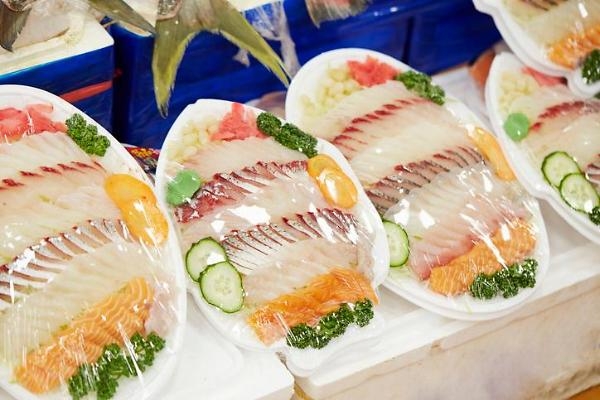
A relentless, record-breaking heat wave has pushed sea temperatures high enough to trigger the first high-water-temperature damage at fish farms this year, with the initial casualties reported on Jeju Island. Experts warn that if the intense heat persists through August, mass die-offs of farmed fish could spread and disrupt both the supply and price of raw fish.
According to the Ministry of Oceans and Fisheries and Jeju Island authorities, two fish farms in Daejeong-eup, Seogwipo, suffered a mass flounder die-off, setting off the first formal high-water-temperature damage recognition process in the Jeju region this year.
The initial death toll was estimated at about 9,000 fish, but follow-up inspections raised that figure to more than 21,000. Losses are estimated at about 92 million won ($63,800).
Jeju Island authorities, municipal offices and the National Institute of Fisheries Science conducted a joint investigation and provisionally classified the incident as a fishery disaster caused by high water temperatures, initiating the relevant procedures. However, disease testing is still under way, and if a disease is confirmed, the incident will not qualify as high-water-temperature damage. Final recognition and eligibility for recovery support will be determined after review by the Ministry of Oceans and Fisheries' Fishery Disaster Response Deliberation Committee.
At the time the die-off was reported, the surface water temperature in nearby waters stood at about 27 degrees Celsius, and the temperature inside the farms measured 27 to 28 degrees.
Jeju Island authorities believe the flounder could not withstand the stress of high water temperatures as the recent heat wave rapidly warmed the sea. The dead fish were pre-market specimens weighing about 700 grams each.
High water temperatures are spreading along coastlines across the country.
The Ministry of Oceans and Fisheries raised its high-water-temperature disaster alert to the "Alert" level at 6 p.m. on July 21, after the National Institute of Fisheries Science issued high-water-temperature advisories for eight sea zones, including inner bays of the Yellow Sea and South Sea and coastal waters around Jeju.
This year's first high-water-temperature advisory came 12 days later than last year because of a delayed monsoon season, but water temperatures have risen more steeply since then. Surface temperatures at fish farms in Tongyeong, Geoje and the Namhae area of South Gyeongsang Province have recently climbed to 28 to 29 degrees Celsius, exceeding the 28-degree advisory threshold.
The deeper concern is that high-water-temperature damage has already become a recurring problem.
In Jeju, rising coastal water temperatures driven by climate change have caused farm losses every year. In 2024, about 2.215 million flounder died at 78 land-based fish farms, causing roughly 5.3 billion won in damage. Last year, about 1.8 million flounder died at 62 farms, resulting in losses of 5.2 billion won.
Nationwide, last year's high-water-temperature advisory ran for 71 days — from July 24 to Oct. 2 — the longest stretch since the advisory system was introduced in 2017. Aquaculture losses that year reached 143 billion won, the highest on record since statistics were first compiled, with rockfish alone accounting for 58.3 billion won in damage.
Mass die-offs of farmed fish can eventually feed through to consumer prices.
The Korea Maritime Institute found that after last summer's large-scale die-offs, farm-gate prices for rockfish remained more than 50 percent above year-earlier levels across all regions.
Because flounder and rockfish require more than a year of rearing before they are ready for market, a single drop in output takes considerable time to recover. Prices at Noryangjin Fish Market surged in early June this year as rising water temperatures compounded fuel-cost pressures. Wild-caught flounder jumped 37 percent in a single week to 11,100 won per kilogram, while farmed flounder fetched 20,000 won per kilogram and farmed red sea bream reached 12,400 won per kilogram.
Imported seafood prices are also rising, limiting any price-stabilizing effect. According to the Korea Agro-Fisheries and Food Trade Corporation, the price of imported salted mackerel this month reached 11,017 won per bundle, up 29 percent from a year earlier, while deep-sea frozen squid rose 7.3 percent to 5,211 won per fish. A weaker won pushing up import costs is largely to blame.
Experts are concerned that a prolonged heat wave could bring harmful algal blooms on top of high water temperatures. The current advisory stands at the "Alert" level, but if the heat continues into August, losses for fish farmers could worsen significantly. Fish farms are stepping up oxygen supply and water temperature management, while consumers are being advised to prepare for potential seafood price swings this summer.
rainbow@heraldcorp.com





