![Foreign tourists walk through central Seoul. [Yonhap]](https://wimg.heraldcorp.com/news/cms/2026/08/03/news-p.v1.20260803.81edd8daca494d478dec0bcb1a1ff085_P1.jpg)
"We will nurture tourism as a national strategic industry and open the era of 30 million inbound visitors at the earliest possible date."
That was the pledge from Minister of Culture, Sports and Tourism Choi Hwi-young at a national tourism strategy meeting. With global enthusiasm for K-culture driving a sharp rise in foreign arrivals, the target no longer sounds like empty rhetoric.
The problem is accommodation infrastructure. Handling the surge of foreign visitors requires sufficient lodging, but supply is falling well short. In Seoul, where tourists are most concentrated, hotel room supply has barely recovered to pre-pandemic levels. Demand is climbing while room supply stands still, pushing hotel rates higher by the day.
Home-sharing — converting existing residential space in urban areas into short-term lodging — has emerged as a promising alternative. But it remains hemmed in by layers of stringent regulation.
Visitors surging, Seoul room supply stuck
Inbound foreign tourism has been climbing steeply. Cumulative arrivals for the first half of this year reached 10.71 million, up 21.3 percent from the same period last year — a pace roughly a month ahead of where last year's comparable total was reached. The government has set a target of 23 million foreign visitors this year and is pursuing 30 million by 2029.
Accommodation supply, however, is not keeping pace. According to the Ministry of Culture, Sports and Tourism's registry of tourism lodging businesses, the number of registered facilities nationwide grew 35.07 percent, from 2,218 in 2019 to 2,996 in 2025. But measured by room count, the increase over the same period was just 10.07 percent — from 206,079 rooms to 226,840.
Seoul, which draws the largest share of visitors, is in worse shape. The number of registered tourism lodging facilities in the capital rose from 460 (60,044 rooms) in 2019 to 572 (62,057 rooms) in 2025, but room count grew only 3.4 percent — roughly one-third the national average increase of 10.1 percent.
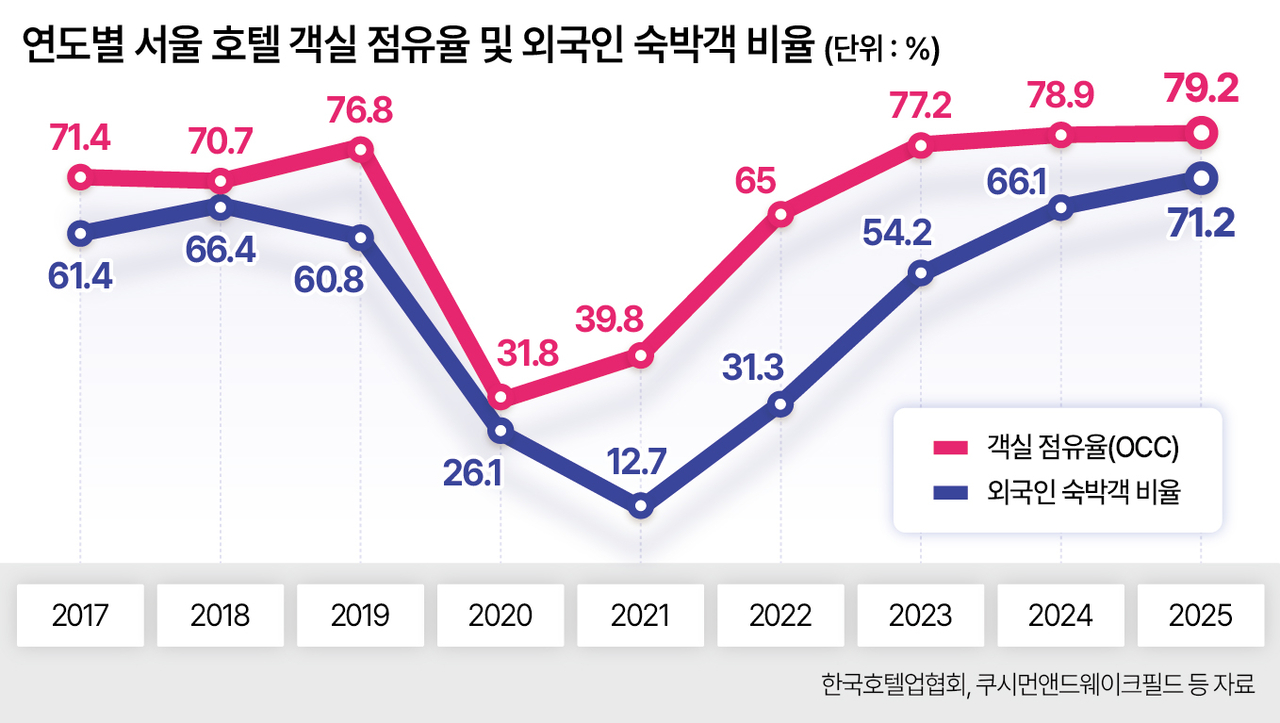
The room shortage is feeding into higher prices. According to Cushman & Wakefield Korea's 2026 Seoul Hotel Market research note, Seoul hotel occupancy last year hit 79.2 percent, the highest since 2017, while revenue per available room (RevPAR) surged 67 percent from 2019 levels to around 207,345 won ($145). Four-star hotels, which foreign visitors tend to prefer, saw the steepest climb — average daily rates (ADR) rose 92 percent compared with 2017.
Building new hotels to close the gap is not a quick fix. Large lodging facilities require years of site acquisition, construction and permitting, making it difficult to respond swiftly to rapidly growing demand.
Home-sharing, which repurposes existing residential space without large-scale construction, has gained attention as a faster way to expand supply. But it too has struggled to absorb the surge in demand, held back by regulations that experts say are excessive.
'You need consent from more than half the building' — rules divorced from reality
![A guest works remotely from a home-sharing accommodation. [Airbnb]](https://wimg.heraldcorp.com/news/cms/2026/08/03/news-p.v1.20260803.b94c431bff6f4f59a76f0e48dce970bd_P1.jpg)
The legal framework for home-sharing in South Korea — the Urban Homestay for Foreign Tourists regime, known by its Korean acronym — took effect in December 2011. Anyone wishing to operate a short-term rental such as an Airbnb listing in an urban apartment, villa or detached house must register under the Tourism Promotion Act's urban homestay provisions.
The law was enacted during an earlier hallyu wave, when a surge of foreign visitors exposed a shortage of budget accommodation. The idea was to let residents rent out spare rooms, easing the lodging crunch while giving tourists a taste of Korean home life. Roughly 15 years on, demand for home-sharing has grown consistently, but the regime has drawn criticism for failing to keep up with a changed market. The two most-cited barriers are the resident-consent requirement and the owner-occupancy requirement.
Kim, a prospective home-sharing operator preparing to launch a business in Mapo-gu, Seoul, has been unable to file a business registration for months because of the regulatory hurdles. "To legally operate home-sharing in the city, urban homestay registration is mandatory — but the regulations make it structurally impossible to start a business in the first place," he said.
Kim ran a home-sharing property in Mangwon-dong, Mapo-gu from 2018 until September 2025 and recently tried to restart. He ran straight into the consent wall. To register an urban homestay in a multi-unit building, an operator must obtain the agreement of more than half of all households in the entire building, as well as the consent of every unit on the same floor and on the floors immediately above and below.
"Getting residents to sign a consent form so you can host foreign tourists is genuinely difficult," Kim said. "Under the current system, launching a legitimate home-sharing business is no easy task."
![A guest shares a meal with a host. [Airbnb]](https://wimg.heraldcorp.com/news/cms/2026/08/03/news-p.v1.20260803.236a1dfdb7b748fba22cd4ae4e54ddfd_P1.jpg)
In practice, the consent process frequently devolves into negotiations. Residents have demanded cash payments or utility bill coverage in exchange for their signatures, and operators who secured consent from one set of neighbors have found themselves exposed when those residents move out and new ones file complaints. What is supposed to be a one-time entry requirement becomes a permanent variable threatening the viability of the business.
Chae Bo-young, chairwoman of the Korea Minbak Industry Association, said the consent requirement is the most urgent problem to fix. "It does nothing to address residents' actual concerns, yet it blocks business entry entirely," she said. "Because consent is so hard to obtain, the number of registered urban homestay operators in Jung-gu — one of Seoul's most tourist-heavy districts — has barely changed from where it stood around 2014 and 2015, even as inbound tourism has grown strongly."
Operators who clear the consent hurdle then face the owner-occupancy requirement. Under the current urban homestay rules, the host must actually live in the property while receiving guests. Critics say this is increasingly at odds with what tourists want — most now prefer an independent lodging environment rather than sharing space with a host.
The requirement that hosts and guests share a home has also created safety concerns. In 2024, a host in his 30s was sentenced to one year and six months in prison after attempting to sexually assault a foreign female tourist staying at the apartment where he lived.
Kim Seong-jun, head of communications for Airbnb Korea, said the rule has become an anachronism. "Today, smartphones and remote management systems allow hosts to communicate with guests and manage a property perfectly well without being physically present," he said. "Insisting on an owner-occupancy requirement that no longer reflects how people live is deeply out of touch with reality. The urban homestay framework has not incorporated any of the changes in trends since it was first introduced in 2011, and it needs to be reformed."
'Shift from upfront restrictions to post-entry oversight'
![Tourists crowd Myeong-dong street in Jung-gu, Seoul. [Yonhap]](https://wimg.heraldcorp.com/news/cms/2026/08/03/news-p.v1.20260803.bf65bf34c98a488bba1205a2502d0312_P1.jpg)
Other countries also regulate home-sharing, but unlike South Korea, most have moved toward a notification-based system — replacing prior approval requirements with post-entry oversight — to keep the sector within a manageable regulatory framework.
Japan is the clearest example. In 2018, it enacted the Private Lodging Business Act, sharply lowering the barriers to home-sharing. Previously, operators had to obtain a license under the Inn Business Act by meeting strict facility and hygiene standards. Under the new law, a simple notification to a prefectural government is all that is required to legally operate a home-sharing business for up to 180 days a year. The law also allows hosts who do not live on the premises to delegate management to a licensed property manager, removing the owner-occupancy obligation. In national strategic special zones such as Osaka, even the 180-day cap was lifted to absorb growing tourism demand.
The consequences of tightening short-term rental rules offer a cautionary tale. When the city of Lisbon, Portugal recently imposed sweeping restrictions on short-term rentals such as Airbnb listings, citing a housing shortage, roughly 40 percent of short-term rental permits in the city were revoked and more than 6,000 home-sharing units were pushed out of the market. The sudden drop in supply drove hotel rates in central Lisbon up 15 to 25 percent, and cost-conscious travelers began redirecting their trips to less-regulated destinations such as Sintra and Faro. Tighter regulation had backfired, producing higher accommodation costs and a dispersal of tourists away from the city.
Academics and industry experts agree that preparing for an era of 30 million foreign visitors will require easing the upfront restrictions on urban homestay registration and strengthening post-entry oversight instead. Regulations that block entry outright — such as the resident-consent and owner-occupancy requirements — need to be overhauled promptly to reflect current market realities and shifting trends, they say.
Seo Won-seok, chairman of the Korea Tourism Research Association, said South Korea should follow Japan's lead. "Japan, which once regulated home-sharing under the same framework as conventional lodging businesses, enacted a new private lodging law ahead of the Tokyo Olympics and shifted its policy approach from upfront restriction to post-entry management," he said. "A structure that blocks entry the way ours does now cannot handle 30 million foreign visitors. The discussion about moving from a regulation-centered to a management-centered system is urgently needed."
terry@heraldcorp.com