![Members of a task force on industrial accident deaths at migrant worker dormitories hold a press conference outside a greenhouse dormitory in Pocheon, Gyeonggi Province, calling for a full investigation and fundamental remedies following the death of a migrant woman worker at a vinyl greenhouse dormitory in December 2020. [Newsis]](https://wimg.heraldcorp.com/news/cms/2026/08/04/news-p.v1.20260804.394daa42261843758130108d0695e311_P1.jpg)
The government has established a legal basis to prevent employers from housing foreign workers in illegal temporary structures, but critics say the sweltering-dormitory problem may remain unresolved.
The amended Foreign Employment Act tightens regulations around whether a structure is legally compliant under the Building Act, but stops short of guaranteeing that housing can actually withstand extreme heat or cold.
Only 'illegal' structures targeted — legally registered temporary buildings still allowed as worker housing
According to the Ministry of Employment and Labor on Tuesday, the amended Foreign Employment Act — promulgated in June — requires that housing provided by employers to foreign workers be listed in the building register or temporary-structure register as suitable for residential use, and meet the dormitory standards set out in Article 100 of the Labor Standards Act.
The core of the revision is to prohibit the use of unlicensed or illegal temporary structures as housing — a practice that had been difficult to sanction — and to create a legal basis for the central government to provide administrative and financial support when local governments pursue residential environment improvement projects. The amended law takes effect in June 2027 after a one-year grace period.
Starting this year, the ministry introduced a new support program to improve housing conditions for migrant workers in the agricultural sector, offering employers who convert dormitories to standard buildings up to 18 million won ($12,600) in renovation costs. Public dormitories for migrant workers are also being developed in Gimhae and Sacheon in partnership with local governments.
However, the revision focuses solely on eliminating illegal temporary structures — it does not ban temporary structures outright.
"We are not prohibiting all temporary structures," a ministry official said. "If a temporary structure has been legally permitted and meets the dormitory standards under Article 100 of the Labor Standards Act, it is difficult to sanction its use as housing." The official added that the intent of the revision was to prevent illegal temporary structures from being used as housing, not to uniformly restrict all legally registered ones.
In effect, an employer who properly registers a temporary structure under the Building Act and meets the Labor Standards Act's dormitory requirements may still use it to house foreign workers.
Labor Standards Act silent on temperature and insulation — the fatal flaw for 'legal' temporary housing
The problem is that "legally compliant housing" and "safe housing" are not necessarily the same thing.
Recent media reports on rural migrant worker dormitories lay bare the gaps in the current system.
The Seoul Shinmun reported that the interior temperature of a vinyl greenhouse dormitory at a farm in Pocheon, Gyeonggi Province, reached 38.9 degrees Celsius. The Hankyoreh also covered a dormitory in Sohol-eup, Pocheon, where the surface temperature inside a shade screen climbed to 46.7 degrees, with workers saying that even running the air conditioner made no difference — "It's still hot. It's pointless."
In structures where container-style rooms are installed inside a vinyl greenhouse shell, heat trapped in the outer shell and walls cannot escape even with cooling units running, severely diminishing the effect of air conditioning, according to those familiar with conditions on the ground.
In winter, the same structures risk exposing residents to extreme cold due to poor insulation. In December 2020, a Cambodian migrant worker died in a vinyl greenhouse dormitory in Pocheon, Gyeonggi Province, sparking a nationwide debate over housing conditions for rural foreign workers.
The current legal framework sets no separate standards for responding to such extreme weather conditions.
Article 22-2 of the Foreign Employment Act requires that employer-provided housing meet the dormitory standards of Article 100 of the Labor Standards Act and be legally designated for residential use under the Building Act. Article 100 of the Labor Standards Act does address the structure, facilities, location, living environment and floor area of dormitories — but it does not specify standards for insulation performance, cooling or heating capacity, or indoor temperature maintenance in extreme heat or cold.
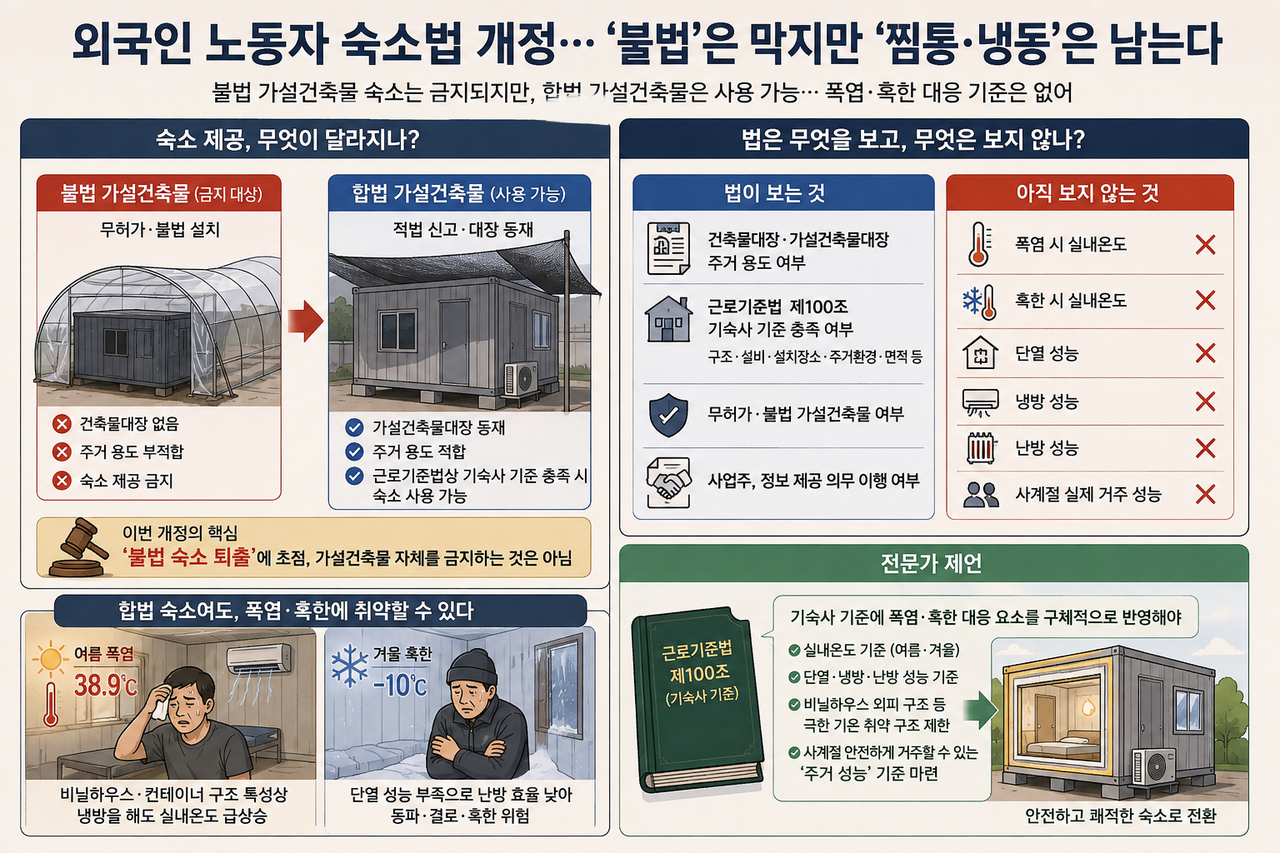
The upshot is that even housing legally registered under the Building Act and meeting dormitory standards can become a sweatbox in summer and a freezer in winter — and the current legal framework has no mechanism to screen for that.
"For legally registered temporary structures, we look at whether they meet the standards under Article 100 of the Labor Standards Act," a ministry official said. "Illegal temporary structures are subject to sanctions, but for legal ones, we have to assess whether they satisfy those standards."
Experts say that as climate extremes become the norm, regulations must go beyond legal compliance and reflect actual livability.
"Eliminating illegal housing and creating housing where people can actually live safely are two different things," a labor sector official said. "The dormitory standards in the Labor Standards Act need to be made more specific — covering insulation, cooling and heating performance, and year-round residential standards that can handle both extreme heat and extreme cold."
"Na Yu-jeong" is a column that explains useful policy information in plain language. It examines the background behind proposed policies and what changes mean, and guides readers on who can use them, when, and how.
fact0514@heraldcorp.com