![Minimum Wage Commission Chairman Kwon Sun-won speaks after the panel's 14th plenary session at Government Complex Sejong on July 14, where next year's minimum wage was set at 10,700 won per hour. [Yonhap]](https://wimg.heraldcorp.com/news/cms/2026/08/06/rcv.YNA.20260714.PYH2026071420490001300_P1.jpg)
South Korea's hourly wage inequality narrowed through the 2010s but has been widening again since 2020, driven by a slowdown in minimum wage growth that has weakened gains for low-paid workers, compounded by a rise in non-regular employment and increasing job polarization, some analysts say.
According to a paper published Thursday by Kim Su-hyeon, a researcher at the Korea Employment Information Service, in the Journal of Korean Industrial Relations, an analysis of the Ministry of Employment and Labor's Survey on Labor Conditions by Employment Type showed that hourly wage inequality began expanding again from 2020.
The wage gap between high-paid and low-paid workers narrowed from 5.517 times in 2010 to 3.485 times in 2020, but has since widened again, reaching 3.619 times in 2024. The researchers identified the growing gap between median-wage and low-wage workers as the central driver of the post-2020 increase in wage inequality.
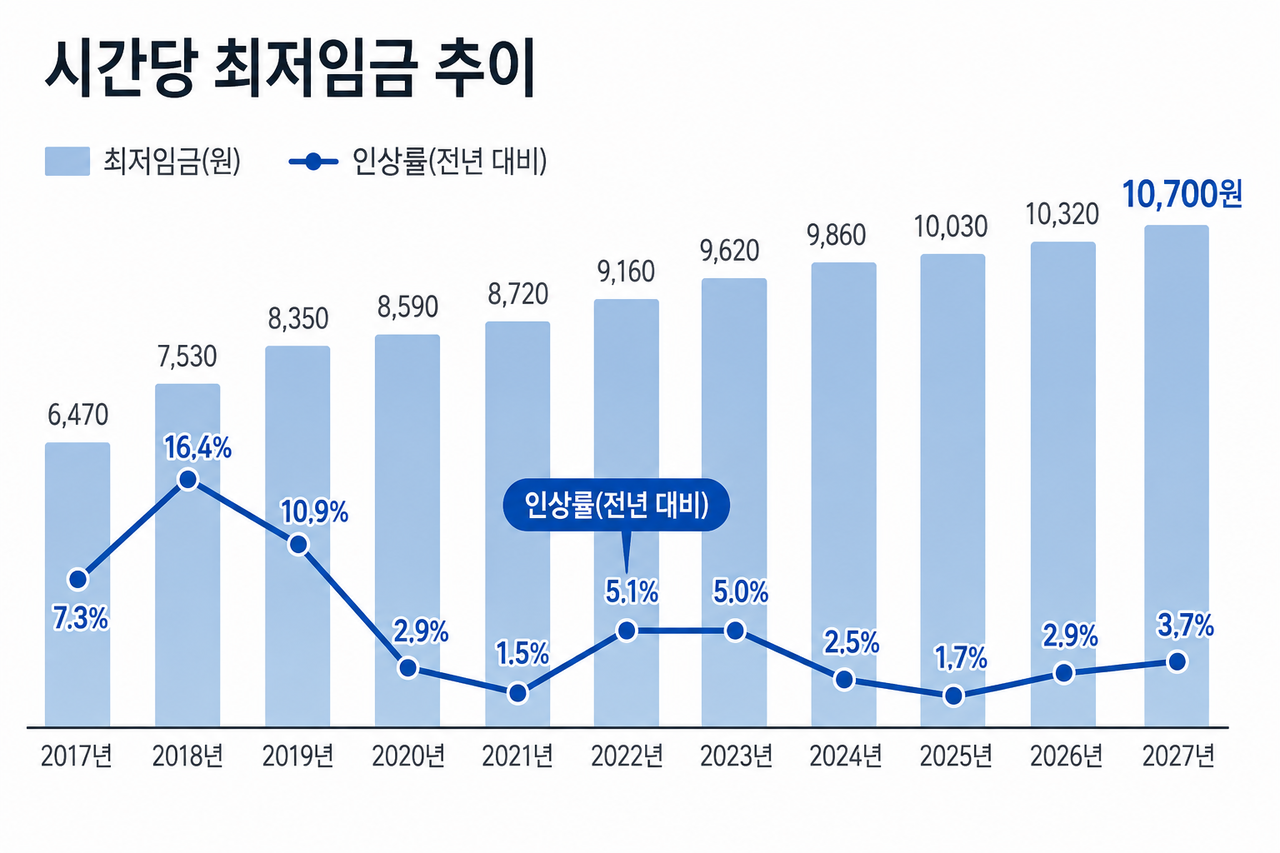
The slowdown in minimum wage growth was identified as the single biggest factor. The hourly minimum wage rose at an average annual rate of 7.7% between 2010 and 2020, but that pace fell to 3.5% between 2020 and 2024 — less than half the previous rate.
The researchers found that before 2020, minimum wage increases had compressed the bottom of the wage distribution by lifting low-paid workers' earnings, but that this effect weakened as the pace of increases slowed. As a result, the equalizing effect on wage structure also diminished.
Structural changes in the labor market also played a role. On the supply side, a rising share of workers aged 50 and older — a consequence of aging — widened gaps at the top of the wage distribution, while growth in the number of highly educated workers and long-tenured employees deepened inequality at the lower end.
On the demand side, an increase in high-skill jobs such as managers and professionals, alongside a decline in mid-skill roles such as machine operators and assemblers, fueled job polarization and widened the wage gap further.
The expansion of non-regular employment was also cited as a major cause. The researchers found that a higher share of non-regular workers deepened wage inequality in both the 2010s and 2020s, with the effect growing more pronounced in recent years as the pace of increase accelerated.
"The slowdown in minimum wage growth has weakened the wage structure's ability to reduce inequality," Kim said, calling for policy efforts to improve job security and working conditions for non-regular workers and to maintain the relative wage level at the bottom of the distribution.
Meanwhile, the Ministry of Employment and Labor has officially set the minimum wage applicable from 2027 at 10,700 won ($7) per hour, up 380 won, or 3.7 percent, from this year's 10,320 won.
fact0514@heraldcorp.com