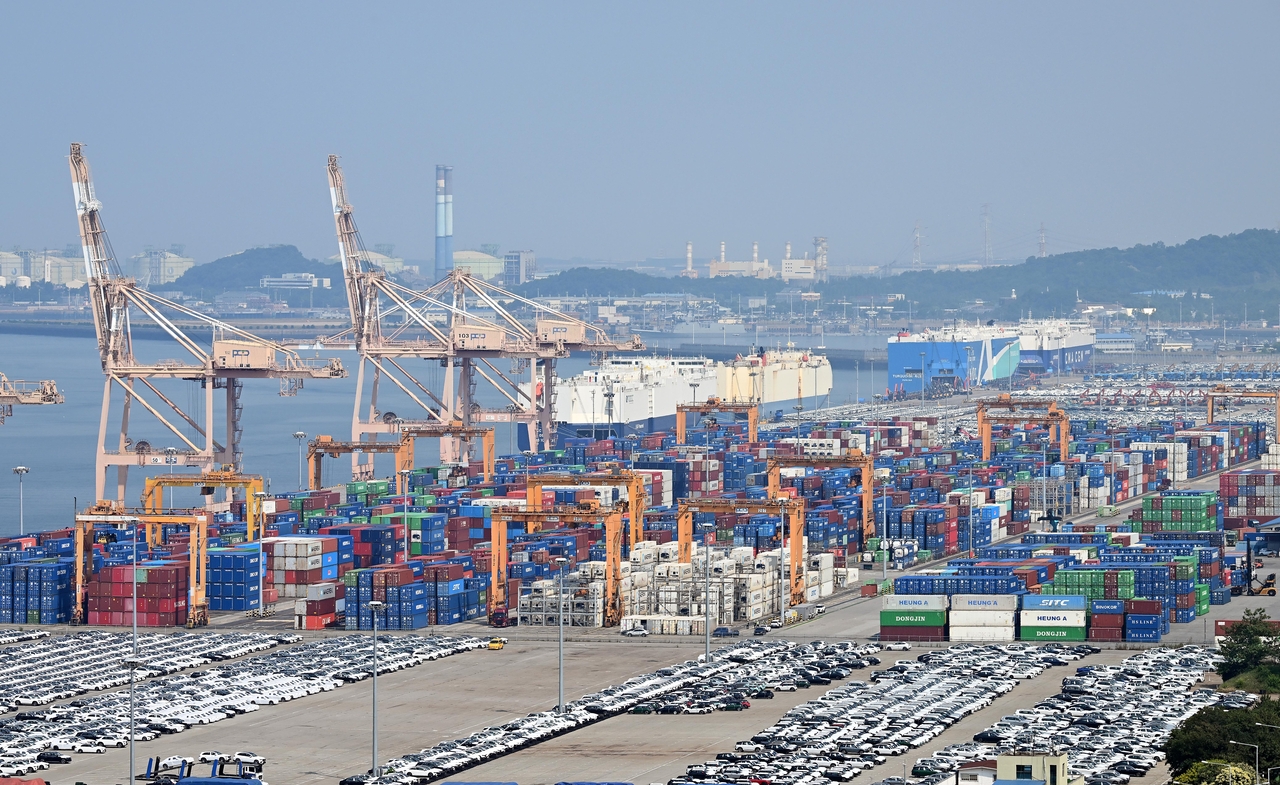
South Korea's current account surplus hit a record high for the second consecutive month in June, driven by a surge in semiconductor and broader IT exports alongside solid gains in non-IT sectors such as steel. With the annual surplus now widely expected to far exceed the Bank of Korea's forecast, market attention is turning to the central bank's revised growth outlook and benchmark interest rate decision, both due Aug. 27.
Kim Yeong-hwan, director general of the BOK's financial statistics department, said Thursday at a briefing on the preliminary balance of payments for June 2026 that goods exports topped $100 billion for the first time in June, pushing the current account surplus to a record high for the second straight month. "Excluding April, when a large dividend payment weighed on the balance, we have set a new all-time monthly record every month since February," he said.
The cumulative current account surplus for the first half of this year reached $191.01 billion, surpassing the BOK's earlier first-half forecast of $151.5 billion by $39.51 billion, or 26.1 percent. The figure is already roughly 1.5 times the full-year surplus of $123.05 billion recorded last year.
Semiconductors led the export surge, but non-IT goods also contributed. In June, IT exports rose 160.4 percent from a year earlier, while non-IT exports climbed 18.6 percent.
Park Seong-gon, head of the BOK's balance of payments team, said the scale of semiconductor export growth tends to overshadow gains in non-IT sectors, but added that non-IT performance has been solid in its own right. "Semiconductors are leading exports, but other categories are contributing as well," he said. He noted that steel exports in particular have continued to grow despite tariff headwinds, supported by rising demand from AI data center construction in the United States.
The strong momentum is expected to carry into July. Kim said that while customs-cleared trade data for July came in slightly below June, robust semiconductor exports should push the goods trade balance to another all-time monthly high. According to the Ministry of Trade, Industry and Energy, exports last month rose 62.8 percent year-on-year to $98.89 billion — down from June's historic crossing of the $100 billion threshold but still the second-highest monthly total on record. Semiconductor exports alone surged 178.8 percent to $41.01 billion, accounting for roughly half the total.
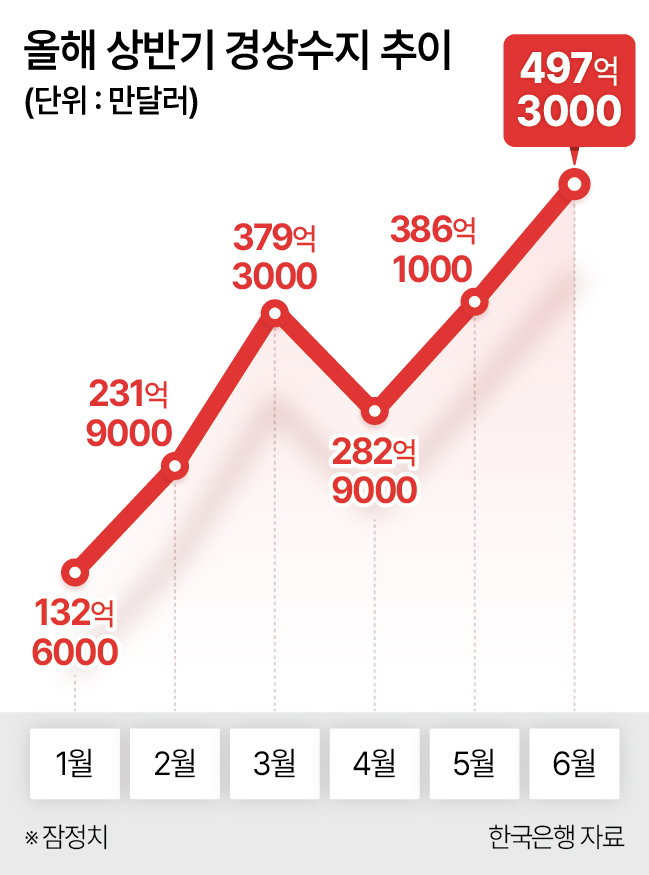
The full-year current account surplus now looks increasingly likely to exceed the BOK's forecast as well. The central bank had projected an annual surplus of $250 billion — $151.5 billion in the first half and $98.5 billion in the second. "We already have a $191 billion surplus just through the first half, so the full-year figure will come in above that forecast," Kim said.
The string of record surpluses is adding upward pressure to South Korea's economic growth trajectory. The BOK's advance estimate showed real GDP expanded 0.6 percent quarter-on-quarter in the second quarter, three times the central bank's own forecast of 0.2 percent. Real gross domestic income rose even faster, up 3.6 percent — roughly six times the real GDP growth rate — reflecting sharp improvements in the terms of trade. On a year-on-year basis, real GDI grew 15.6 percent, the fastest pace since the first quarter of 1988, when it rose 16.4 percent.
Domestic and international institutions are increasingly converging on a full-year growth forecast in the 3 percent range. Morgan Stanley raised its GDP growth forecast for South Korea by 0.6 percentage points to 3.4 percent. The Ministry of Economy and Finance has set a 3 percent growth target for this year, and the BOK itself said at its second-quarter GDP briefing that annual growth of 3 percent would be achievable if the economy contracts an average of just 0.1 percent quarter-on-quarter in the third and fourth quarters.
Minutes from last month's Monetary Policy Board meeting showed that one board member assessed that "the favorable export trend is expected to continue, supported by structurally strong global demand for semiconductors and the resulting improvement in the terms of trade, while domestic demand conditions are also expected to improve." The member added that as the semiconductor boom continues, income gains for businesses and households are expected to gradually feed through to domestic demand via investment and consumption, further widening the upside risks to growth.
Markets are now focused on the revised economic outlook the BOK's Monetary Policy Board will release Aug. 27. In its May forecast, the central bank raised its growth projection for this year to 2.6 percent, up 0.6 percentage points from its February estimate of 2 percent. A revision into the 3 percent range is widely seen as a foregone conclusion; the key question is how high within that range the new figure will land.
There is also growing speculation that the BOK could raise the benchmark interest rate for a second consecutive meeting on the same day. Second-quarter GDP came in well above expectations, and July consumer price data showed core inflation — the underlying price trend indicator — accelerating at a faster pace. At the previous policy meeting, a number of board members signaled the need for further rate increases, with some saying it was difficult to conclude that the most recent hike alone would be sufficient to achieve the inflation target.
However, skepticism about consecutive rate hikes persists within the board. Some members have raised concerns that raising rates further while headline consumer inflation has edged down slightly and the exchange rate is stabilizing could impose disproportionate burdens on vulnerable borrowers. With BOK Governor Shin Hyun-song repeatedly flagging the need for additional tightening, the rate decision is expected to involve considerable internal debate.
kimstar@heraldcorp.com