![Signs warning of restrictions on activities within the greenbelt zone are posted throughout the Seoripul district. [Herald DB]](https://wimg.heraldcorp.com/news/cms/2026/08/06/news-p.v1.20251118.1e70637ceb3849898832738a748b10dd_P1.jpg)
Attention is turning to whether South Korea's long-stalled housing supply pipeline will finally get moving after President Lee Jae-myung ordered officials Monday to "secure the maximum available housing supply" at a closed-door Cheong Wa Dae meeting on the real estate and stock markets. New residential land development led by the Korea Land and Housing Corporation (LH) and housing construction on idle urban sites are expected to be the top priorities. However, the industry continues to call for private land and building rezoning to be tackled first as the most urgent fix, given that large-scale supply plans announced under measures such as the Jan. 29 package have already been running behind schedule.
Government hunts for vacant land, set to push LH-led site development
The Ministry of Land, Infrastructure and Transport plans to announce a third round of Greater Seoul housing supply measures as early as next week, according to government sources Thursday. President Lee has said he would "fly by helicopter over the greater metropolitan area if needed to find supply sites," and state-owned land and idle plots in Seoul and its outskirts are expected to be fully mobilized.
The centerpiece of the new package is new residential site development. Land Minister Kim Yun-deok has said the government would consider "partially lifting greenbelt restrictions" to boost housing supply, making the release of remaining greenbelt land in the three high-end Gangnam districts — Gangnam-gu, Seocho-gu and Songpa-gu — the leading option under discussion. Candidate sites include a reserve forces training ground in Naegok-dong, Gangnam-gu, areas around Segok-dong and Jagok-dong, and the Suseo vehicle depot.
On top of the roughly 10,000 units from aging government buildings and idle sites announced in the Jan. 29 package, additional supply measures are also expected. In January, the government unveiled a "gap supply" plan to deliver between 30 and 1,200 units at aging urban government buildings and idle sites managed by the Ministry of Land, Infrastructure and Transport, the Ministry of Economy and Finance, and regional housing corporations including Seoul Housing and Communities Corporation and Gyeonggi Housing and Urban Development Corporation. Sites now under additional review reportedly include the Seoul Regional Office of the Public Procurement Service, LH's Yeouido site, the former Gwangjin-gu office building and school sites vacated by relocations such as Cheongdam High School.
Accelerating ground-breaking on already-announced supply plans is also cited as a pressing government task. The government earlier launched a pan-government task force for rapid residential site development to speed up housing construction starts on public land, including third-generation new towns. The task force is centered on the Ministry of Land, Infrastructure and Transport and draws in related ministries and agencies — including the Ministry of Economy and Finance, the Ministry of Climate, Environment and Energy, the Cultural Heritage Administration and LH. It works to compress timelines to construction start by advancing key tasks such as compensation, permitting, cultural heritage surveys and environmental impact assessments.
A particular priority is accelerating third-generation new towns where ground-breaking has been delayed, including Hanam Gyosan and Bucheon Daejang. Until now, implementing agencies such as the Ministry of Land, Infrastructure and Transport and LH negotiated individually with the relevant ministries and agencies on each issue. The new approach reflects the government's determination to have all related ministries work together to break ground on even a single unit as quickly as possible.
Industry calls rezoning of private land and buildings urgent; some push for special legislation
The government's additional supply pledges have been met with skepticism in parts of the market, however. A significant number of the candidate sites now under review or being pursued were previously proposed under the Moon Jae-in administration, only to be halted, delayed or scrapped. The Yongsan International Business District and the Taereung Country Club site in Nowon-gu, for instance, both featured in the Jan. 29 package announced earlier this year, had already appeared in the Moon administration's Aug. 4, 2020 housing measures. The greenbelt area around Naegok-dong in Seoul was also reviewed under the Moon government before the plan fell through.
![The government unveiled the Jan. 29 package pledging 60,000 homes in the greater Seoul urban area, but local governments including the Seoul Metropolitan Government have pushed back, citing inadequate transportation plans. Observers say timely housing delivery will not be easy. Pictured is an aerial view of the Taereung Country Club site, where the government has said it will build 6,800 homes. [Yonhap]](https://wimg.heraldcorp.com/news/cms/2026/08/06/news-p.v1.20260202.3b55c66c976849d8b684487ac750e33a_P1.jpg)
The Seoripul district — ambitiously launched under the previous administration and now being pushed hard by the current government — is also mired in delays due to fierce opposition from residents. The project aimed to deliver a total of 20,000 units, with 18,000 in Seoripul District 1 and 2,000 in District 2, but nearby residents have announced plans to pursue administrative litigation and the dispute remains unresolved. LH's financial health, a key pillar of public housing supply, is also repeatedly cited as a factor contributing to the supply bottleneck.
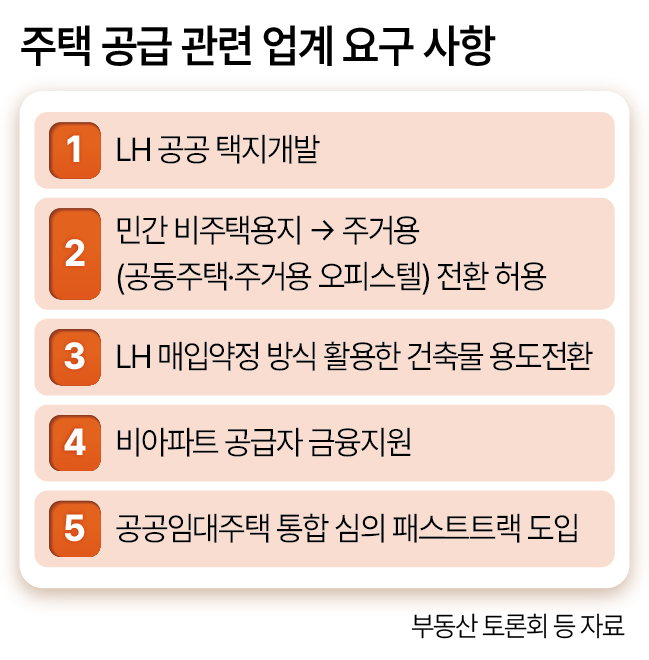
Against this backdrop, the industry is calling for private land development to proceed alongside public-led site development. The most prominent proposal is to allow non-residential land and buildings to convert to residential use, stimulating private housing supply. The industry is asking the government to "set the stage" so that private developers can build apartment complexes and residential officetels.
One widely discussed option involves changing the district-unit plans for urban support facility zones and self-sufficient facility zones — privately owned land that has sat idle for years — to residential use, enabling construction of apartment complexes and officetels. There are also calls to actively convert vacant commercial and office buildings, such as knowledge industry centers, for use as housing.
To that end, specific proposals on the table include enacting special legislation to establish a comprehensive policy support framework and piloting projects through LH's purchase-commitment scheme.
Commercial real estate rental market surveys show that vacancy rates as of end-2024 were broadly elevated nationwide — 8.9 percent for offices, 13 percent for mid-to-large retail spaces, 6.7 percent for small retail spaces and 10.1 percent for collective retail complexes. "Rising vacancies stem from structural shifts that are hard to predict — population movement, urban aging and changing consumption trends — which is why active rezoning for housing supply is necessary," said an official from a residential development company.
hss@heraldcorp.com
lucky@heraldcorp.com