![Ulsan Mayor Kim Sang-uk (right) inspects the algae situation and tap water supply management at Hoeya Lake in Cheongyang-eup, Ulju-gun, Ulsan, on Wednesday. [Ulsan city government]](https://wimg.heraldcorp.com/news/cms/2026/08/06/news-p.v1.20260806.60118691f9d2406ab53586a77df9abfb_P1.jpg)
Busan, Ulsan and South Gyeongsang Province are facing a drinking water emergency as the region endures its hottest summer and most severe drought on record. On Sunday, the daytime high in Yangsan, South Gyeongsang Province, hit 42.5 degrees Celsius — and the extreme heat is fueling a rapid surge in toxic cyanobacteria in local water sources.
Harmful cyanobacteria thrive when water temperatures rise above 25 degrees Celsius, flow slows due to low reservoir levels, and nutrients such as phosphorus and nitrogen accumulate — conditions that together trigger algal blooms.
According to Busan, Ulsan and South Gyeongsang Province authorities, weekly monitoring detected 56,949 cells per milliliter of harmful cyanobacteria at the Mulgeum and Maeri points on the Nakdong River — the drinking water source for residents of Busan and Yangsan — on Monday. With the heatwave and drought continuing, the count is expected to exceed 10,000 cells again in the next survey on Monday, Aug. 10, which would trigger an upgrade from the current "Attention" alert to the higher "Alert" level, issued when counts exceed 10,000 cells for two consecutive weeks.
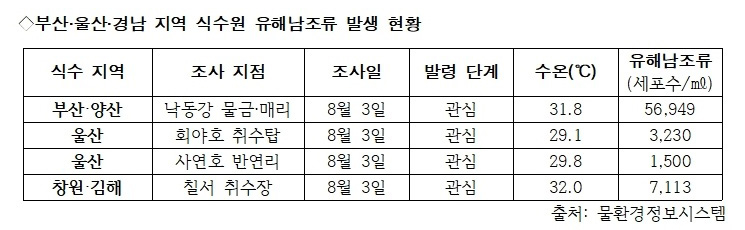
At the intake tower of Hoeya Lake, Ulsan's main drinking water source, counts of 1,810 cells on July 27 were followed by 3,230 cells on Monday — two consecutive weeks above 1,000 cells — prompting the Nakdong River Basin Environmental Office to issue a cyanobacteria alert for the lake for the first time since 2009, 17 years ago. At the Banyeon-ri point of Sayeon Lake, counts have remained above 1,000 cells for four consecutive weeks — 1,850 cells on July 13 and 1,500 cells on Monday — keeping it at the "Attention" level.
Raw water at Ulsan's Cheonsang water treatment plant recorded 1.55 micrograms per milliliter of the algal toxin microcystin on July 20, exceeding the Ministry of Climate, Environment and Energy's monitoring threshold of 1 microgram per milliliter. At the Chilseo point on the Nakdong River, the cell count reached 22,173 on July 16 before falling to 1,519 on July 23, but rose again to 7,113 on Monday, keeping it at the "Attention" level of more than 1,000 cells.
Busan currently draws about 90 percent of its daily drinking water supply of 1.05 million to 1.1 million tons from the Nakdong River, with the remaining 10 percent coming from Hoedong Reservoir in Geumjeong-gu. Ulsan draws 380,000 to 390,000 tons per day from Hoeya Lake, Daeam Lake and Sayeon Lake, supplementing the shortfall with 93,000 tons of raw water from the Nakdong River.
South Gyeongsang Province meets its daily drinking water demand of 1.27 million tons using river water including the Nakdong River (60 percent), dams (37.3 percent), reservoirs (2.6 percent) and groundwater (0.1 percent).
In response, waterworks authorities across the region have stepped up monitoring from once to three times a week as cyanobacteria cell counts rise. They are focused on delivering safe tap water to households through four measures: installing algae barriers, operating water-spray systems, deploying algae-removal vessels, and applying advanced water purification treatment.
To improve the removal of algal toxins and odor-causing compounds, authorities are adding powdered activated carbon at intake towers and adjusting coagulant, chlorine and ozone concentrations during the purification process, while shortening the backwashing cycles for filter beds and activated carbon beds.
In Ulsan, the Hoeya water treatment plant has changed its intake depth from a single draw at 26 meters to a combined draw at 26 meters and 20 meters to reduce the impact of cyanobacteria. Algae barriers, water-spray systems and underwater aerators are also in operation to prevent the spread of algal blooms.
South Gyeongsang Province, which relies heavily on river water for its drinking supply, is working to minimize the inflow of pollutants such as livestock waste that contribute to algal blooms, and is also exploring emergency measures to flush out algae using environmental response water from upstream dams.
Kim Dong-hun, head of Ulsan's waterworks authority, urged residents to report any abnormalities such as odors in tap water to the city's water quality research institute. "We will do our utmost to supply clean and safe drinking water to our citizens," he said.
cityblue@heraldcorp.com