![Key attendees pose for a photo at the Kosdaq Connect 2026 event marking the 30th anniversary of the Kosdaq market, held at the Conrad Hotel in Yeouido, Seoul, on July 1. From left: Kim Se-wan, president of the Korea Capital Market Institute; Song Byeong-jun, chairman of the Korea Venture Business Association; Oh Gi-hyeong, chairman of the Korea Premium K-Capital Market Special Committee; Jeong Eun-bo, chairman of Korea Exchange; FSC Chairman Lee Eok-won; Lee Dong-hun, chairman of the Kosdaq Association; Kim Hak-gyun, chairman of the Korea Venture Capital Association; and Hwang Seon-o, deputy governor of the Financial Supervisory Service. [Korea Exchange]](https://wimg.heraldcorp.com/news/cms/2026/08/06/news-p.v1.20260701.081a2f8740fc438aa0e13fbe18f932ec_P1.jpg)
A wave of "final warning" notices has hit the market following the tightening of delisting rules, as Korea Exchange issued a large batch of disclosures alerting investors that companies failing to meet listing maintenance requirements for 25 consecutive trading days may be placed under administrative watch. With five more trading days of non-compliance enough to trigger that designation, analysts say the so-called penny stocks and other companies falling short of listing standards that have long lingered on the market are now facing a genuine test of the new delisting regime.
Korea Exchange said Thursday that 68 such cautionary disclosures were issued Wednesday. On Kosdaq, 51 notices warned of a potential administrative watch designation — 39 involving share prices below 1,000 won and 12 involving market capitalizations below 20 billion won ($14 million). The 39 share-price cases included 33 initial watch-designation warnings and six notices of a possible additional designation ground for companies already under watch. On the KOSPI market, 17 investor-caution notices were issued, covering 10 companies with share prices below 1,000 won and seven with market capitalizations below 30 billion won.
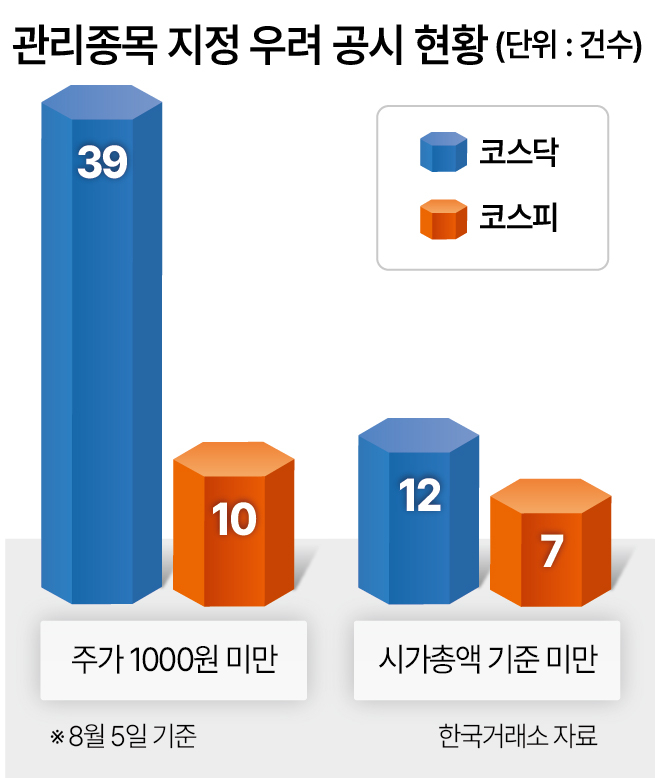
Wednesday marked the first time companies had been subject to advance administrative watch-designation notices under the revised listing rules for failing to meet listing maintenance standards for 25 consecutive trading days.
The disclosures are part of a procedure through which Korea Exchange alerts investors to risk before formally placing a company under administrative watch. If a company remains non-compliant for another five trading days, it will be designated as an administrative watch stock. Should it then fail to recover its share price or market capitalization for at least 45 of 90 consecutive trading days, grounds for delisting will arise.
Strengthening listing maintenance standards is a central pillar of the delisting reform plan the Financial Services Commission announced in February. Financial regulators concluded that a structure of many listings but few delistings — described in Korean market parlance as "many births, few deaths" — was eroding confidence in the capital market and undermining market efficiency, prompting a sweeping overhaul of listing maintenance requirements. Revised listing rules that took effect July 1 tightened four key delisting criteria: market capitalization, share prices below 1,000 won (penny stocks), complete capital impairment and disclosure violations.
Jeong Ji-su, a research fellow at the Korea Capital Market Institute, said the reform is expected to reduce the long-term survival of insolvent companies, lower the risk of investor harm and market manipulation, and contribute to restoring confidence in the capital market and boosting the Korea premium. Jeong also cautioned that companies facing delisting risk may engage in illegal activity, making it necessary to strengthen detailed oversight and investor protection measures alongside the new rules.
Listed companies are also moving quickly to adapt. The most common responses have been share consolidations and mergers between affiliates. According to Hanwha Investment Securities, a total of 243 share consolidation disclosures were filed between Feb. 12 — when the delisting reform plan was announced — and July 2, comprising 51 on the KOSPI market and 192 on Kosdaq. That compares with four filings in the same period in 2024 and 10 in 2025, a more than 24-fold increase in a single year. "Kosdaq, which has a far higher concentration of penny stocks, recorded nearly four times as many cases as the KOSPI market," said Eom Su-jin, a researcher at Hanwha Investment Securities. "It seems clear that share consolidations since February are aimed at avoiding the penny stock criterion."
At least one company has publicly cited delisting risk as a rationale for a merger. Kosdaq-listed Humax absorbed its affiliate Humax Holdings in June, stating in the merger filing that "the likelihood of being subject to administrative watch designation and delisting requirements has increased under the delisting reform plan." At the time, Humax had a market capitalization of 26.3 billion won and Humax Holdings had a market capitalization of 17.1 billion won. Humax Holdings was already trading below Kosdaq's listing maintenance threshold of 20 billion won, while Humax itself was approaching the delisting threshold, adding to the pressure to maintain its listing. Both companies had previously pursued share consolidations to avoid falling below the 1,000-won share price requirement.
"Tightening delisting standards may increase short-term volatility in low-priced and small-cap stocks, but over the long term it is likely to lead to a market restructuring centered on quality companies, ultimately strengthening investor protection and restoring market confidence," said Im Jeong-eun, a researcher at KB Securities. "It is important that the regime be operated consistently so that the tightening of listing maintenance standards translates into a genuine improvement in market quality."
hajun825@heraldcorp.com