![The logo at the entrance of CXMT's factory on the outskirts of Beijing on July 27, when the Chinese memory chipmaker listed on the Shanghai Stock Exchange's STAR Market. CXMT surged as much as 470 percent during trading that day, briefly overtaking Industrial and Commercial Bank of China to become the most valuable company on China's mainland market by market cap. [AFP/Yonhap]](https://wimg.heraldcorp.com/news/cms/2026/08/06/rcv.YNA.20260727.PAF20260727118601009_P1.jpg)
Korean investors are splitting their bets on China's AI sector. When Chinese memory chipmaker CXMT listed on Shanghai's STAR Market on July 27, it reignited market interest in China's semiconductor self-sufficiency drive — but Korean retail investors poured more than twice as much money into Zhongji Innolight, an AI optical transceiver maker that debuted on the Hong Kong Stock Exchange on July 30. Both companies are plays on China's AI industry, but the growth stories investors chose were starkly different.
According to the Korea Securities Depository, Korean investors' net purchases of overseas stocks from CXMT's listing through recently totaled approximately $38.52 million for Zhongji Innolight and approximately $16.71 million for CXMT. Among all overseas stocks ranked by net purchases — a list dominated by US semiconductor leveraged ETFs and big-tech names — Zhongji Innolight ranked 14th and CXMT 25th.
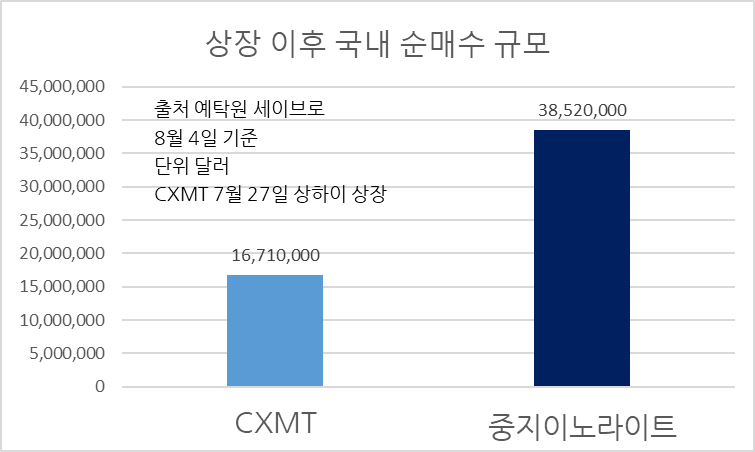
Although both are leading Chinese semiconductor stocks, their investment cases diverge sharply. CXMT is a bet on China's ability to build a homegrown memory industry independent of Samsung Electronics and SK Hynix — the so-called semiconductor self-sufficiency drive. Zhongji Innolight, by contrast, is a play on the benefits flowing from global big-tech companies such as Nvidia and Meta expanding their AI data center investment. Korean investors appear to have given the higher score to the latter story.
Top mainland stock on debut day: investing in China's memory independence through CXMT
CXMT's listing drew attention for good reason. China is the world's largest consumer of DRAM chips, yet it has long depended almost entirely on overseas suppliers — Samsung Electronics, SK Hynix and Micron. As US semiconductor regulations tightened, memory self-sufficiency became a core industrial strategy for Beijing, and CXMT sits at the center of that strategy. The listing carried symbolic weight as the first time China's memory industry has faced a full capital-market valuation.
Analysts interpreted the listing as a signal of broader investment expansion across China's semiconductor ecosystem. Park Ju-young, a researcher at Kiwoom Securities, said the listing "will serve as a catalyst for accelerating China's semiconductor localization," adding that "once capacity scale-ups and production-line upgrades begin in earnest, we expect a positive impact on the earnings and share prices of Chinese semiconductor materials, parts and equipment companies."
Market expectations were correspondingly high. CXMT quickly joined the ranks of China's leading technology stocks by market cap after its debut, with optimism over China's semiconductor ambitions rapidly priced into its valuation.
Korean investors, however, appear to be drawing a distinction between the long-term growth potential of China's memory industry and its current technological competitiveness. While CXMT is rapidly gaining ground in commodity DRAM, it is not yet a competitor to Korean firms in HBM — the high-bandwidth memory central to AI chips.
Kim Dong-won, head of research at KB Securities, said that "even if CXMT continues its aggressive capacity expansion, it will not directly clash with the core customer base of Samsung Electronics and SK Hynix," and that "supply shortages are likely to persist as demand for AI server memory continues to grow."
![Liu Sheng, chairman and CEO of Zhongji Innolight (center), toasts with Bonnie Chan, CEO of Hong Kong Exchanges and Clearing (left), and Michael Wong, acting Financial Secretary of Hong Kong, at a ceremony marking Zhongji Innolight's initial public offering at the Hong Kong Stock Exchange on July 30. [AFP/Yonhap]](https://wimg.heraldcorp.com/news/cms/2026/08/06/rcv.YNA.20260730.PAF20260730108201009_P1.jpg)
Zhongji Innolight: a leader in optical transceivers — the key AI data center component — now more accessible via Hong Kong listing
Korean investors, however, saw greater growth potential not in memory chips but in AI infrastructure — judging that the expansion of global AI data center investment would translate into earnings more quickly than China's memory self-sufficiency drive.
Zhongji Innolight makes optical transceivers used inside AI data centers. Optical transceivers are critical components that transmit large volumes of data at high speed using light signals between AI chips and servers, and between servers. AI servers grow more powerful as more GPUs are connected, but that performance cannot be realized unless the GPUs can exchange data fast enough. Optical transceivers reduce this bottleneck, boosting overall AI server performance — meaning demand for them grows in step with AI data center investment.
Zhongji Innolight is the dominant player in this market. According to research firm LightCounting, the company held a 21.2 percent share of the global optical interconnect solutions market last year, ranking first worldwide. Its sales and net profit in the first quarter of this year rose sharply from a year earlier, with roughly 60 percent of revenue coming from the US market — a sign that the company benefits directly from AI data center expansion by Nvidia and other global technology companies rather than from domestic Chinese demand.
Global investment banks have taken note. Goldman Sachs said that "as AI server performance improves, demand for next-generation optical networking equipment capable of transmitting data faster and more efficiently will grow more quickly than expected," and described Zhongji Innolight as "a key beneficiary of expanding AI infrastructure investment, backed by next-generation optical communications technology and large-scale mass production competitiveness."
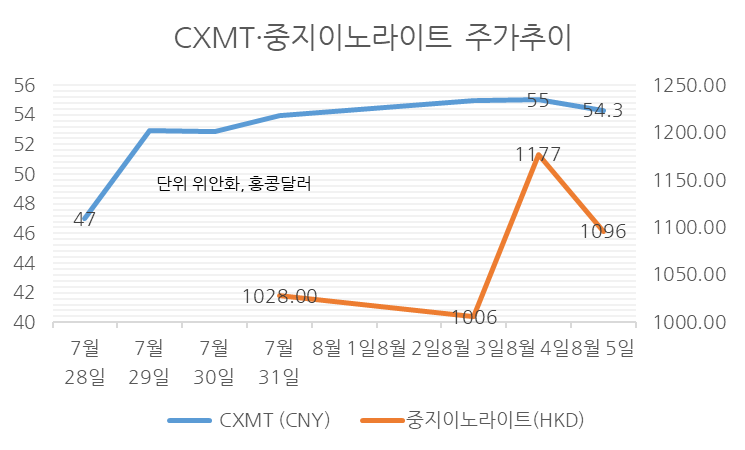
Goldman Sachs more than doubled its price target for Zhongji Innolight in response, citing expectations that demand for high-performance optical transceivers will accelerate as data centers grow more sophisticated and require faster processing of ever-larger data volumes, and that the company will maintain its competitive edge in next-generation optical communications.
Accessibility also played a partial role in the divergence in net purchases. Zhongji Innolight has been listed on the Shenzhen Stock Exchange since 2012, but direct investment by Korean retail investors was not straightforward. Its recent H-share listing in Hong Kong made it relatively easy to trade like any other Hong Kong-listed stock. CXMT, listed on Shanghai's STAR Market, remains difficult for Korean retail investors to access directly. Even so, the market broadly views the decisive factor behind the gap in net purchases as the expectation that "global AI infrastructure" growth will translate into earnings faster than "China's memory self-sufficiency" — rather than accessibility alone.
Park Su-jin, a researcher at Mirae Asset Securities, said that "given the accessibility and trading-regime constraints on STAR Market-listed companies, using related ETFs is a realistic alternative for investing in Chinese semiconductors," adding that "investors should focus on the structural growth of China's semiconductor value chain rather than individual stocks."
kacew@heraldcorp.com