Bill introduced by ruling party lawmaker Lee Hun-gi with about 10 co-sponsors
Key provisions of the proposed inheritance and gift tax amendment analyzed
Unlisted-share valuation method extended to listed companies to prevent undervaluation
Subsidiaries and sub-subsidiaries to be assessed at actual value
Measure goes beyond government's own tax reform plan — could reverse its effect
In effect a tax hike; business community pushback in legislative process seen as inevitable
The details of a proposed amendment to South Korea's inheritance and gift tax law — informally dubbed the "share-price suppression prevention bill" — have been made public. Introduced by the ruling Democratic Party of Korea, the bill could significantly increase the tax burden on controlling shareholders of conglomerates with multiple affiliates. The key change: a share-valuation method previously applied only to unlisted companies would be extended to listed ones. Also notable is a provision requiring that the value of subsidiaries and sub-subsidiaries directly controlled by a major shareholder be calculated using the unlisted-company valuation method.
The bill, submitted to the National Assembly on Wednesday by Democratic Party of Korea lawmaker Lee Hun-gi, has three core provisions.
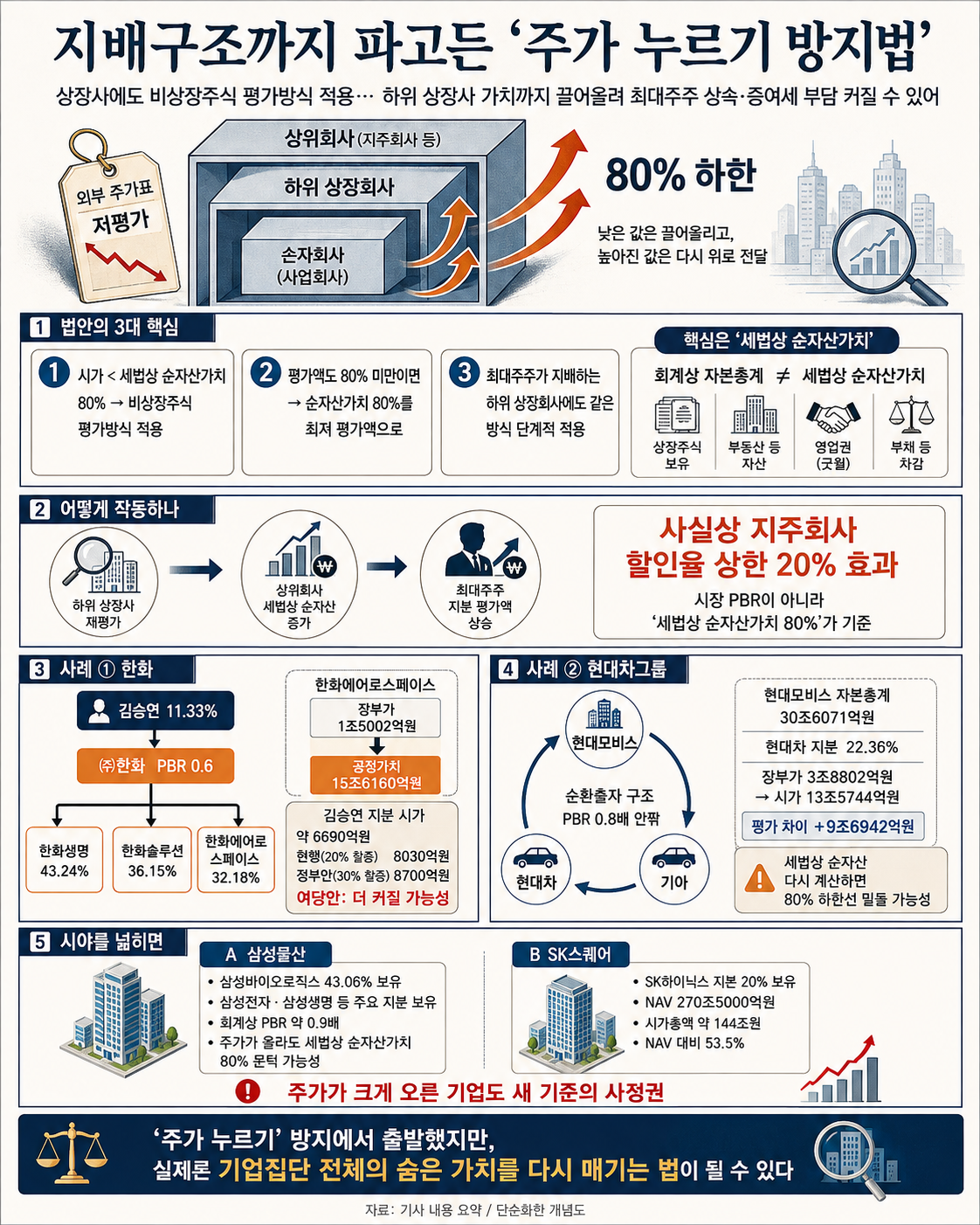
① If the per-share market value of listed shares held by a controlling shareholder (calculated as the average over the four months before and after the valuation date) falls below 80 percent of the per-share net asset value under tax law, the unlisted-share valuation method applies.
② If the assessed value still falls below 80 percent of the per-share net asset value under tax law, that 80 percent figure becomes the floor valuation.
③ The same valuation method applies not only to listed companies directly held by the controlling shareholder, but also to shares in lower-tier listed companies where that company or a related party qualifies as the controlling shareholder.
The most striking element is the concept of net asset value under tax law. Defined by the enforcement decree of the inheritance and gift tax act, this figure differs from the total equity shown in standard accounting books. Assets are in principle valued at market price, and liabilities are deducted only to the extent recognized under tax law. Goodwill and similar intangibles are also subject to separate valuation.
The tax-law net asset value can diverge substantially from its accounting counterpart. Companies whose tax-law valuations of held shares or real estate exceed book value, or that carry goodwill additions, tend to show a higher tax-law net asset value than their accounting equity total. As the denominator — net asset value — grows larger, the degree to which the share price appears undervalued deepens. Even listed companies whose accounting price-to-book ratio exceeds 0.8 times could well fall short of 80 percent of their tax-law net asset value.
The broader impact comes from provision ③, designed to ensure that actual value is consistently reflected across multi-tier ownership structures. Until now, listed companies needed only to reflect the share value of the company directly subject to inheritance or gift tax — unlike unlisted companies, they were not required to recalculate the value of stakes held in other entities. But once a listed company's share value is assessed using the tax-law net asset value standard, the value of any listed subsidiaries or sub-subsidiaries it holds must also be recalculated accordingly. The structure works from the bottom of the ownership chain upward: values are recalculated at each tier and fed into the net asset value of the company above, with a floor preventing any assessed value from dropping below 80 percent of the tax-law net asset value at each step. Low values are pulled up, and those higher figures are then passed up to the parent company.
Since the turn of the century, many of South Korea's major conglomerates have restructured through spin-offs and other reorganizations, separating holding companies from operating units and creating layered ownership structures in which a controlling shareholder governs multiple companies through a single entity. If the bill takes effect, it would sever the chain by which undervalued lower-tier listed companies drag down the succession valuation of the controlling company above them.
If current law and the government's proposal have focused mainly on the "price tag on the outside of the box" — the market value of the listed shares subject to inheritance or gift tax — the ruling party's bill takes an approach of picking up the entire box and revaluing everything inside, including the lower-tier listed companies it contains.
Most groups — Hanwha, Hyundai Motor, Samsung, SK — likely to face higher taxes
Consider some real-world examples. Hanwha Group and Hyundai Motor Group, both of which have aging patriarchs and pressing succession needs, illustrate the stakes well. Kim Dong-kwan and Euisun Chung stand to inherit or receive as gifts the controlling stakes in their respective groups' holding companies from Kim Seung-youn and Chung Mong-koo.
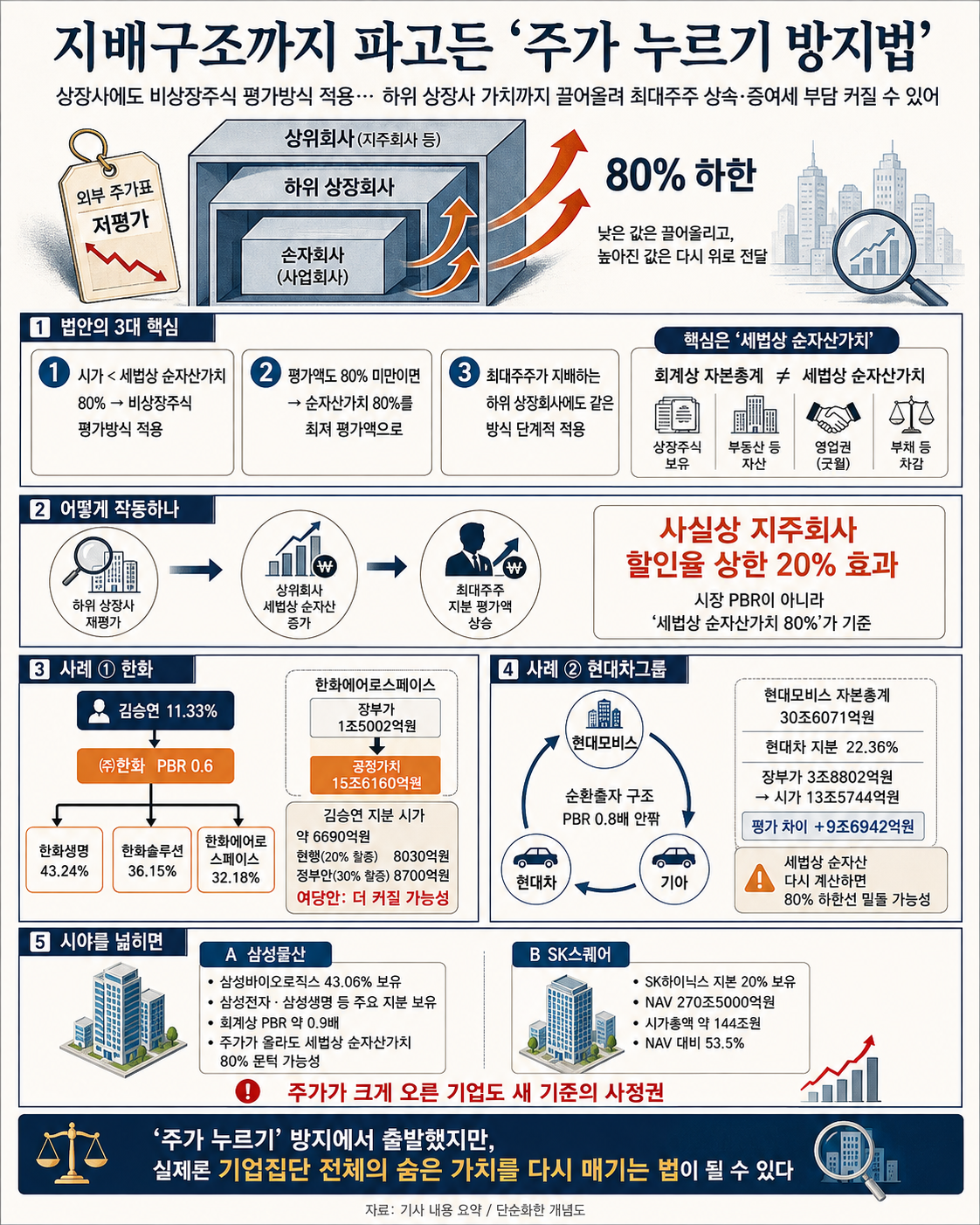
Hanwha Corp.'s share price currently stands at 83,800 won ($59), giving it an accounting price-to-book ratio of about 0.6 times. Calculated against the tax-law net asset value, however, that ratio could fall even lower.
Hanwha Corp. holds 43.24 percent of Hanwha Life Insurance, 36.15 percent of Hanwha Solutions and 32.18 percent of Hanwha Aerospace. Because Hanwha Corp. is itself a listed company, it has not been required to recognize the surging market value of Hanwha Aerospace at fair value for tax purposes.
Under the proposed bill, however, Hanwha Aerospace's share price would have to be reflected at market value when calculating Hanwha Corp.'s tax-law net assets. According to its 2025 annual report, the book value of Hanwha Corp.'s stake in Hanwha Aerospace stands at 1.5 trillion won, while the fair value of that same stake at the same point in time was 15.62 trillion won — a vast gap. Listed companies such as Hanwha Life Insurance and Hanwha Solutions, whose accounting price-to-book ratios already fall below 0.8 times, would be subject to the unlisted-share valuation method if their market prices also fall short of 80 percent of the tax-law net asset value; if the resulting assessed value is still low, 80 percent of net asset value becomes the floor.
Kim Seung-youn currently holds an 11.33 percent stake in Hanwha Corp. with a market value of about 669 billion won. Taking that figure as the market price, current law applies a 20 percent controlling-shareholder premium to arrive at 803 billion won as the taxable base. Under the government's proposed tax reform, the across-the-board premium would be replaced by a 30 percent surcharge tied to the price-to-book ratio falling below 0.8 times, producing a taxable base of 870 billion won.
Under the ruling party's bill, however, the assessed value could climb far higher. Revaluing Hanwha Corp.'s assets under tax-law standards could substantially raise its net asset value, and if the current market price falls short of 80 percent of that figure, the unlisted-share valuation method would kick in.
Hyundai Motor Group's situation differs somewhat, but the likelihood of a heavier tax burden remains significant. The central succession issue for the group's controlling shareholder is the stake that Honorary Chairman Chung Mong-koo holds in Hyundai Mobis. The group operates through a circular ownership structure — Hyundai Mobis to Hyundai Motor to Kia and back to Hyundai Mobis — and all three companies have accounting price-to-book ratios of around 0.8 times. Recalculated against the tax-law net asset value standard, however, all three would likely fall below the 80 percent floor.
Hyundai Mobis's 2025 separate financial statements show total equity of 30.61 trillion won. The book value of its 22.36 percent stake in Hyundai Motor stands at 3.88 trillion won, while the market value of that stake at end-2025 was 13.57 trillion won. Applying the end-2025 market value alone, the valuation gap on the Hyundai Motor stake comes to about 9.69 trillion won above book value.
Succession is not an immediate concern at Samsung Group or SK Group, but widening the lens to include them makes the picture even more striking. The bill is named after share-price suppression, yet the companies whose share prices have risen the most this year could find themselves squarely within the scope of the new valuation standard.
Samsung C&T, where Lee Jae-yong serves as controlling shareholder, is the top shareholder of Samsung Biologics with a 43.06 percent stake and also holds shares in major affiliates including Samsung Electronics and Samsung Life Insurance, making it the apex of the group's ownership structure. This year's sharp rally in Samsung Electronics and Samsung Life Insurance shares has lifted Samsung C&T's own share price considerably, pushing its accounting price-to-book ratio to around 0.9 times. Even so, the surge in the value of its held stakes means the company's market price could fall well short of 80 percent of its tax-law net asset value.
At SK Group, Chey Tae-won controls SK hynix through SK Corp. and SK Square. SK hynix's share price has surged, pulling SK Square — which holds a 20 percent stake in SK hynix — sharply higher as well. SK Square's self-reported net asset value stood at 270.5 trillion won as of July 27, while its market capitalization was about 144 trillion won, roughly 53.5 percent of that figure. If the tax-law net asset value approximates the reported net asset value, even a company whose share price has surged would fall far short of the new 80 percent threshold.
Tax-efficient governance structures exposed — controversy expected to be fierce
The ruling party's bill would in effect cap the discount on the tax-law net asset value of holding companies at 20 percent. Even in a year like this one — when the discount to net asset value has been narrowing rapidly thanks to the government's corporate value-up policy and share buyback and cancellation programs — most major domestic holding companies still trade below a price-to-book ratio of 0.8 times.
The bill could also affect structures in which an unlisted company controls a major listed subsidiary. Under current law, unlisted shares are already valued based on tax-law net assets and earnings value, with held listed shares reflected in net assets at market price only. The proposed amendment, however, would value a listed subsidiary at 80 percent of its tax-law net asset value whenever its market price falls short of that threshold. This raises the likelihood that unlisted companies, too, would be assessed at higher values than before.
The ruling party's bill does include one significant concession: it would abolish the 20 percent controlling-shareholder valuation premium for both listed and unlisted shares alike. It also adds listed shares held by controlling shareholders to the list of assets eligible for payment of inheritance tax in kind. The intent is to avoid imposing a uniform tax on unrealized control premiums and to give shareholders a way to pay in stock when raising cash is difficult. The key question is whether the floor effect of the net asset value provision raises assessed values by more than the premium abolition reduces them.
The bill is still a proposal, and its contents could change during National Assembly deliberations. Strong pushback from the business community is likely to come quickly. The bill's stated purpose is to prevent controlling shareholders from suppressing share prices, but the tax-law net asset value standard it introduces makes no distinction between companies that have suppressed their share prices and those that have not.
After unifying China, the first Qin emperor standardized weights and measures across the realm. Korean tradition holds that Park Hyeokgeose, the founder of Silla, possessed a golden ruler. Joseon-era storytellers crafted a legend in which Yi Seonggye received a golden ruler from heaven before becoming king, lending legitimacy to the dynasty's founding. The ruler and the scale have long symbolized state power itself. Standards matter that much.
In most countries, listed shares are valued at market price for inheritance and gift tax purposes. Legislation that transplants the alternative valuation yardstick designed for unlisted shares — where no daily market price exists — onto listed shares with prices quoted every trading day has few if any precedents among major economies. The problem is that in the Korean market, the belief that companies or their controlling shareholders can influence share prices is widespread. Given the volatility seen in Korean markets recently, the rationality of market prices is itself open to question. One can only hope this moment sparks a debate worth having.
kyhong@heraldcorp.com