South Koreans pay an average of 5.15 million won in insurance premiums per year (2025, Insurance Development Institute). Making every won count — that is what this column is about.
![Kim Jin-ho (pseudonym, 63) has run an auto parts company for 28 years and planned to hand it to his son — until a proposed tax overhaul upended his calculations. Even with the deduction, his son would be locked in for 12 years. His assets are tied up in a factory and company shares, so where does the cash to pay the tax come from? [Created using Gemini]](https://wimg.heraldcorp.com/news/cms/2026/08/08/news-p.v1.20260808.ba5f0bb2ec714c7a90aefc2dfbc58b9d_P1.png)
Kim Jin-ho (pseudonym, 63) has run an auto parts manufacturing company in southern Gyeonggi Province for 28 years. With most of his assets tied up in a factory lot and company shares, he began preparing a few years ago to hand the business to his son. He was not particularly worried about taxes. He had heard many times that anyone who had managed a business for more than 10 years would qualify for the family business inheritance deduction.
A recent government announcement changed that. Under the proposed reform, the standard requirement would rise to 30 years of management. The deduction would not be entirely out of reach, but his son would have to maintain the business for more than 10 years after inheriting it. The bigger problem was that even meeting the requirements would not shield the company's entire assets from taxation.
As Kim weighed whether to consult a tax accountant first, an insurance adviser he had known for years offered an unexpected suggestion: insurance companies also provide inheritance and succession consultations — at no charge.
The government's recently unveiled tax reform package includes sweeping changes to the family business inheritance deduction, upending the calculations of small and medium-sized enterprise owners who had planned to pass their companies to the next generation. The concern is greatest for those who relied on the existing rules without making separate preparations. If they fall short of the deduction requirements, or if the scope of the deduction shrinks, the tax bill remains in full. Company shares and factory properties are hard to sell quickly, leaving owners asset-rich but cash-poor when the time comes.
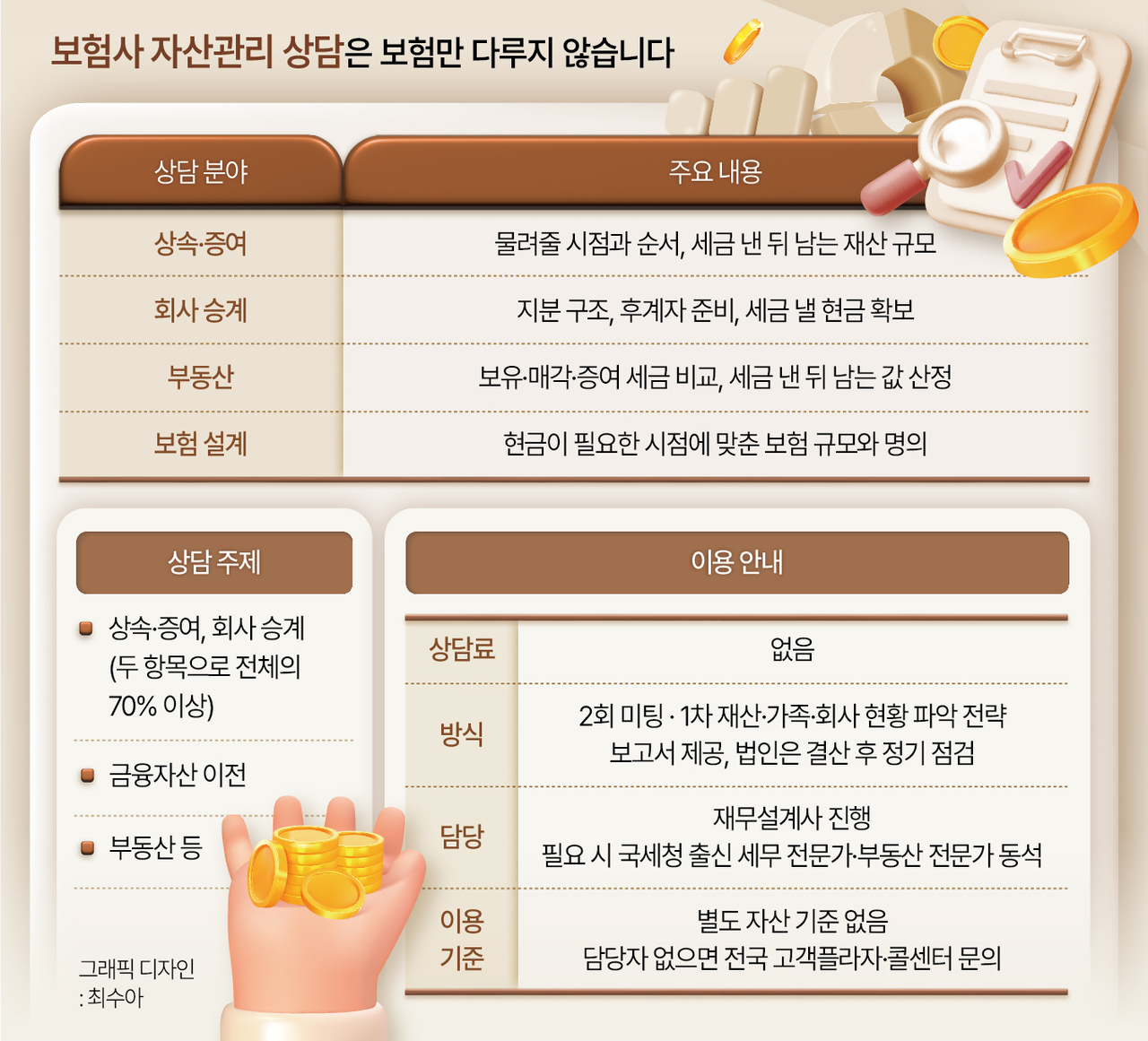
Banks and brokerage firms are not the only places to work through these concerns. Insurance companies also have wealth management units that handle inheritance and succession planning. At some insurers, inheritance, gift and business succession consultations account for more than 70 percent of all advisory sessions. Kim decided to sit down with a specialist to find out what he might be missing.
What exactly changed in the tax law?
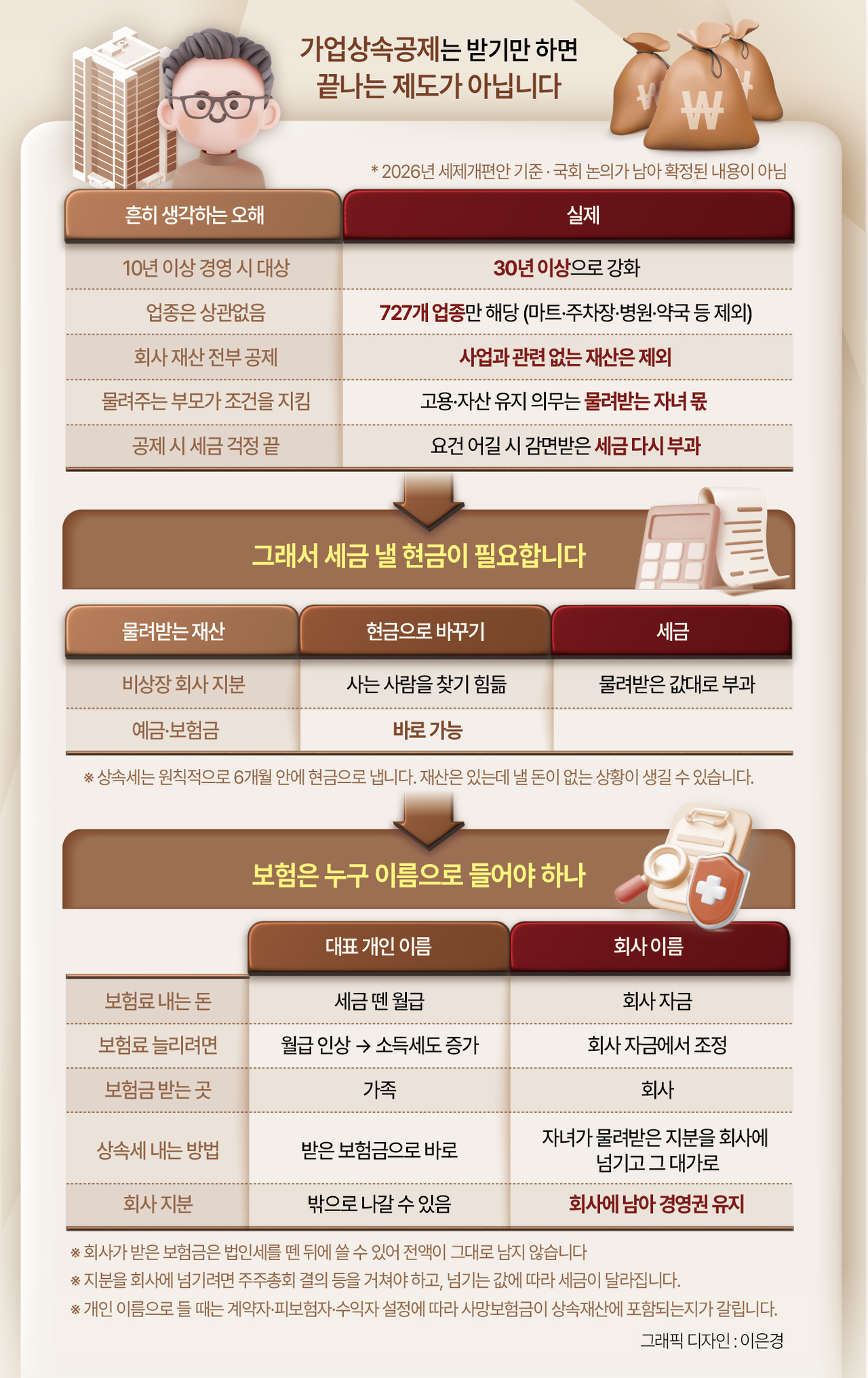
The centerpiece of the reform is the management-period requirement. Under current rules, 10 or more years of management qualifies a business for the deduction. Going forward, the standard threshold rises to 30 years. The post-inheritance compliance period — during which the heir must maintain the business's industry, assets and employment — also doubles, from five years to 10.
In exchange, the benefit grows. The deduction ceiling rises from a maximum of 60 billion won ($42.3 million) to 100 billion won. The amount is calculated by multiplying years of management by 2 billion won, so 30 years still yields 60 billion won — the same as today — while reaching the full 100 billion won ceiling requires 50 or more years of management.
The eligible industries also narrow. Of the 1,205 categories in the Korea Standard Industrial Classification, only 727 would remain eligible. Supermarkets, bus and taxi transport, parking lots, warehousing, hospitals and pharmacies are among those excluded. A new screening step would also require approval from a public-private review committee before the deduction could be claimed.
The proposal is still under review, however, and must go through National Assembly deliberations before it takes effect.
So does that mean I lose the deduction entirely?
Not necessarily. The proposal allows owners who have managed their business for between 20 and 30 years to still claim the deduction, on the condition that the heir's post-inheritance compliance period is extended by the number of years short of 30.
In Kim's case, he falls two years short of 30, so his son's compliance period would be the standard 10 years plus two additional years — 12 years in total. The two-year gap may sound small, but the implications are significant. For 12 years, his son could not change the business's industry and would have to maintain its assets, shareholding and employment levels.
The more important question, then, is not whether the deduction can be claimed, but whether the conditions can realistically be met for 12 years.
Once I get the deduction, is the tax issue resolved?
That is one of the most common misconceptions. Most business owners who come in for consultations say their company qualifies for the deduction — but when the requirements are examined one by one, the reality often differs from their expectations.
First, qualifying for the deduction does not mean the company's entire assets are shielded. Assets unrelated to the business are excluded. Real estate or investment assets held in the company's name may fall into this category.
The post-inheritance compliance requirements are the more critical issue. Violating any of the conditions triggers repayment of the reduced tax. But those conditions are not something the owner passing on the business can control — they fall entirely on the successor who inherits it. No matter how thoroughly a father prepares, it is the son who will be bound by those conditions. If parent and child do not discuss this together in advance, the heir may only discover the full weight of the obligation after the fact.
Can insurance companies really help with this kind of planning?
Many people find it surprising that insurance companies offer inheritance and succession consultations. But life insurance death benefits are typically paid out at the very moment an inheritance occurs. That overlap means asset transfer has long been a core area of expertise for insurers.
At Samsung Life, inheritance, gift and business succession consultations account for more than 70 percent of all advisory sessions. Where wealthy clients once asked "what should I invest in," the question has increasingly become "how do I pass this on."
The trend has also shifted noticeably over the past year or two. As real estate regulations have changed frequently, property inquiries have declined somewhat, while consultations on business succession and financial asset transfers have grown.
How does a consultation actually work?
The standard process involves two meetings. The first covers the client's asset profile, family structure and business situation. At the second, the adviser presents a tailored strategy in a written report.
For corporate clients, the process does not end there. Because tax laws change every year and business circumstances evolve, advisers meet with clients again after each fiscal year-end to review the plan.
Consultations are led by financial planners. For areas requiring deeper expertise — tax matters or real estate — specialists with National Tax Service experience and property experts join the session. Some insurers also work under agreements with external tax and real estate firms. There is no consultation fee.
What should I be doing to prepare?
The advice is not to rely on the deduction alone — liquidity planning needs to go alongside it.
Inheritance is not something that happens today; it is a future event, and no analysis done now can perfectly account for the tax rules or asset conditions at that future moment.
That means insurance is not a complete answer either. Rules can change, as this reform proposal shows, and the deductible portion of a business may shrink if the company's structure changes. Either scenario increases the general inheritance tax burden.
That is why advisers also walk clients through options such as advance gifting — transferring assets before death — and installment payment plans that spread the tax bill over several years. Insurance is presented as one tool within a broader succession plan, not the whole solution.
For owners like Kim, whose assets are concentrated in real estate and company shares, the tax liability can be large while available cash is scarce. That is precisely why the priority should be designing which assets to transfer, when, and when to have cash on hand — rather than simply checking what the tax rate will be.
So how does one actually generate the cash?
There are several approaches. For a corporate owner considering insurance, the first decision is whether to take out the policy in a personal name or in the company's name.
A personally held policy means premiums are paid from after-income-tax funds. Because the coverage needed to fund an inheritance tax bill is typically substantial, aggressively raising one's salary to cover the premiums pushes up the income tax base as well — potentially resulting in a higher overall tax burden.
If the company pays the premiums, the policy becomes a corporate asset and the death benefit goes to the company. This structure matters because the heaviest inheritance asset for a corporate owner is typically the company's shares. Shares in an unlisted company are difficult to sell — finding a buyer is rarely straightforward, making them hard to convert to cash.
The arrangement works as follows: the company takes out a policy as the policyholder, and when the owner dies, the company receives the death benefit. The heir then transfers the inherited shares back to the company in exchange for that payment, using the proceeds to cover the inheritance tax. Because the shares stay within the company, management control is preserved.
One caveat: the death benefit the company receives is recorded as non-operating income and may be subject to corporate tax. That means the full benefit amount is not necessarily available to spend. Consultations factor in this point so clients can size their coverage appropriately. For those paying inheritance tax in installments over multiple years, the key figure is the amount due in the first installment.
Transferring shares back to the company also requires a shareholder resolution and other procedural steps, and the tax treatment varies depending on the transfer price. Obtaining a tax review in advance is the safer course.
For personally held policies, the designation of policyholder, insured and beneficiary matters greatly. Whether the death benefit is included in the taxable estate depends on how those roles are assigned, so this must be confirmed before the policy is taken out.
Do you also advise on real estate?
Real estate almost never stays out of an inheritance or gift consultation. It makes up such a large share of wealthy clients' assets that it is treated not as a separate topic but as part of the overall asset structure, examined alongside tax considerations.
Real estate carries different taxes and regulations at every stage — buying, holding, selling and transferring. The question should not simply be "how much will I net if I sell now," but a side-by-side comparison of the tax outcomes from holding, selling and transferring to a child. Advisers recommend evaluating real estate by its after-tax value — what remains after taxes — rather than its market price.
A "burdened gift" — transferring property along with its jeonse deposit or mortgage — can also be an option. The outcome varies depending on the type of property, its location, how long it has been held and the nature of the attached debt, so each case must be assessed individually. When needed, the scope of the consultation can extend to the execution structure after the transfer, including trust arrangements.
My son isn't ready yet — that worries me.
That concern comes up almost as often as the tax questions. Preparing to hand over a company is one thing; whether the person receiving it is ready is an entirely separate matter. And if the compliance period stretches to 12 years, the son's own commitment is a prerequisite.
Samsung Life runs education programs aimed at the children of its high-net-worth clients, divided into two tracks by age. One is designed for college-age children: over four weeks during a school break, participants attend lectures on management and the humanities and visit companies in person. The other is a 10-week program for children already working in their 30s and 40s.
There are also dedicated programs for the owners doing the transferring — regular lectures, book clubs and cultural events that bring together business leaders facing the same questions.
Behind these programs is a guiding belief: that transferring assets is less about economics than about the values a family shares. Gifting is not simply the handover of material wealth — it is the transfer of the assets a parent's generation built, along with the values embedded in them.
What about my personal assets outside the company?
The inheritance tax calculation works the same way even without a business in the picture. It is a challenge that people without companies face just as directly. The approach, however, varies with the scale of the estate.
A common misconception needs clearing up first. Many people say "once you have more than 3 billion won, half goes to taxes" — but that 50 percent rate applies not when total assets exceed 3 billion won, but when the taxable base, after all deductions, exceeds that threshold. Take an estate of 2 billion won with a surviving spouse and two children: after applying the spousal deduction and the standard lump-sum deduction, the inheritance tax comes to roughly 130 million won. That figure assumes the spouse actually inherits the legally prescribed share.
For estates above 5 billion won, advance gifting and a detailed inheritance plan are worth examining carefully. For estates in the 1 billion to 3 billion won range, however, rushing to make gifts is not always the better move.
Some strategies are best avoided. Splitting ownership across multiple names to reduce taxes, or dividing a family home into fractional shares among several children, can backfire. When those children later try to buy their own homes, those inherited shares become a liability.
The barrier to getting a consultation is not high. Samsung Life sets no minimum asset threshold; if the assigned adviser judges that a specialist consultation is warranted, the referral is made. Clients without an assigned adviser can reach out through any branch nationwide or via the call center. The insurer's dedicated family office unit for high-net-worth clients, however, operates with a threshold of total assets of 20 billion won or more, financial assets of 3 billion won or more, or annual sales of 30 billion won or more for corporate clients.
One principle applies regardless of the size of the estate: inheritance comes for everyone, and the earlier the preparation, the less it costs to transfer wealth. That matters all the more because grief and financial burden tend to arrive at the same time.

psj@heraldcorp.com