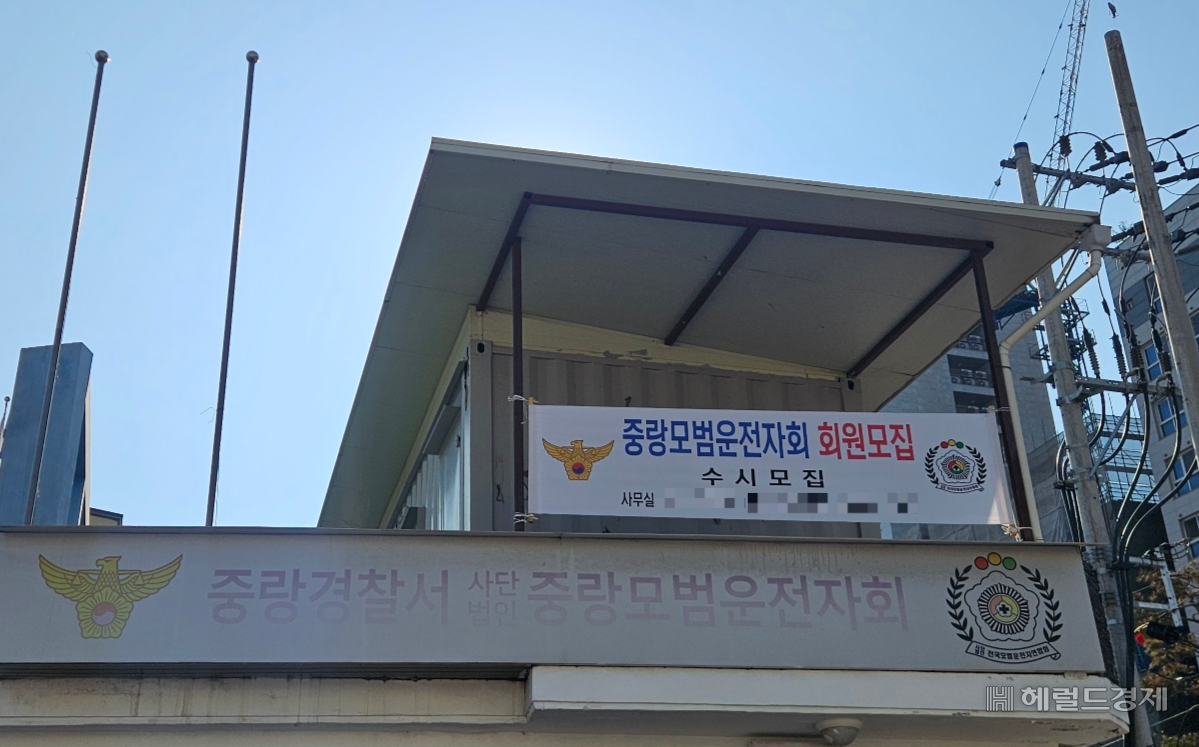
A single-story dark-brown brick building in Mangwu-dong, Jungnang-gu, Seoul, sits right beside the Mangwu police substation. For more than three decades it has served as the operational base for the Jungnang chapter of the Model Drivers Association, a volunteer group dedicated to local traffic safety. But a container unit installed on the building's rooftop without any official filing has drawn scrutiny — its illegal status confirmed only after a complaint was recently lodged.
A Jungnang Police Station official said the station's facilities department was conducting an on-site inspection and legal review after receiving a complaint suggesting that "an illegal structure was being left alone simply because it sits on police property."
The container-style structure is an unregistered temporary building erected without the required construction notification. Land registry records show the 826.1-square-meter site is state-owned land under the management and ownership of the Korean National Police Agency. A Jungnang-gu district office official confirmed the finding: "An on-site check verified that it is indeed a temporary structure installed without notification and has been used without going through proper legal procedures."
What makes the case more troubling is that neither the district office nor the police took any administrative action during the more than 30 years the structure was in use. The district office had not even been aware of the structure's existence — let alone its unregistered status — until the complaint came in. "We first learned about it through media inquiries and the complaint," a district office official said. "There is no record of any prior consultation with the permitting department before that."
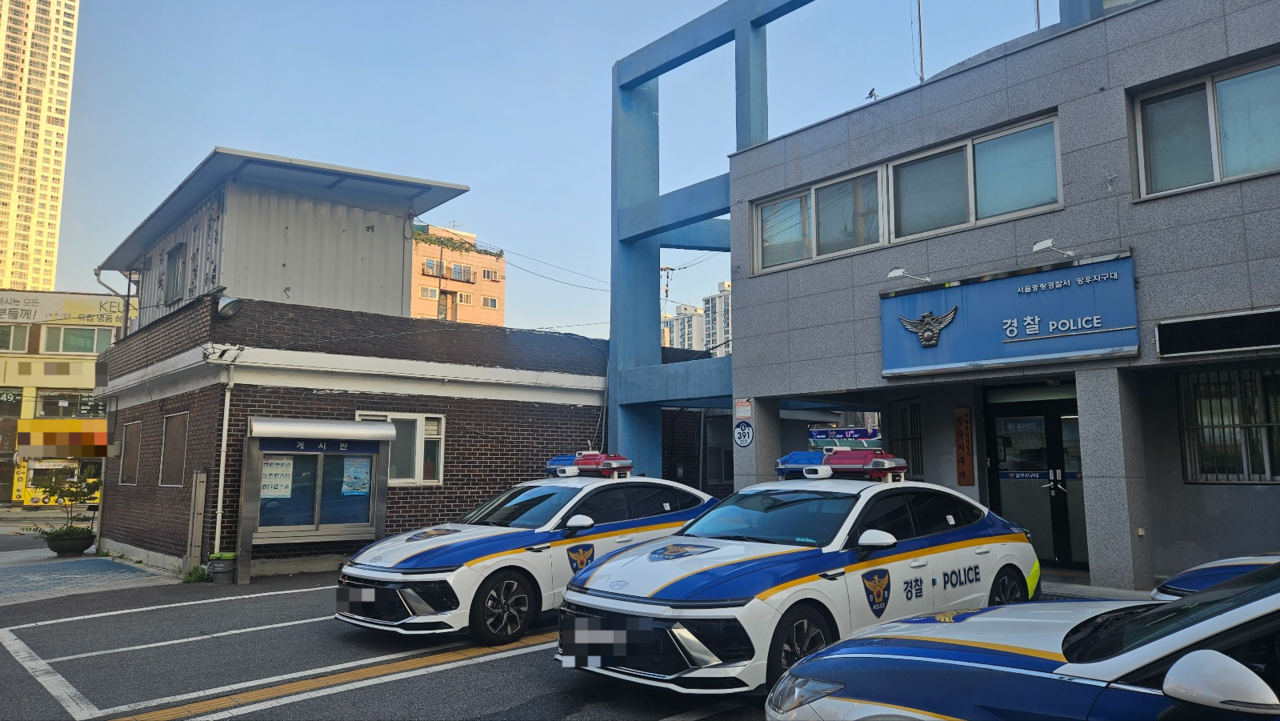
Under Article 29 of the Building Act — a special provision for public-use buildings — a public institution can be deemed to have obtained a permit or filed the required notification if it consults with the relevant permitting authority. The district office said it is reviewing with police whether retroactive legalization on those grounds is possible.
In practice, however, no such consultation has taken place. "There has been no consultation with the architecture division," a Jungnang-gu district office official said. "No official discussions or applications related to demolition or new construction have come in."
'Where do we go after 30 years of service?'
In the meantime, complaints from residents through the district office — as well as voices within the police and online — have raised pointed questions: would a structure like this have drawn an immediate correction order if an ordinary citizen had put it up? And should a law-enforcement agency be held to a stricter standard?
For the Model Drivers Association itself, however, the illegal-structure controversy is secondary to a more pressing concern: the prospect of losing their home entirely. Hyeon Gi-tae, chapter head of the Jungnang branch of the Korean National Police Agency's Model Drivers Association, said founding members pooled their membership dues in 1991 to build the structure on the site of a former checkpoint. "Most of the people involved at the time have passed away, so no accurate documents or records of how it was built remain," he said.
He added that the rooftop container was installed to serve as a rest area and storage space because the office was too small. "It is illegal, but at the time it was space put together to keep the volunteer work going," he said.
The chapter must vacate its current premises when the Mangwu substation is rebuilt next year. Hyeon said police have plans for a new substation but no plan for where the association will go. "This is a space our members built over more than 30 years by pooling their dues," he said. "If we're told to leave with no alternative, where are we supposed to go?"
He also warned that demolishing the container would leave the group with nothing to work with even if they eventually found a new location. "It's not just a matter of tearing it down and being done with it — we'd lose even the bare minimum of facilities we'd need somewhere else," he said.

The Model Drivers Association is a nonprofit volunteer organization. Members collect monthly dues to cover operating costs such as electricity and water bills. Under the Road Traffic Act, they are also required to perform at least two hours of traffic-directing volunteer duty each month during the morning rush hour — from 7 a.m. to 9 a.m. on weekdays. Yet the group receives virtually no support for office space.
"Most of our members put their livelihoods on hold to volunteer, and we cover all the office running costs out of our own dues," Hyeon said. "Now even the bare minimum of a base to operate from is at risk of disappearing."
Police say relocation is planned; district office says talks haven't started
The association's office is more than a rest space — it is the operational hub where members prepare for traffic-directing duties and coordinate deployment. Yet office arrangements vary widely from chapter to chapter depending on who provides support and local circumstances.
According to the Seoul Metropolitan Police Agency, all 31 police stations in Seoul have a Model Drivers Association chapter, but only four — Jungnang, Jongno, Hyehwa and Songpa — use police-affiliated buildings. The Jongno chapter occupies the second floor of the Gugi-dong community policing center, while the Hyehwa and Songpa chapters use former traffic center buildings; all three are legally compliant structures. Most chapters rent ordinary office space or secure separate premises with support from local governments.
A Seoul Metropolitan Police Agency official said the association is not required to be based on police property. "The form of office space differs by area, and it is more common for chapters to operate with support from local governments," the official said.
Jungnang Police Station said it intends to pursue relocation of the association alongside the rebuilding of the Mangwu substation, though no alternative site or concrete relocation plan has been worked out yet. "The new substation budget has been approved and design work is under way," a station official said. "Since the association will also need to move, we are looking into alternative sites." On the illegal container, the official said the station is "working with the district office to find a way forward."
jookapooka@heraldcorp.com
raining@heraldcorp.com