Corporate owners who snapped up their own company shares during the Kospi's surge continued buying aggressively even as the market plunged last month. The wave of buybacks — seen as a bid to reassure shareholders — has pushed monthly transaction volumes to nearly three times the roughly 200 trades recorded at the start of this year. While owner buybacks are widely viewed as a sign of responsible management, shareholders are increasingly calling for more tangible returns.
Over 400 owner buyback transactions in July alone
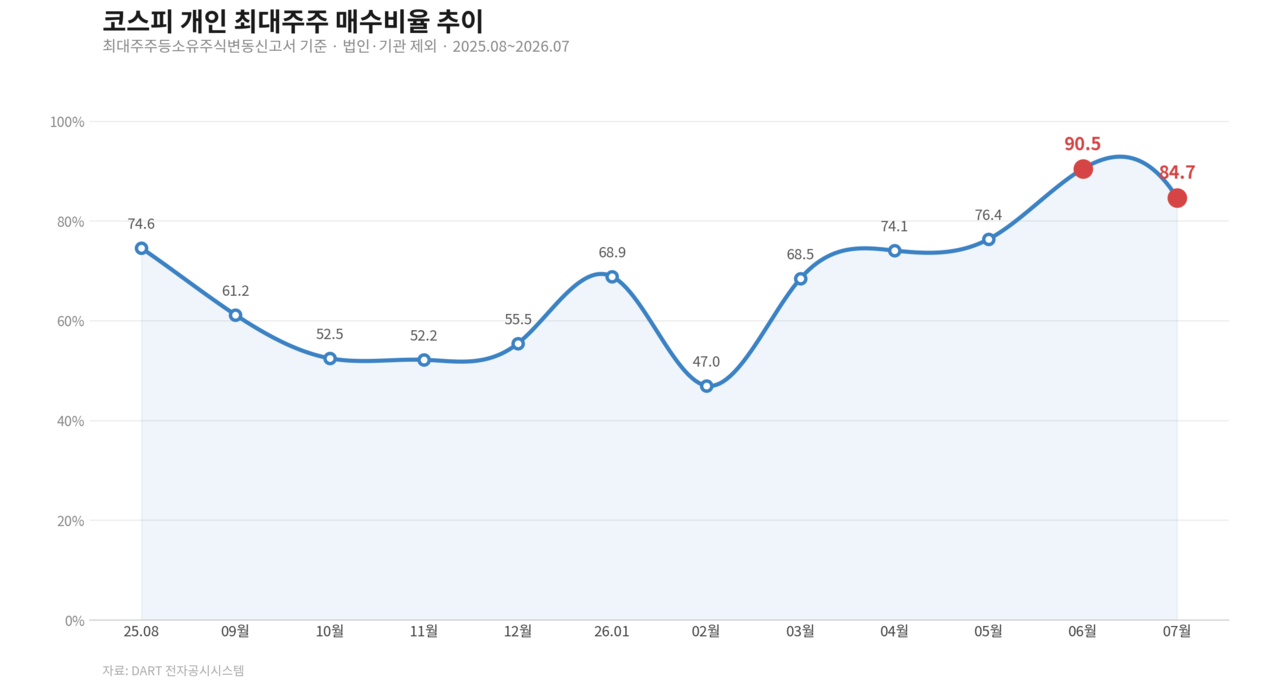
A comprehensive review of 3,947 trading disclosures filed by the largest individual shareholders of Kospi-listed companies on the Financial Supervisory Service's DART system over the past year — from August 2025 through July 2026 — found that buybacks in July, immediately after the Kospi's sharp decline, reached 444 transactions. That figure represents 84.7 percent of the 524 total trades, including sales, recorded that month.
The July tally is comparable to June, when the Kospi broke its all-time high above the 9,000 mark. Largest shareholders bought back shares 447 times in June, accounting for 90.5 percent of the month's 494 total transactions. Owners who had been buying aggressively during the rally kept up the pace even after the crash. The Kospi hit its all-time high of 9,114.55 on June 22 and has since fallen nearly 40 percent.
Owner share trading triples as Kospi swings sharply
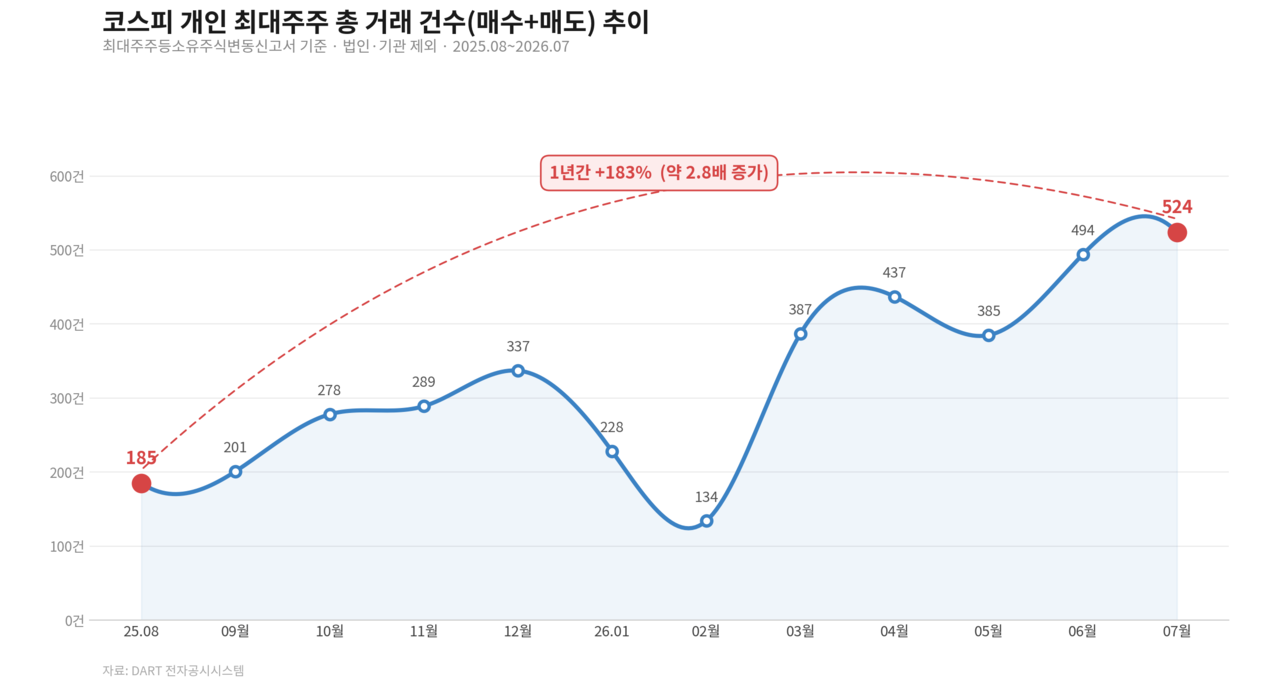
Owner buybacks have grown consistently over the past year. The share of purchases within total trades has risen, but what stands out is the sheer increase in overall transaction volume.
Monthly buyback rates and transaction counts were: August 2025 at 74.6 percent (138 transactions), September 2025 at 61.2 percent (123), October 2025 at 52.5 percent (146), November 2025 at 52.2 percent (151), December 2025 at 55.5 percent (187), January this year at 68.9 percent (157), February at 47 percent (63), March at 68.5 percent (265), April at 74.1 percent (324), May at 76.4 percent (294), June at 90.5 percent (447) and July at 84.7 percent (444). The buyback rate has stayed broadly in the 70 percent range over the year, but the number of transactions has nearly tripled.
Owner buybacks have drawn particular attention during the recent market downturn. SK Group Chairman Chey Tae-won purchased 3,620 shares of SK Hynix on Thursday at an average price of 1.35 million won ($954) per share, for a total of 4.8 billion won. The transaction was sized just below the 5 billion won threshold that triggers advance disclosure requirements. Samsung Electronics President and CEO Roh Tae-moon also bought 3,045 Samsung Electronics shares on the same day at 230,000 won per share, for a total of 700.35 million won.
Other executives also made buybacks last month. Kwak Dong-shin, chairman of Hanmi Semiconductor, purchased 5 billion won worth of shares; Lee Gyu-ho, chairman of Kolon, bought 200 million won worth; Kim Dong-chun, president of LG Chem, acquired 100 million won worth; and Moon Hyuk-su, chief executive of LG Innotek, bought 100 million won worth. At Hyundai Elevator, all 30-plus executives collectively acquired 1 billion won worth of shares.
Warnings of a 'vicious cycle' as owner buying stokes volatility

Some analysts warn that the interplay between sharp Kospi swings and owner buybacks is creating a "vicious cycle." The argument is that as the market gyrates, owners launch large-scale buybacks to prop up share prices, and those transactions in turn send buy signals to the broader market, amplifying volatility in a self-reinforcing loop.
"The Kospi's sharp swings and owner buybacks are repeating in a pattern where it is impossible to determine which comes first," said Lee Bo-mi, a senior research fellow at the Korea Institute of Finance.
'Without shareholder returns, buybacks are just a short-term boost'
Owner buybacks are typically read as a declaration of commitment to responsible management, and they tend to stoke buying sentiment among investors. The day after Chey's SK Hynix purchase on Thursday, the stock hit its daily upper limit on Friday, buoyed by gains in semiconductor stocks on US markets.
Not everyone views owner buybacks positively, however. Kang So-hyun, a researcher at the Korea Capital Market Institute, said in a report that "buybacks carried out when share prices are falling sharply may end up being used only temporarily to realize capital gains." If buybacks do not translate into broader shareholder returns, she said, they risk amounting to nothing more than a fleeting price boost.
Hwang Yong-sik, a professor in the business administration department at Sejong University, said the recent debate over amending the Commercial Act — which has prominently featured proposals to require mandatory cancellation of treasury shares — appears to be prompting owners to respond during the market downturn. "However, if there is no process to enhance value through share cancellation, the effect may be limited to simply strengthening owners' control, which could actually generate a backlash from shareholders," he said.

klee@heraldcorp.com