The government has decided to accelerate its three major mega-projects — semiconductors, physical AI and AI data centers — by enacting special legislation and establishing dedicated administrative bodies before the end of this year.
Within a month of selecting the Gwangju military airport as the site for the Honam semiconductor cluster, the government has set a deadline for relocating the base's functions and announced that corporate investment projects worth hundreds of trillions of won in the Chungcheong and Yeongnam regions will begin in earnest this year.
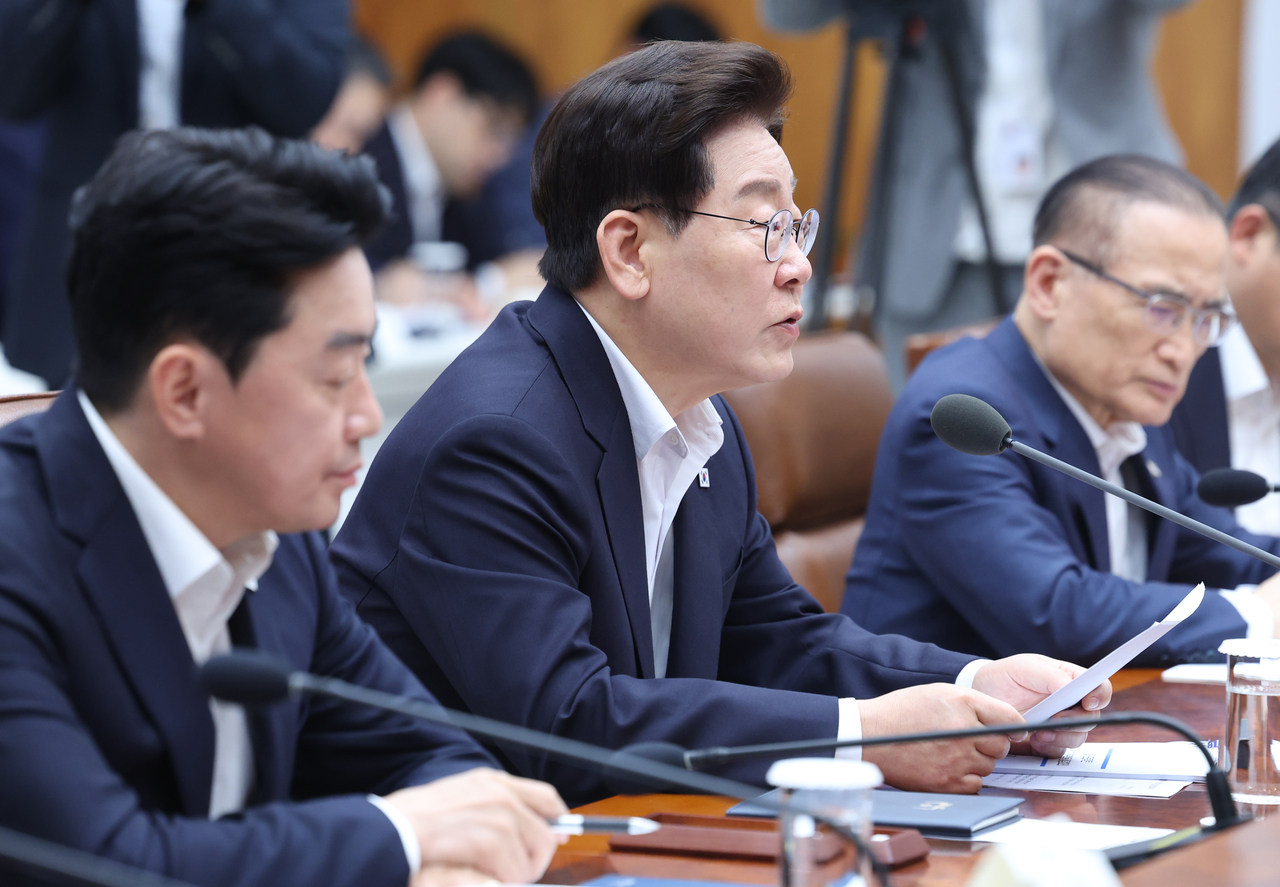
President Lee Jae Myung, speaking Monday at the second public-private joint review meeting on mega-projects held at Cheong Wa Dae, directed the Ministry of National Defense to temporarily redeploy the functions of the Gwangju air base to other military airports by mid-2028, so the site can be converted into a semiconductor industrial complex as early as possible.
The government plans to complete the relocation of military facilities and their temporary dispersal by the second half of 2028.
At the first meeting, held July 6, the government designated the Gwangju military airport — spanning 8.25 million square meters — as the site for the Honam semiconductor cluster, but specific timelines for relocating military facilities and supplying power and water were not announced at the time.
At Monday's second meeting, held within a month of the first, the government laid out schedules for military facility relocation and infrastructure supply, giving the investment roadmap greater definition.
For power, the government will rapidly build a first-phase supply line to begin delivering electricity by the end of 2028. It plans to draw on local renewable energy and energy storage systems and to expand combined heat-and-power and LNG generation.
For water, the government plans to secure 650,000 tons per day by 2030 through treated wastewater reuse and reservoirs including Dongbok Dam, Juam Dam and Naju Dam.
The government will also push to enact a special law for mega-special zones this year to shorten permitting and environmental-impact assessment periods. A dedicated mega-project office will be established at Cheong Wa Dae, and a pan-government mega-project support council will be set up under the prime minister's office to facilitate inter-agency cooperation and help resolve corporate investment obstacles.
However, the government deferred a decision on one of the bill's central issues: whether to grant an exemption from the 52-hour workweek limit.
Presidential Chief of Staff Kang Hoon-sik said the government does not believe the success of the mega-projects is directly tied to the 52-hour rule. "Rather than the government staking out a position first while labor is strongly opposed, this is something that should be possible only when the relevant regions and labor groups discuss it together and reach agreement," he said.
The mega-special zone bill is legislation the government and the ruling party are pursuing to provide a package of fiscal, financial, tax and infrastructure support to mega-special zones where advanced and innovative industrial ecosystems are to be developed.
Earlier disclosed government plans had included on the discussion agenda the introduction of a so-called "white-collar exemption." Under it, managers and research-and-development workers in the top 3 percent of earners could, with worker consent, be freed from the 52-hour weekly cap, with standard allowances paid in lieu of overtime, night-shift and holiday premiums.
In response, the two major umbrella labor federations declared on Aug. 3 that they would "strongly condemn and block the pursuit of the mega-special zone bill," pushing back immediately.
Large-scale investment projects in the Chungcheong and Yeongnam regions — outside the Honam area — are set to begin in part this year. In the Chungcheong region, six companies — SK Hynix, Samsung Electronics, Samsung Electro-Mechanics, Samsung Display, Samsung SDI and Naver — will break ground or begin capacity scale-ups this year on projects totaling 246 trillion won ($173 billion).
In the Yeongnam region, eight companies — SK Group, Samsung Electronics, Samsung SDS, LG Innotek, LG Display, Hanwha, Hyundai Motor and Doosan — will break ground or begin scale-ups this year on projects totaling 107 trillion won.
President Lee asked the business leaders attending the meeting — including Samsung Electronics President Kim Yong-gwan and SK Group Executive Vice President for Future Growth Jeong Seung-il — to continue paying close attention to shared-growth activities. "I understand you are already dedicated to such efforts, but I ask that you give them even greater attention going forward," he said.
oskymoon@heraldcorp.com