South Korea and China reach substantive conclusion to FTA services and investment follow-up negotiations after 8 years and 8 months
Co-production expanded beyond film; outbound tourism services and broader market access also agreed
South Korea and China have reached a substantive conclusion to follow-up negotiations on services and investment under their free trade agreement, paving the way for Korean films and games to receive most-favored-nation treatment in the Chinese market and expanding opportunities for the Korean content industry.
The deal has also raised hopes that China's informal ban on Korean cultural content — in place for nearly a decade since South Korea's deployment of the Terminal High Altitude Area Defense system in 2016 — may finally be eased.
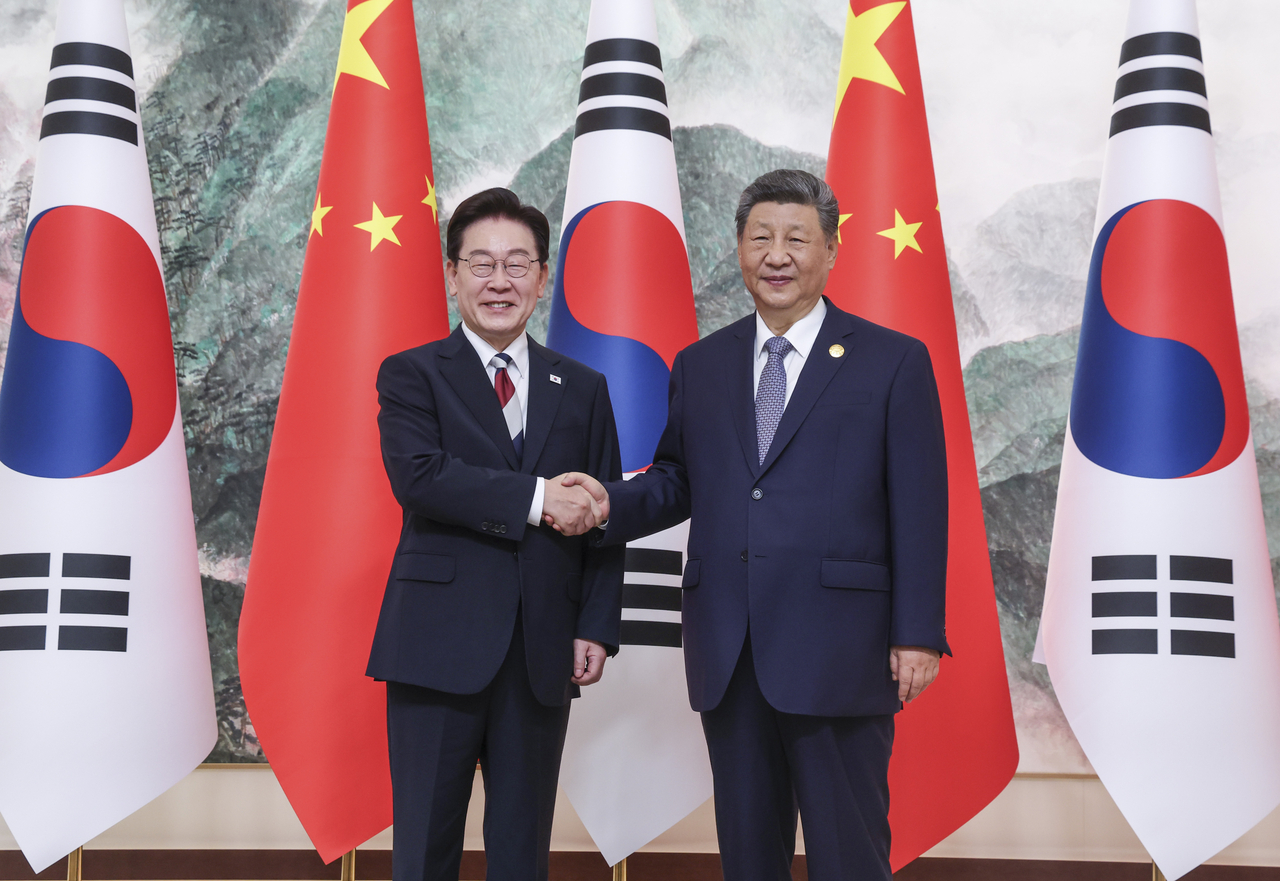
According to the Ministry of Trade, Industry and Resources, China committed to granting South Korea most-favored-nation status in sectors including film and games, and agreed to raise its level of openness in tourism, legal services, construction and other areas. The two countries formally declared the substantive conclusion at a bilateral summit held on the sidelines of the Asia-Pacific Economic Cooperation summit on Wednesday.
A substantive conclusion means negotiations have effectively ended, though some technical details will be finalized at the working level.
The follow-up negotiations stem from the Korea-China FTA, which took effect in December 2015. The two sides began talks in March 2018 to raise the level of liberalization in services and investment, reaching an agreement after eight years and eight months.
Under the deal, China pledged most-favored-nation treatment for South Korea in film, games and related sectors, ensuring Korean content is not treated less favorably than that of any third country. China also agreed to apply a non-discrimination principle in the pre-screening of online games, films and other content.
The two countries also agreed on an annex for co-production of audiovisual programs, expanding the scope of eligible content beyond film to include drama series, animation, entertainment programs and documentaries.
The Ministry of Trade, Industry and Resources said the agreement would invigorate joint program production between the two countries and broaden the production base for South Korea's content industry.
In tourism, South Korean travel agencies operating in 23 regions across China will be permitted to arrange overseas travel for both Chinese nationals and foreign residents in China — a business known as outbound tourism services.
Market access will also expand in legal services, retail, construction and finance. In legal services, South Korean law firms will be allowed to establish offices and enter into joint representation and business partnerships with Chinese firms not only in the Shanghai Free Trade Zone, as previously permitted, but also in the Tianjin and Qianhai free trade zones and the Hainan Free Trade Port.
In retail, South Korean companies seeking to operate more than 30 stores in China will be allowed to do so independently, without forming a joint venture with a Chinese partner. In construction, restrictions on the types of projects South Korean firms may participate in will be removed.
In finance, China committed to "future most-favored-nation treatment," meaning South Korean firms will automatically benefit from any greater financial market opening China grants to third countries in future trade agreements.
The ministry said South Korea has also committed to a higher level of openness than under the original agreement in legal services, retail and audiovisual sectors, within the bounds of domestic law and existing regulations. It cited examples including allowing business partnerships between law firms of both countries, equipment leasing and rental services for construction machinery, and film screening services.
Both sides also agreed to include a prohibition on performance requirements, meaning neither country may demand technology transfers or impose similar conditions as a prerequisite for investment.
Protections related to the investor-state dispute settlement regime were expanded and procedural details clarified. The market-opening framework shifted to a negative-list approach, under which all sectors are open in principle and only exceptions are listed as reservations. New regulations beyond those already on record will not be introduced as a rule.
A ratchet clause will also be introduced, preventing either side from rolling back regulatory improvements made through voluntary legislative changes.
The ministry said the agreement raises the standard of openness and rules governing services and investment beyond the original FTA, laying an institutional foundation for deeper bilateral cooperation in those areas.
Goods trade between South Korea and China stood at $272.9 billion last year, while services trade reached $38.8 billion — a gap the ministry said shows significant room for services trade to grow.
oskymoon@heraldcorp.com