One in eight wage workers in South Korea received hourly pay below the legal minimum wage last year, according to government data.
At micro-businesses with fewer than five employees, three in 10 workers fell below the threshold, and the rate approached four in 10 among temporary workers. Sub-minimum-wage employment is concentrated among the most vulnerable segments of the labor market — women, youth, older workers and those with lower levels of education.
According to the Minimum Wage Commission's 2026 minimum wage deliberation handbook released Tuesday, about 2.769 million workers earned below the minimum wage last year, representing 12.4% of the total wage-earning workforce of about 22.413 million. The figures are drawn from the Ministry of Statistics' supplementary survey on economically active population.
The sub-minimum-wage rate has fluctuated since the COVID-19 pandemic but remains below its 2021 peak. The number of workers earning below the minimum wage stood at about 3.215 million in 2021, or 15.3% of all wage workers. It then fell to about 2.756 million (12.7%) in 2022, rose to about 3.011 million (13.7%) in 2023, eased to about 2.761 million (12.5%) in 2024, and came in at about 2.769 million (12.4%) last year.
The gap by workplace size was stark. At firms with one to four employees, 30.3% of workers earned below the minimum wage last year. The rate was 17.6% at firms with five to nine employees. At companies with 300 or more employees, it was limited to 1.8%. The smaller the workplace, the sharper the rise in the share of workers receiving sub-minimum pay.
Differences by employment type were equally pronounced. The sub-minimum-wage rate reached 38.5% for temporary workers and 32.0% for daily workers, while permanent employees registered just 3.6% — less than a tenth of the temporary worker rate. Workers with less job security were far more likely to be paid below the legal floor.
By gender, 16.2% of female workers earned below the minimum wage, compared with 9.0% of male workers — a gap of 7.2 percentage points, meaning women's rate was about 1.8 times that of men.
By age, the rate was most pronounced among young workers entering the labor market for the first time and among older workers. Some 49.5% of workers aged 19 and under — in effect one in two — received pay below the minimum wage. The rate for workers aged 60 and older was 31.9%, far above the overall average of 12.4%.
Education level also made a significant difference. Workers with a high school diploma or less had a sub-minimum-wage rate of 22.5%, roughly four times the rate for junior college graduates (5.8%) and more than five times that of university graduates (4.3%).
Compared with other major economies, South Korea's statutory minimum wage is not particularly low. This year, the United Kingdom's minimum wage stands at 12.21 pounds per hour, Germany's at 13.9 euros per hour and France's at 12.02 euros per hour. The US federal minimum wage is $7.25 per hour, though many states set higher rates — Washington, D.C., for instance, pays $17.95 per hour. Japan's national average hourly minimum wage is 1,121 yen, lower than South Korea's.
The core problem is the significant gap between the statutory minimum wage and what workers actually receive. Because sub-minimum-wage employment is concentrated among micro-businesses, temporary and daily workers, women, youth and older workers, raising the minimum wage alone is insufficient — ensuring compliance in the field is equally pressing.
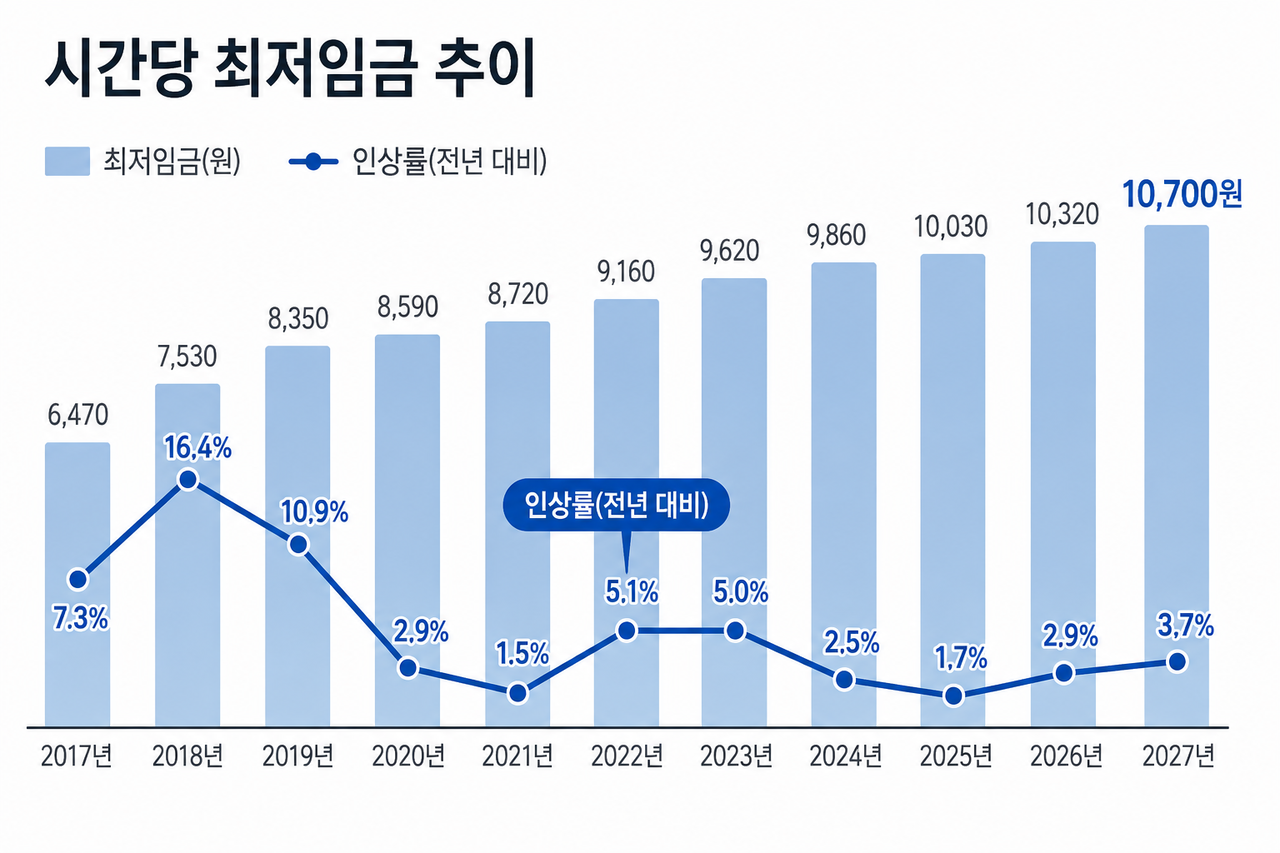
Meanwhile, the Ministry of Employment and Labor has finalized next year's minimum wage at 10,700 won ($8) per hour, up 380 won, or 3.7%, from this year's 10,320 won. Based on a standard 209-hour work month, the monthly equivalent comes to 2.236 million won.
The number of workers affected by next year's minimum wage increase is estimated at between 660,000 and about 2.978 million, depending on the methodology used. Based on the employment type survey, the figure is 660,000, an impact rate of 3.8%; based on the supplementary survey on economically active population, it is about 2.978 million, with an impact rate of 13.3%.
fact0514@heraldcorp.com