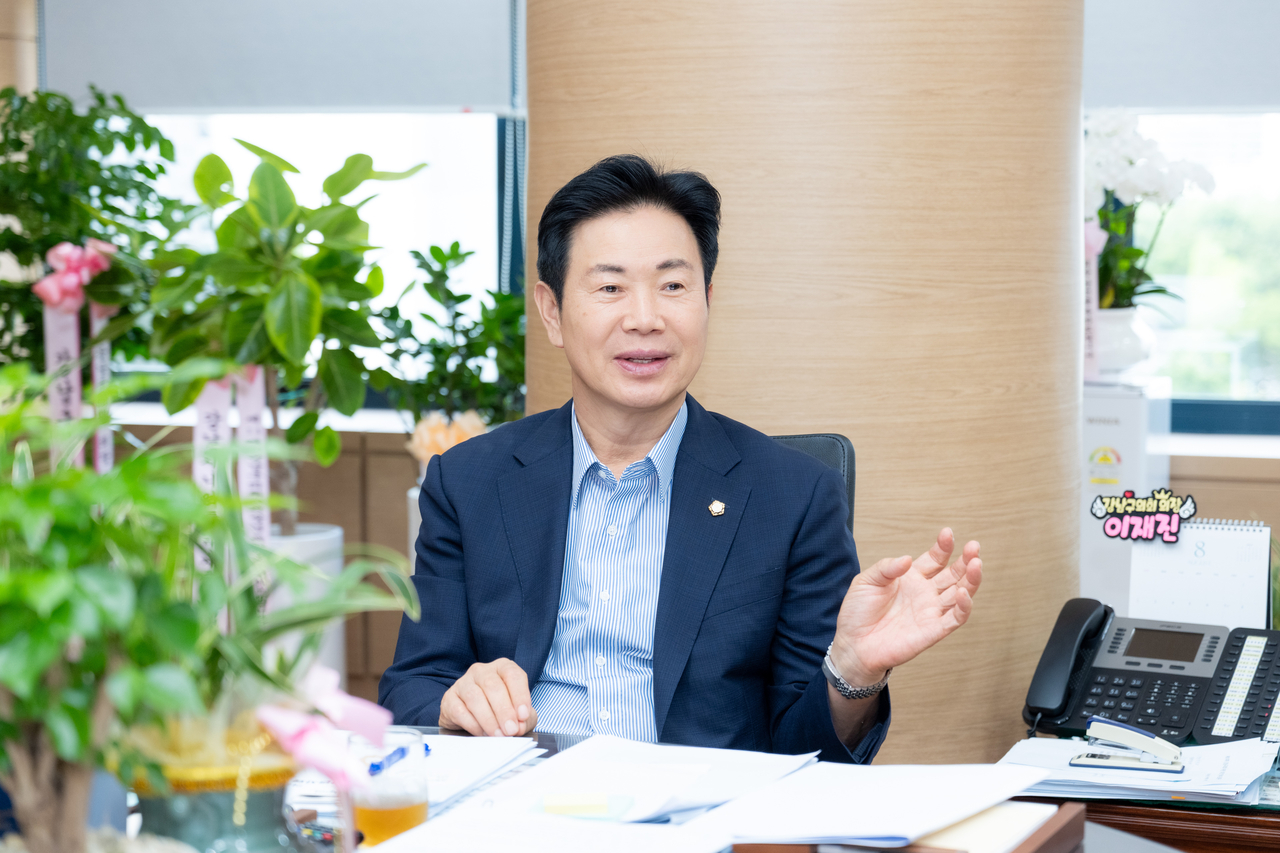
Lee Jae-jin, 64, speaker of the Gangnam-gu Assembly, is the most senior member of the 10th Assembly, serving his fourth consecutive term.
He is widely regarded as a politician of exceptional leadership and collegial character — a reputation underscored by his unanimous election as speaker by all 25 members of the Gangnam-gu Assembly.
Lee sat down for an interview Tuesday morning to discuss the district's most pressing issues, his philosophy of governance and his vision for running the assembly.
He identified traffic congestion and parking as the most urgent problems Gangnam-gu must address.
"Gangnam is the economic and business heart of South Korea, so an enormous number of vehicles and people pass through every day," Lee said. "But the existing traffic system and parking facilities are not keeping pace with the rapidly changing urban environment and growing demand." He called for a scientific and flexible signal system tailored to Gangnam's characteristics, saying traffic data and closed-circuit television cameras should be actively used to respond to constantly shifting traffic flows driven by rush hours, commercial districts, schools and major events.
Analyzing traffic volume in real time and operating signal systems more efficiently would reduce chronic congestion and significantly improve residents' mobility, he said.
On parking, Lee said multi-dimensional solutions were needed that go beyond conventional approaches.
"To make efficient use of limited urban space, we need to expand layered development that combines underground parking with above-ground parks," he said. "We also need a range of measures that improve both economic value and efficiency, such as nighttime discounts at public parking facilities." He added that traffic and parking were not merely lifestyle inconveniences but core challenges that determine residents' quality of life and the district's competitiveness. "The assembly will work closely with the executive branch to actively propose the necessary policies and carefully review budgets and systems to ensure effective solutions are put in place," he said.
'Reconstruction must go beyond individual complexes toward a future-oriented urban overhaul'
Alongside traffic and parking, Lee cited Gangnam-gu's sweeping reconstruction and redevelopment projects as another major priority.
"Gangnam has led South Korea's economic and residential culture for decades, but many of the large apartment complexes built in the 1970s and 1980s mean it is now time to fundamentally reshape the urban structure," he said.
He said the district must move beyond simply reconstructing individual apartment complexes toward a future-oriented urban overhaul that takes into account transportation, education and everyday infrastructure together.
The Gangnam-gu Assembly plans to actively support the executive branch's policy of expediting reconstruction approvals to ensure the work proceeds without disruption.
"The part of the reconstruction process that causes residents the most difficulty is the lengthy administrative procedures and various review stages," Lee said. "The assembly will proactively identify systems that are unreasonable or in need of improvement, and work with the executive branch to find ways to accelerate project timelines."
He also said recent urban renewal efforts must go beyond simply supplying housing to emphasize multi-dimensional use of urban space and development that reflects local characteristics. "We will uphold both values — protecting residents' property rights and creating a pleasant living environment," he said.
'Routine budget practices will be boldly reviewed'
Lee also outlined the assembly's plans to cut spending as a way to overcome the fiscal constraints facing Gangnam-gu.
"The biggest concern in how Gangnam-gu currently manages its budget is the practice of carrying over existing allocations without adequately verifying whether projects are delivering results," he said.
He said the assembly must closely examine whether any projects are being repeated without sufficient performance review, or fail to reflect changing times and residents' needs.
"Because local finances are funded by residents' taxes, any new project must first be assessed for necessity and effectiveness," Lee said. "We also need a system that continuously evaluates the performance of existing projects." He added that the focus should not be on how much money was spent, but on how much tangible benefit residents actually feel relative to the funds invested.
The Gangnam-gu Assembly plans to strengthen the principles of performance-driven budgeting and "focus and prioritization" throughout its budget review process going forward.
"Projects that are merely formalistic or whose effects are unclear will be boldly reconsidered," Lee said. "The resources saved will be prioritized for investment in areas directly tied to residents' lives — resolving traffic and parking problems, expanding reconstruction infrastructure and broadening targeted welfare programs."
A 'learning assembly' with first-term lawmakers
Lee identified strengthening lawmakers' expertise and fostering mutual respect as the core principles for running the first half of the 10th Gangnam-gu Assembly.
"The 10th Gangnam-gu Assembly has welcomed more young and capable first-term lawmakers than ever before," he said. "Having lawmakers with fresh perspectives and new ideas enter the assembly is a very positive development for Gangnam-gu."
However, he also stressed that legislative work cannot be carried out on passion alone. Drafting ordinances, reviewing budgets and conducting administrative audits all require both expertise and experience.
"As a four-term lawmaker, my role as speaker is to share the experience I have accumulated while respecting the fresh perspectives and enthusiasm of first-term members," Lee said. "Above all, I want to build a 'learning assembly' in the first half of this term."
To that end, the assembly plans to run intensive study sessions starting this month, centered on first-term lawmakers and professional staff, to build practical legislative skills in areas such as ordinance review, budget deliberation and policy analysis.
"Rather than abstract theoretical instruction, I want to raise each lawmaker's expertise through case-based discussions and research that can be applied directly in real legislative settings," Lee said.
He also identified strengthening the policy support capacity of assembly secretariat staff and professional researchers as an important task.
"The assembly's competitiveness is not built by lawmakers alone," he said. "The policy support capacity of professional staff and secretariat employees is equally important." He added that a culture of communication in which lawmakers and staff respect each other and exchange views freely must take root before the quality of the assembly's policy work can improve.
'The assembly belongs to residents, not lawmakers'
Lee also laid out a firm philosophy on communicating with residents.
"The assembly belongs to residents, not lawmakers," he said. "No matter how good the policies the assembly discusses, if they do not reflect residents' voices, it cannot be called good legislative work."
Accordingly, the Gangnam-gu Assembly in the first half of this term plans to focus its efforts on becoming an assembly that residents trust and one that meets residents at their level.
"Communication with residents cannot happen only inside the assembly," Lee said. "Going directly to neighborhoods and everyday settings across the district to hear residents' opinions — and ensuring that goes beyond resolving individual complaints to drive institutional improvements and new ordinances — that is the assembly's role."
To lower the threshold for public engagement, the assembly will also expand resident forums and on-site consultations. It plans to activate communication channels so that diverse resident opinions are sufficiently reflected in major policy decisions and the ordinance-drafting process.
The assembly will also strengthen the transparency of its legislative activities.
"I will make the assembly's work more actively public and explain it more clearly, so that residents can easily understand what is being discussed, why budgets are allocated the way they are and why ordinances are enacted," Lee said.
"I want to make the Gangnam-gu Assembly not just an administrative body but a policy platform closest to residents," he said in closing. "Creating a virtuous cycle in which residents can raise their opinions at any time and see those opinions translated into actual policies and ordinances — that is an important goal for the first half of the 10th Gangnam-gu Assembly."
His remarks reflected a determination to ensure that the district-level assembly fulfills its proper role.
seouldream01@heraldcorp.com