The extreme heat wave this summer is driving "heatflation" — price increases caused by high temperatures — and the trend is expected to persist through the Chuseok holiday. Major vegetable- and fruit-growing regions are suffering from drought following the heat wave, and livestock prices show no sign of easing, putting growing pressure on household food costs.
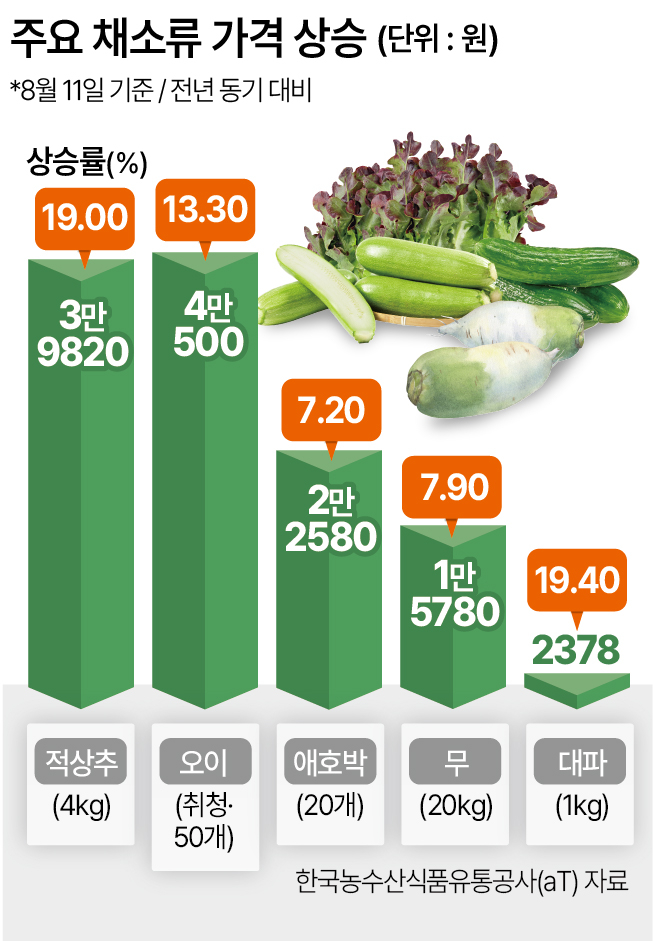
According to data from the Korea Agro-Fisheries and Food Trade Corporation (aT) released Wednesday, the average retail price of red-leaf lettuce (4 kilograms) stood at 39,820 won ($28) as of Tuesday — up 30 percent from the previous month and 19 percent from a year earlier. The retail price of green-leaf lettuce (4 kilograms) soared to 40,350 won, a 16.6 percent increase from the same period last year. Spinach (4 kilograms) has also surged rapidly since July, reaching 51,820 won. While that remains below the year-earlier level of 59,797 won, analysts caution against complacency given that prices climbed into the 80,000-won range last September.
The relentless rise in vegetable prices reflects the combined impact of extreme heat exceeding 40 degrees Celsius and worsening drought. Dry conditions have intensified across the Yeongnam and Honam regions, directly affecting crop yields. Leafy vegetables such as lettuce and spinach, which require consistent moisture, have been hit hardest.
Cucumbers, which have high water content, have also been affected. The retail price of cucumbers (50 count) rose 13.3 percent year-on-year to 40,500 won, while zucchini (20 count) climbed 7.2 percent over the same period to 22,580 won. Both vegetables grow best in cooler temperatures, making summer price increases typical — but this year's prolonged heat wave may have reduced normal shipment volumes below historical averages. Green onions (1 kilogram), another crop sensitive to heat, rose 19.4 percent year-on-year to 2,378 won.
Livestock prices have also been trending steadily upward. The consumer price of top-grade (1++) Hanwoo tenderloin (100 grams) rose 21 percent year-on-year to 18,836 won, while the same grade of sirloin climbed 23.8 percent to 15,812 won. Domestic samgyeopsal (100 grams) rose 5.2 percent over the same period to 2,929 won.
![Shoppers browse stalls at Gyeongdong Market in Dongdaemun-gu, Seoul, as prices for some vegetables spike amid the ongoing heat wave, adding to the burden on household grocery budgets. [Yonhap]](https://wimg.heraldcorp.com/news/cms/2026/08/12/rcv.YNA.20260806.PYH2026080609540001300_P1.jpg)
Egg prices remain elevated as well. The average consumer price of domestic extra-large eggs (30 count) stands at 7,411 won — down 2.9 percent from the previous month but still 5.3 percent higher than a year ago. Livestock prices already rose once this year due to the fallout from animal infectious diseases, and further increases are possible given concerns about heat-related deaths among livestock. Pigs and chickens are particularly vulnerable to heat because of their limited ability to dissipate body heat.
Fruit supplies are also flashing warning signs. The average retail price of Hongro apples (10 kilograms) — a staple of Chuseok ancestral rites — is 78,325 won, down 23.9 percent from last year. However, farm damage from heat and drought is being reported ahead of the main harvest season. "Prices could end up higher than last year, when they broke the 100,000-won mark," one industry official warned.
The government is closely monitoring the impact of heatflation on food prices while cautioning against overstating the situation. On vegetable prices specifically, authorities said overall supply and demand conditions for August and September are expected to remain stable. Their assessment is based on a general increase in output for major vegetables earlier this month, which kept wholesale and retail prices below average seasonal levels.
Lee Eun-hee, a professor of consumer science at Inha University, said additional checks are needed on items that have seen sharp price increases or whose output has fallen short of expectations. "The government should consider measures to ease the burden on consumers — such as releasing stockpiles, actively expanding imports, and providing discount support at hypermarkets," she said.

soho0902@heraldcorp.com