Dance, poetry, traditional Korean music and contemporary art unite within a thousand-year-old space
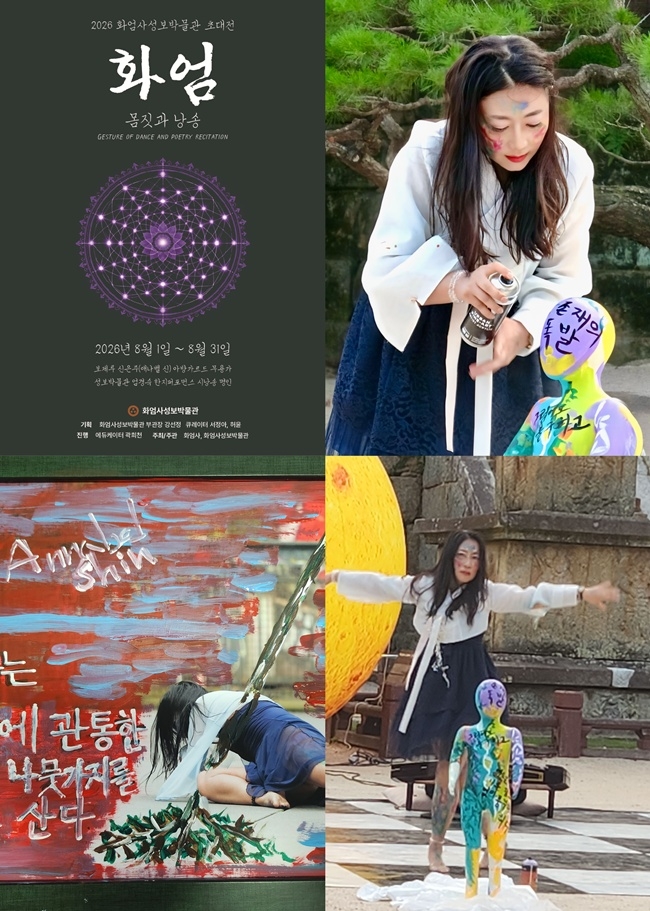
Hwaeomsa Temple on Jirisan — the head temple of the 19th district of the Jogye Order of Korean Buddhism, led by abbot Wuseok — is presenting a new encounter between a traditional Buddhist sanctuary and contemporary art, channeling its millennium-old Hwaeom philosophy through dance, poetry recitation, traditional Korean music, drawing, painting, sculpture, installation and photography.
The temple is hosting "Hwaeom Exhibition — Gestures and Recitation" at Bojeru Pavilion and the Seongbo Museum through Aug. 31, followed by "Boundary Hwaeom — From Paris to Gurye," a show featuring seven Korean artists who have long been based in Paris, extending the Hwaeom worldview into contemporary visual art.
Both exhibitions share a common spiritual foundation in the Hwaeom Buddhist concepts of dependent origination and Indra's net — the idea that all beings reflect one another through their relationships and together form a single world.
Dance and poetry, sound and image, Korea and Paris, tradition and modernity: across different genres and spaces, these elements converge at Hwaeomsa into a single artistic web of connection.
The first exhibition, "Hwaeom Exhibition — Gestures and Recitation," features avant-garde dancer Shin Eun-ju (Annabel Shin), who works across Paris, Korea and Tokyo, alongside Eom Gyeong-suk, a poetry reciter and hanji performer who leads the International Hana Arts Association.
Shin explores the fundamental question "Who am I?" through dance, drawing and media art.
She layers drawings over photographs taken in Paris and reconstructs her own movements as painterly images, extending dance — a time-based art — into the exhibition space.
At the Seongbo Museum, Eom presents a "listening exhibition" in which visitors scan QR codes to hear poetry recitations while viewing the works. Visitors can listen directly to recited pieces including "The Bell of Hwaeom," experiencing a new kind of exhibition that fuses the visual and the auditory.
A special performance centered on "The Silence of the Beloved" by Han Yong-un — independence activist, Buddhist monk and poet — will be held at Bojeru Pavilion on Liberation Day, Saturday.
The performance honoring Han's spirit will bring together Eom's poetry recitation and hanji performance, Shin's avant-garde dance, and traditional Korean music played on the daegeum, gayageum, yanggeum, jing, buk and gueum.
Eom will open with a recitation of "I Want to Meet a Beautiful Person," then restage a hanji performance — originally presented at a UN-related international event in 2016 — alongside a recitation of "The Silence of the Beloved."
Shin will perform "Hell Game," a work inspired by Buddhist practice and mindfulness, as well as "Avant-Garde Silence of the Beloved," a piece she has performed at events marking the centenary of Han's poem, accompanied by daegeum and gayageum.
The performance will close with both artists staging a Liberation Day tribute inspired by the Taegukgi, the South Korean national flag, set to the folk song "Sangju Arirang."
"The Hwaeom concept of dependent origination means that no being exists in isolation — all are endlessly connected," Shin said. "I wanted to create an exhibition in which gesture and voice, image and space enter into relationship with one another and form a single world."
The temple's contemporary art program then expands into "Boundary Hwaeom — From Paris to Gurye."
The exhibition brings Korean artists who have spent years creating in Paris back to the ancient temple on Jirisan to unfold their artistic journeys. Its subtitle is "Nomadic Thinking Beyond Boundaries," and its concept is described as "The Atelier, a Path of Seeking: A Nomad's Map of Thought."
The show focuses on the dialogue that emerges when the free artistic forms of Paris meet the solemn stillness of Hwaeomsa, crossing the boundaries between East and West, tradition and modernity.
The artists' years in Paris converging with the temple's millennium of history gives the exhibition a meaning beyond a simple presentation of works — it becomes, in the organizers' framing, a journey of artistic homecoming and renewal.
The exhibition features seven Korean artists who have worked in France: Hong Hyeon-ju, Moon Chang-don, Choi Hyeon-ju, Hoon Moro, Park Woo-jeong, Hong Il-hwa, Park In-hyeok and Oh Se-gyeon.
Working across painting, sculpture, installation, video and photography, the artists are all members of Sonamoo Artists Association, a leading Korean artists' organization in Paris founded in 1991.
Each artist brings a distinct theme rendered in their own artistic language — color and order, the cosmos and DNA, memory and space, light and time, human existence and AI, nature and ecology, and the body and movement.
Through both exhibitions, Hwaeomsa aims to preserve its identity as a place of Buddhist practice and cultural heritage while expanding its role as an open cultural space where Korea's traditional culture and the world's contemporary art can meet and speak to each other.
"The gestures and recitations, Han Yong-un's 'The Silence of the Beloved,' and the contemporary art of the Paris-based artists may look like different forms of expression, but they are all connected by the single Hwaeom spirit of connection," a temple exhibition official said. "We hope that tradition and modernity, East and West, practice and art will reflect one another at Hwaeomsa and together weave a new Indra's net of culture and art."
parkds@heraldcorp.com