
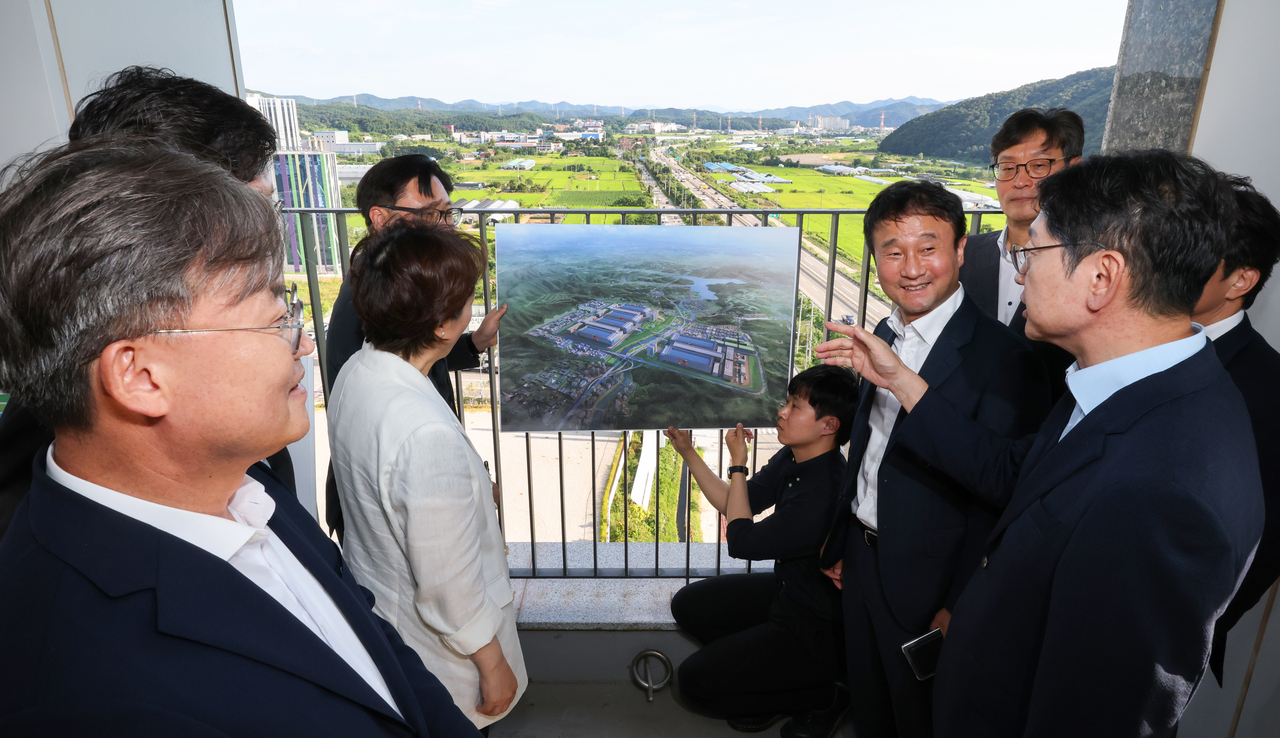
The government will move to fast-track 4.28 trillion won ($3.02 billion) in corporate investment in advanced industries — including semiconductors, secondary batteries and biotech — that has been held up by regulations and licensing procedures.
Under the plan, factories at the Yongin semiconductor cluster will be allowed to obtain separate new building permits for expansions rather than amending existing ones each time. Battery recycling companies will be permitted to move into national industrial complexes in Gumi and Pohang. The government will also ease regulations that have hampered the growth of new industries such as AI data centers and collaborative robots.
Deputy Prime Minister and Minister of Economy and Finance Koo Yun-cheol announced the measures Thursday at a joint emergency economic headquarters and economic ministers' meeting, unveiling the government's first round of "field-centered corporate investment and innovation support measures."
The package was drawn up based on requests from six major business groups, industry associations covering sectors such as semiconductors and secondary batteries, major companies and local governments. The government identified what it termed "field-pending projects" — investments with immediate demand that have been delayed by regulation.
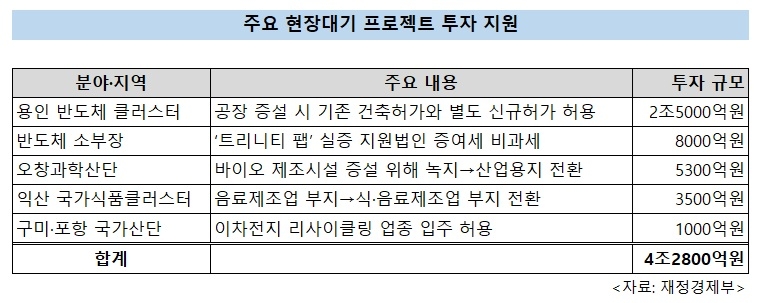
The major field-pending projects included in the package total approximately 4.28 trillion won: 100 billion won for secondary battery recycling in Gumi and Pohang, 2.5 trillion won for the Yongin semiconductor cluster, 800 billion won for semiconductor materials, parts and equipment pilot facilities, 530 billion won for a biotech manufacturing facility in Ochang, and 350 billion won for the Iksan National Food Cluster.
The largest of these is the Yongin semiconductor cluster.
Under the current Building Act's "one site, one permit" principle, adding new structures during factory construction requires amending the existing building permit each time. If another expansion need arises before an amendment is finalized, a fresh amendment application and re-review are required — a process that has caused delays in factory expansion and equipment operation.
To address this, the government will pursue a Building Act amendment in the second half of this year to allow expansion structures at industrial complexes above a certain size to obtain separate new permits, independent of the existing building permit. The change is intended to support the early execution of approximately 2.5 trillion won in investment.
In the semiconductor materials, parts and equipment sector, the government will support 800 billion won in investment in the Trinity fab project. It plans to amend tax law to reduce the gift tax burden on assets received by nonprofit corporations that operate pilot test beds funded by chipmaker contributions, enabling semiconductor materials, parts and equipment companies to verify their products under conditions similar to actual mass-production environments.
Battery recycling companies will be permitted to move into the national industrial complexes in Gumi and Pohang.
Recycling operations that recover lithium, nickel, cobalt, manganese and graphite from spent batteries are a core part of the battery supply chain, but they have been classified as waste-related businesses and barred from national industrial complexes. The government plans to amend industrial complex management plans in the second half of this year to support approximately 100 billion won in new investment.
The measure also aims to build a resource-circulation ecosystem that recovers critical minerals — such as lithium, nickel and cobalt, which are difficult to produce or secure domestically — from spent batteries for reuse. As the shift to electric vehicles accelerates, the government intends to extend the domestic value chain beyond battery manufacturing to include raw material recovery and recycling.
At the Ochang Science Industrial Complex, the city of Cheongju's green-belt land will be converted to industrial land to allow a biotech company to expand its manufacturing facilities. Investment had been blocked because the company needed to expand facilities physically connected to its existing factory but lacked available land within the complex. The government will expedite changes to the industrial complex plan to support approximately 530 billion won in new investment.
At the Iksan National Food Cluster, land designated for beverage manufacturing — which has seen low pre-sale rates — will be reclassified for food and beverage manufacturing. As of the end of last year, the pre-sale rate for beverage manufacturing lots stood at just 22.2 percent, while food and beverage manufacturing lots reached 90.3 percent. The government plans to revise the complex's management plan in the second half of this year to stimulate approximately 350 billion won in new investment.
The government will also address regulations identified as obstacles to advanced industry investment.
AI data centers have been subject to the same parking, elevator and artwork installation requirements as ordinary buildings, despite having few on-site staff. Going forward, the government will ease these standards by excluding server room floor area from the calculations used to determine required facility installations. It plans to finalize related enforcement decrees by March next year, based on the AI Data Center Special Act enacted in June.
The government will also shorten the city gas safety inspection period for semiconductor fabs from seven days to three, and exempt certain inspection items for facilities with adequate safety devices and construction capacity, cutting the overall process from 12 days to about six.
Safety regulations for collaborative robots will be revised in line with the spread of physical AI. Current industrial safety rules require fences at least 1.8 meters high around fixed robots. While exemptions are available for facilities meeting certain safety standards, the criteria have been criticized as unclear in practice. The government plans to develop detailed guidelines that reflect changes in international safety standards and on-site conditions, allowing broader use of collaborative robots while protecting worker safety.
Location regulations for industrial complexes will also be eased. The ceiling on "restricted-industry planning zones" — areas where all industries except those specifically restricted can operate, used for new industries and RE100 compliance — will be raised from 30 percent to up to 50 percent of industrial land area. The landowner consent requirement for designating industry-exception districts will also be lowered from two-thirds to a simple majority.
The government will pursue an amendment to the Industrial Sites Act to allow the minister of land, infrastructure and transport to directly designate urban innovation zones within national industrial complexes of high national importance, such as corporate advanced cities. Designation as an urban innovation zone would free a site from existing land-use regulations and enable high-density, mixed-use development tailored to corporate needs.
The ceiling on the size of opportunity development zones outside Greater Seoul will also be expanded. Metropolitan cities are currently capped at 4.95 million square meters and provinces at 6.6 million square meters. To accommodate large-site projects such as naval vessel maintenance, repair and overhaul, shipyard repair, offshore wind power and data centers, the government plans to raise the limits to 6.6 million square meters for metropolitan cities and 9.9 million square meters for provinces.
Joo Hwan-wook, policy coordination director at the Ministry of Economy and Finance, said the government would continue to monitor whether the measures in the package translate into actual investment, while also working to quickly prepare and announce a second round of measures focused on leading projects for a hyper-innovative economy and green industries, in order to actively support corporate innovation and investment.
The government plans to release the second round of investment measures within the third quarter.
fact0514@heraldcorp.com





