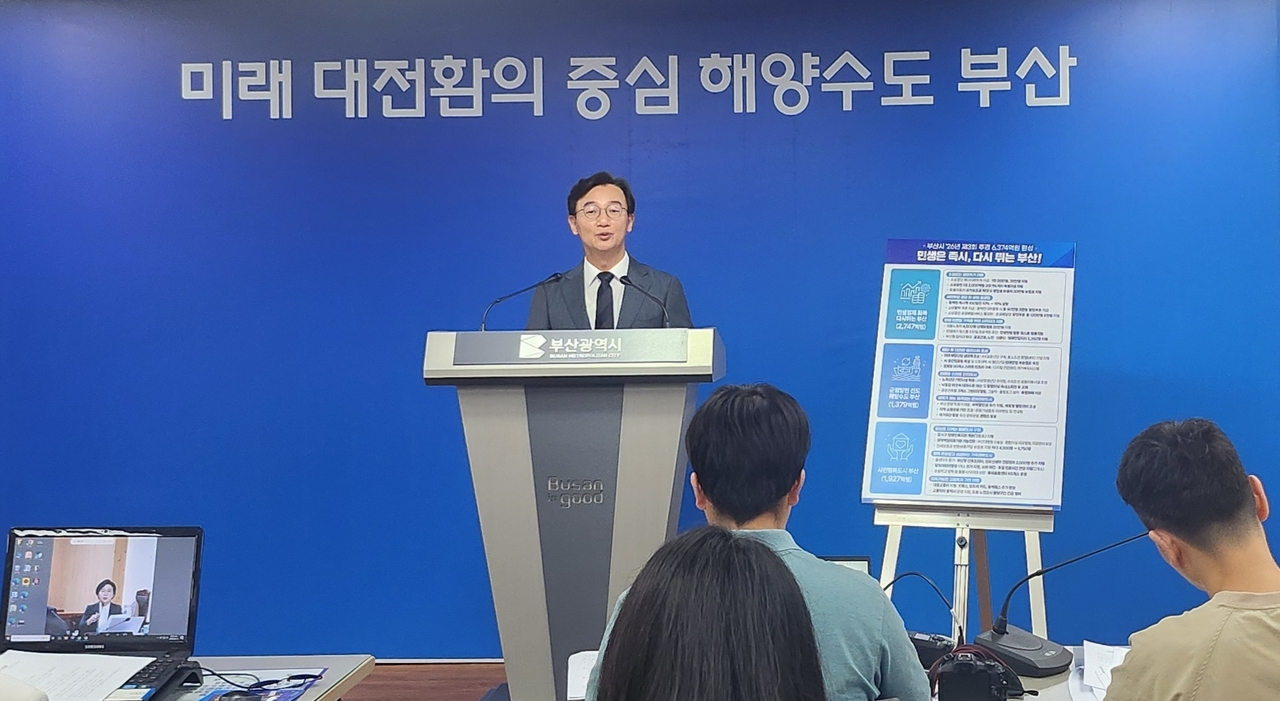
Busan Mayor Jeon Jae-soo held a press briefing at City Hall on Friday morning to present the city's third supplementary budget proposal for 2026, announcing its submission to the city council. The proposal totals 19.4 trillion won ($13.3 billion), a 3.4% increase from the base budget of 18.76 trillion won, with the supplementary portion amounting to 637.4 billion won.
The first supplementary budget since Jeon took office is organized around three areas: 274.7 billion won for reviving the local economy and getting Busan moving again, 137.9 billion won for advancing Busan as a balanced maritime city, and 192.7 billion won for building a healthier and happier city for all residents. The proposal incorporates additional revenue sources, including surplus funds from the 2025 fiscal year settlement.
To support the local economy, the city will allocate 96.1 billion won to help small businesses facing financial hardship. The measures include energy vouchers of 200,000 won per person for 280,000 small business owners with annual sales of 1 billion won or less, special low-interest loans of up to 30 million won at 1 percent for 40,000 businesses, and card fee support through the Dongbaekjeon local currency for 140,000 affiliated merchants with annual sales under 1 billion won. The Dongbaekjeon cashback rate will also be temporarily raised from 10 percent to 15 percent for 100 days.
Under the balanced development and maritime city pillar, the city will add 43.7 billion won to the Busan Opera House completion budget to support its opening next year, and will pursue development of an AI industry-focused smart city complex in Centum City. Funds have also been set aside to expand industrial infrastructure, including a parking facility at the Sasang regeneration industrial complex and a ship repair industry support facility in Daepyeong-dong, Yeongdo-gu.
On the citizen welfare front, the city will expand eligibility for deposit return guarantee fee support — aimed at preventing jeonse fraud — to 1,750 people, and will purchase 200 multi-unit homes to supply as public rental housing for low-income residents. Postnatal care and maternal-newborn health management support will each be extended to 2,000 additional recipients, and more hospitals will be designated under the Dalbit Children's Hospital program to close gaps in after-hours pediatric care.
"I hope this supplementary budget will serve as a starting point for immediately tending to people's livelihoods and getting Busan moving again with full force," Jeon said, calling on residents for their support and the city council for cooperation. Asked about his strategy for persuading the opposition-majority council, he said he would "explain sincerely and listen carefully to the council's views and reflect them," adding, "This supplementary budget contains the minimum support needed to back residents' daily lives and help them get back on their feet — I don't think the city council will see it any differently."
kaf2002@heraldcorp.com