K-beauty is experiencing a second golden age. Having outgrown Asia, Korean cosmetics brands are now expanding into the Americas, Europe, the Middle East and beyond. Their product range has diversified well past skincare to encompass hair care, color cosmetics and beauty devices. The two traditional giants — Amorepacific and LG Household — are now joined by rising challengers such as APR and Goodal Global, making the competitive landscape more dynamic than ever.
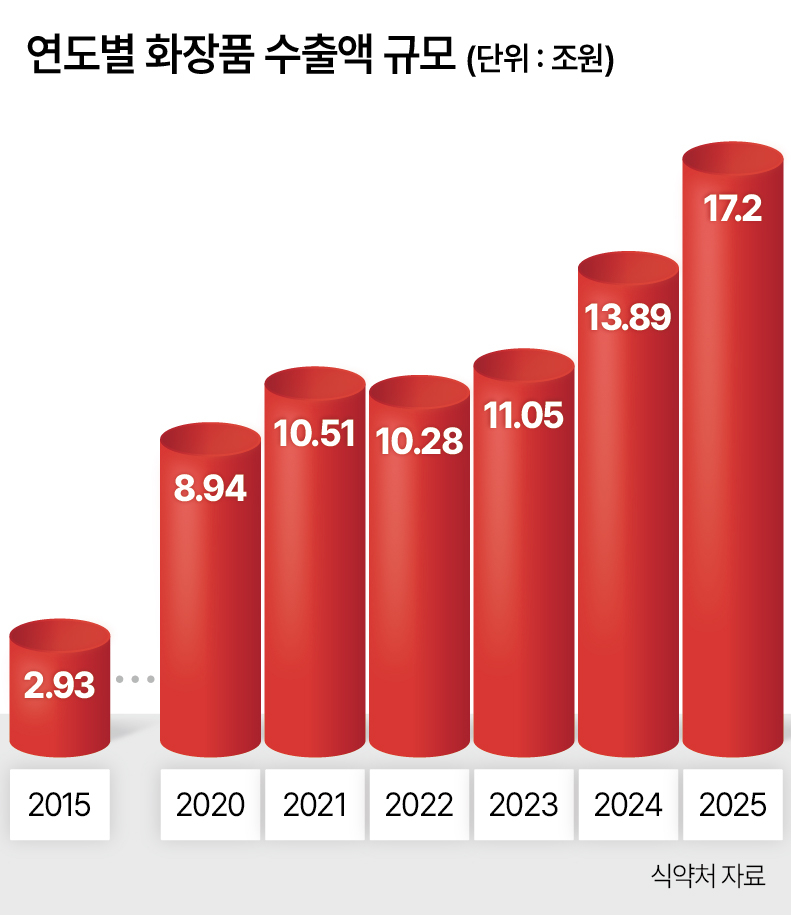
Korea's cosmetics exports grew more than tenfold over the past decade, climbing from 2.93 trillion won ($2.07 billion) in 2015 to 17.2 trillion won in 2025, according to the Ministry of Food and Drug Safety. Last year's export volume surpassed that of the United States, which stood at roughly 15.36 trillion won, placing Korea second in the world behind France at approximately 34.56 trillion won.
Built on Chinese shoppers, K-beauty stumbled when THAAD and COVID hit

K-beauty's first boom came in the 2010s, driven by Chinese daigou — cross-border resellers who traveled to Korea and bought domestic cosmetics in bulk at duty-free shops. Amorepacific's Sulwhasoo and LG Household's The History of Whoo were the standout beneficiaries. At the time, it was a common sight at duty-free counters to see daigou spreading open suitcases and packing them with Korean beauty products. A well-known anecdote holds that Peng Liyuan, the wife of Chinese President Xi Jinping, purchased The History of Whoo products during her 2014 visit to Korea.
At the height of the craze in 2015, Sulwhasoo became the first single cosmetics brand to surpass 1 trillion won in annual sales. The History of Whoo joined that club the following year. Amorepacific posted record consolidated sales of 6.7 trillion won and operating profit of 1.08 trillion won in 2016. That same year, LG Household — excluding its beverage division, as throughout this article — recorded sales of 4.75 trillion won and operating profit of 765 billion won, up 17.3 percent and 32.8 percent, respectively, from the previous year.
The good times did not last. The decision to deploy the Terminal High Altitude Area Defense system, known as THAAD, in 2016 triggered a sharp backlash. Beijing tightened cosmetics quality controls and banned group tours to Korea as retaliatory measures. As Chinese visitors dwindled, sales tumbled. Amorepacific's consolidated revenue fell 10 percent to 6.03 trillion won in 2017, while operating profit dropped 32.4 percent to 731.5 billion won.
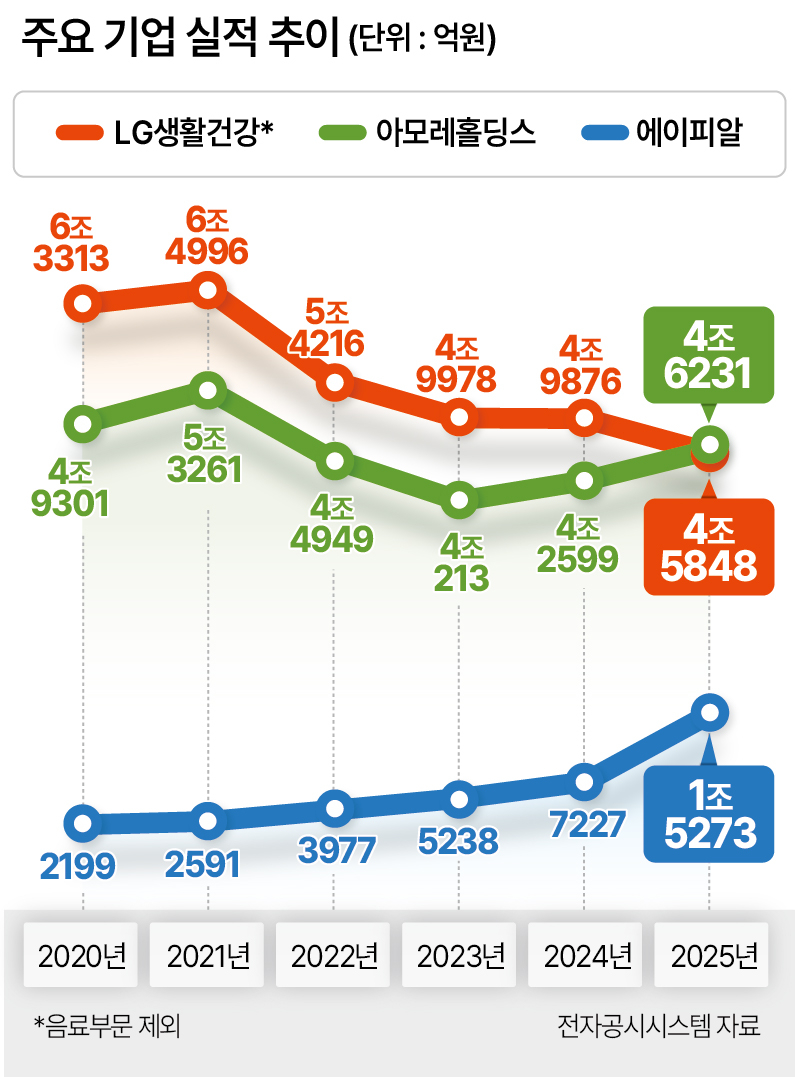
The decline accelerated through the COVID-19 pandemic. Amorepacific's consolidated sales deteriorated to 4.93 trillion won in 2020, with operating profit shrinking to 150.6 billion won. The strict zero-COVID policies China enforced ahead of the 2022 Beijing Winter Olympics then hit LG Household — which had managed to navigate the THAAD fallout with a more flexible strategy. The company's sales fell from 6.5 trillion won in 2021 to 5.42 trillion won the following year, while operating profit was nearly halved, dropping from 1.08 trillion won to 498.9 billion won over the same period.
Export figures also deteriorated. Korea's cosmetics exports to China peaked at 6.9 trillion won in 2021 before plunging to 2.8 trillion won by 2025.
The US emerges as K-beauty's biggest spender; Europe follows
The turnaround came from an unexpected direction. As K-pop stars gained global recognition, the animated film "KPop Demon Hunters" became a worldwide hit, sparking a surge in demand for Korean products. Growth in the US market in particular planted the seeds for expansion into neighboring Latin America.
Industry insiders point to around 2023 as the moment when Americas revenue began to stand out. Amorepacific's sales in the Americas jumped from 76.6 billion won in 2020 to 181.4 billion won in 2022 and 286.7 billion won in 2023, then surged 83 percent to 524.6 billion won in 2024. LG Household's North America sales also rose from 577.5 billion won in 2022 to 641.3 billion won in 2023, while its Latin America sales more than tripled — up more than 177 percent — from 4.8 billion won to 13.3 billion won over the same period.
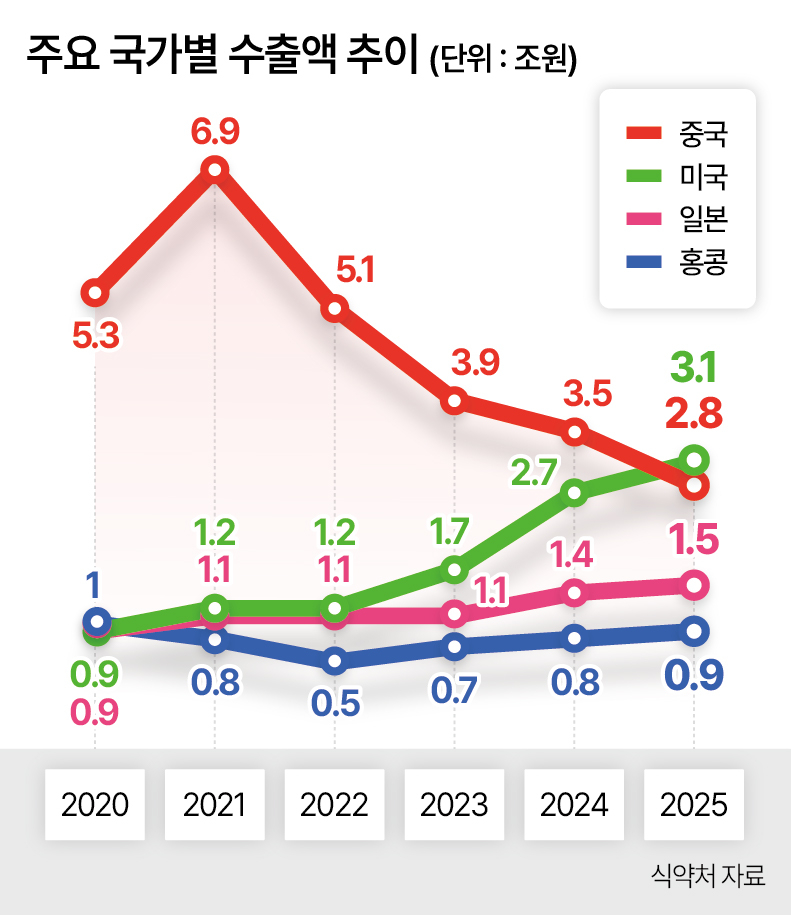
Korea's cosmetics exports to the United States also jumped sharply from 2023. After standing at 900 billion won in 2020, US-bound exports climbed to around 1.7 trillion won in 2023, then 2.7 trillion won in 2024 and 3.1 trillion won in 2025 — setting a new record each year. In 2025, exports to the US surpassed China (2.8 trillion won) for the first time, making America K-beauty's single largest market.
Korea's presence in Europe — the traditional home of luxury beauty — has also grown. Korea Customs Service data show that cosmetics exports to Europe in the first half of this year reached $1.6 billion, outpacing the United States. Poland ranked ninth among Korea's top 10 cosmetics export destinations last year, according to the Ministry of Food and Drug Safety, with exports rising 115 percent from $130 million in 2024 to $280 million last year. The United Kingdom climbed to 11th place, and France made a new entry into the rankings.
Indie brands that mastered online channels soar in the US
![Key Medicube products sold on Amazon [Provided by APR]](https://wimg.heraldcorp.com/news/cms/2026/08/14/news-p.v1.20260720.a99f8293baff415e8919e8b2bad947a6_P1.png)
The stars of this era are indie brands. They broke into the US market by rapidly building awareness through social media platforms such as TikTok and Instagram — a sharp contrast to the earlier K-beauty playbook of opening physical stores in China and other markets. At the time, the US beauty channel was already shifting online, with celebrities such as Selena Gomez and Hailey Bieber launching their own beauty brands in quick succession.
APR is the standout example. Just five years after its founding, the company turned its attention to overseas markets — the US, China and Europe — in 2019. Aggressive online marketing and a strategy focused on driving traffic to its own website helped it surpass 100 billion won in overseas sales within two years. APR then expanded into offline retail abroad, reaching total sales of 1.53 trillion won last year, of which 80 percent — 1.23 trillion won — came from international markets. The US accounted for the largest share of overseas revenue at 37 percent. In the second quarter of this year, the US led the breakdown of overseas sales by region at 49 percent, followed by Europe at 19 percent and Asia at 16 percent.
Amorepacific's Cosrx is another successful indie brand acquisition. Amorepacific spent 935.1 billion won between 2021 and 2023 to acquire the brand, which has since grown rapidly in the US and Europe and helped drive an improvement in Amorepacific's overall earnings.
![Joseon Beauty, the flagship brand of Goodal Global [Joseon Beauty website]](https://wimg.heraldcorp.com/news/cms/2026/08/14/news-p.v1.20260814.7f31e0616121431d98f52abd56657d02_P1.jpg)
Some indie brands that found fame abroad have since been reimported into the domestic market. One such case is Joseon Beauty, acquired in 2019 by Goodal Global, which was founded in 2016. Blending K-beauty with traditional Korean herbal medicine, Joseon Beauty expanded rapidly in overseas markets. Building on that success, Goodal Global acquired a string of brands — including Tirtir, Skinfood, Laka Cosmetic, Skin1004 (Craver Corporation) and Round Lab (Seorin Company) — growing into what the industry calls "the L'Oréal of Korea." The company posted consolidated sales of 1.47 trillion won and operating profit of 273.4 billion won last year.
"Unlike China's beauty market, which was still in a growth phase when Korean companies entered, the US and European markets were already mature, so there was in fact limited room to grow," one industry official said. "An online-first strategy that responded quickly to shifts in local markets, combined with strong product quality, created a synergy that translated into results."
K-beauty brands are now pushing into the Middle East, Africa, India and other markets worldwide. The number of countries importing Korean cosmetics grew from 172 in 2024 to 202 in 2025, according to the Ministry of Food and Drug Safety.
Stuck in the mid-range, K-beauty must overcome R&D gaps and counterfeits
Strengthening research and development is widely cited as the key challenge if the K-beauty boom is to become a lasting trend rather than a passing one. Brands need the capability to meet the increasingly diverse needs of consumers across more than 200 export markets and to differentiate themselves from a growing field of competitors. At present, most K-beauty brands in overseas markets are concentrated in the mid-to-low price segment — squeezed from below by cheap Chinese brands and from above by premium global names such as L'Oréal and Shiseido.
R&D spending at Korea's major cosmetics companies remains stuck at around 3 percent of sales. LG Household spent 157.9 billion won on R&D last year, equivalent to 3.7 percent of revenue. Amorepacific allocated 134.8 billion won, or 3.17 percent of sales. Aekyung Industrial spent 17.1 billion won, representing 2.6 percent of revenue. All fall short of the 4 to 5 percent that global rivals typically invest.
Experts say the government needs to step up its support for the K-beauty industry. Kim Ju-deok, a chair professor in the beauty industry department at Seoul Cyber University, said the sector had largely grown on its own, riding the wave of the Korean Wave. "Now it needs government support across the board — from basic research to talent development," he said. He added that Korean cosmetics face heavier regulation than other industries and their foreign counterparts, and that easing some of those rules at the Ministry of Food and Drug Safety "would be a great help to the industry's growth."
The proliferation of counterfeits is another challenge. APR recently posted an official notice on its website regarding fake versions of its Medicube brand products manufactured in China. Counterfeit K-beauty goods are spreading across overseas e-commerce platforms including Amazon, Lazada and AliExpress. According to the OECD, the value of counterfeit goods infringing on Korean companies' intellectual property rights reached $9.7 billion in 2024, with cosmetics accounting for 10 percent — the third-largest category.
soho0902@heraldcorp.com