![The all-new Telluride Hybrid [Yonhap]](https://wimg.heraldcorp.com/news/cms/2026/08/14/rcv.YNA.20260327.PYH2026032711330007501_P1.jpg)
Kia sold more vehicles than Hyundai Motor in several key US segments in the first half of this year while offering $1,100 less per vehicle in incentives. Overall US sales still favor Hyundai Motor, but Kia's edge is clear in flagship models such as the K4, K5 and Telluride. The brand has shed its old reputation for leaning on discounts to move units, and some analysts say it has repositioned itself as one that grows sales while holding the line on price.
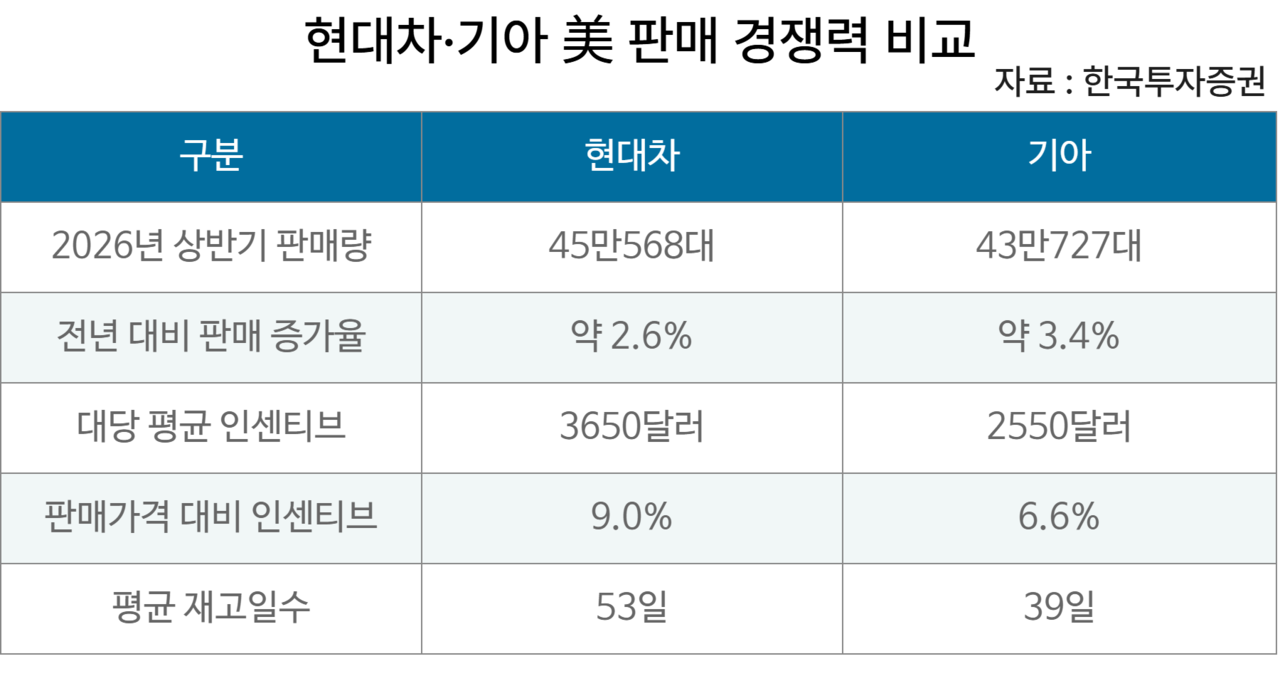
An analysis of data from Korea Investment & Securities, Autodata, J.D. Power and GlobalData found that Kia's average per-vehicle incentive in the US market in the first half of this year was about $2,550 (3.6 million won). Hyundai Motor, including Genesis, averaged about $3,650 — $1,100 more than Kia.
Kia's incentive level was also more than 20 percent below the US industry average of roughly $3,300. The share of incentives relative to vehicle selling price stood at 6.6 percent for Kia, compared with 9.0 percent for Hyundai Motor — a gap of 2.4 percentage points.
Incentives refer to cash discounts and financing support that automakers offer consumers or dealers to stimulate sales. Even when two vehicles carry the same sticker price, a larger incentive means the automaker takes home less. That is why managing incentives matters as much to profitability as raw sales volume.
K5 outsells Sonata 2.7 to 1, inventory turns 14 days faster
Kia's ability to sustain low incentives while staying competitive shows up clearly in segment-by-segment sales figures.
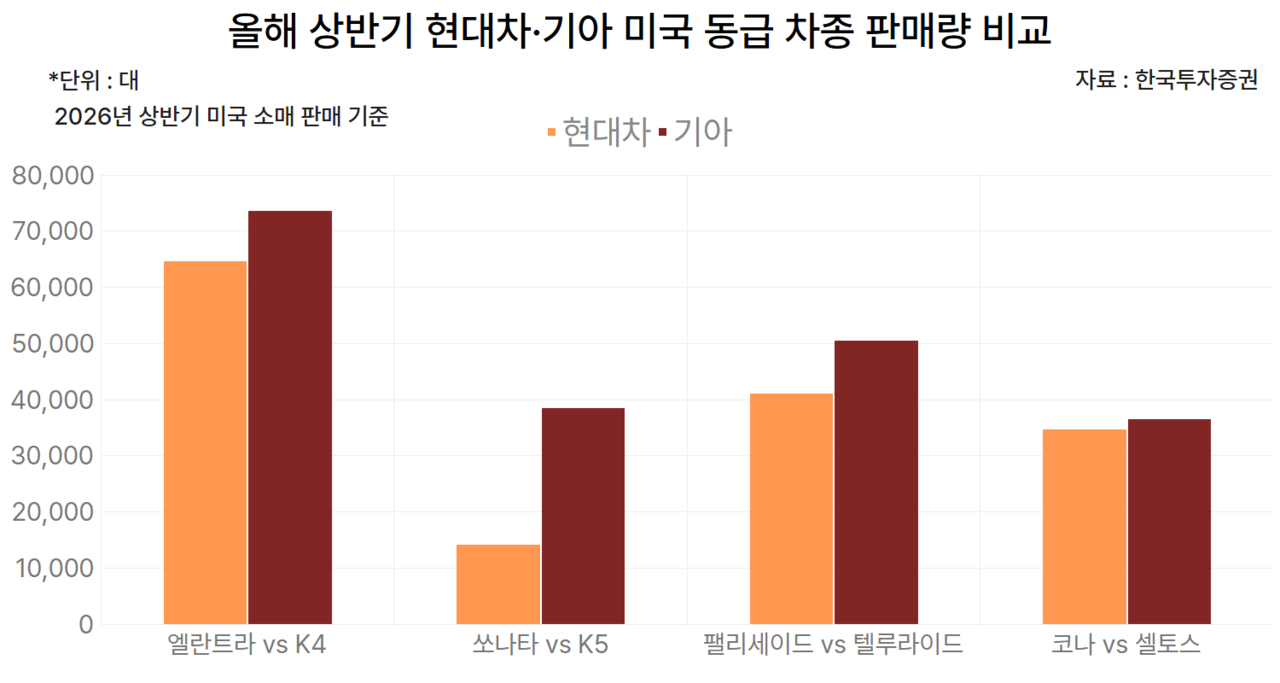
On a US retail basis in the first half of this year, the Kia Telluride sold 50,357 units, outpacing the Hyundai Motor Palisade (40,963 units) by about 23 percent. The compact sedan K4 moved 73,579 units, roughly 14 percent ahead of the Hyundai Motor Elantra (64,503 units).
The gap was even wider in the midsize sedan segment. The Kia K5 sold 38,394 units — 2.7 times the Hyundai Motor Sonata's 14,080. In the subcompact SUV segment, the Seltos edged out the Kona with 36,478 units against 34,617.
Kia does not lead Hyundai Motor in every segment, but some analysts say the figures show a meaningful shift in brand competitiveness when comparing models that share platforms and major components within the same group.
Kia also posted slightly stronger sales growth. Its US sales rose 3.4 percent year-on-year in the first half of this year, ahead of Hyundai Motor's 2.7 percent gain. Both brands outperformed a market that contracted overall, but Kia achieved the higher growth rate with lower incentives.
Inventory is also moving faster. Kia's average days of supply in the US in the first half of this year stood at 39 days, 14 fewer than Hyundai Motor's 53. The less time a vehicle sits on a dealer's lot, the less pressure there is on the dealer to offer additional discounts.
Residual values climb as Kia becomes a brand that sells without heavy discounts
Analysts point to rising residual values as a key driver of the shift. As the value a vehicle retains after a set period of ownership increases, consumers can expect a higher resale price — and automakers gain room to trim new-car discounts.
Kia's 36-month residual value in the US climbed from 39.7 percent in 2018 to 54.3 percent in 2023, and its ranking among all brands rose sharply over the same period, reaching fourth place by 2023. The improvement has continued since. According to Kia, its residual value relative to the segment leader in the US market rose from 88 percent in 2021 to 96 percent in 2025, narrowing the gap to about 4 percentage points.
Some analysts say Kia has built a virtuous cycle over the past several years by holding incentives low: fewer discounts lead to higher residual values, which raise the effective purchase price and improve profitability. The brand is shifting from a "push" strategy — flooding the market with incentives to drive volume — to a "pull" model in which consumers seek out the brand on their own terms.
Particularly notable, some analysts say, is that a Korean brand has for the first time in effect joined the group of low-incentive brands in the US market long dominated by Japanese automakers such as Toyota and Honda.
![Exterior of the updated Kia K5 midsize sedan, the 2027 K5. [Provided by Kia]](https://wimg.heraldcorp.com/news/cms/2026/08/14/news-p.v1.20260702.61e49bf996db475d98b577d69de6449c_P1.jpg)
US pricing held firm, but incentive costs mount amid European competition
Kia's overall incentive burden, however, has not shrunk. In the second quarter of this year, intensifying sales competition in the US and Europe pushed related costs sharply higher.
Kia posted record quarterly sales of 33.3 trillion won ($23.5 billion) in the second quarter of this year, but operating profit fell 4.9 percent year-on-year to 2.63 trillion won. Despite gains in both sales volume and average selling price driven by electric vehicles and hybrids, higher incentive spending weighed on profitability.
Kia's incentive and pricing-related costs in the second quarter totaled 723 billion won, more than double the 341 billion won recorded a year earlier. Kim Seung-jun, Kia's chief financial officer, said at the second-quarter earnings conference call last month that incentive spending had risen by more than $400 per vehicle in the US and by more than 1,000 euros in Europe compared with a year ago.
![Kia vehicles provided during the FIFA World Cup, which ran from June 11 (local time) through July 19, including the Carnival Hybrid, Sportage and Telluride Hybrid X-Line (front row, from left) and the Sorento, Niro, Telluride X-Pro, K4 and K4 Hatchback (back row, from left). [Provided by Kia]](https://wimg.heraldcorp.com/news/cms/2026/08/14/news-p.v1.20260520.0937412ac5b44dc494094b44b5f68d3c_P1.jpg)
The figures also mean that while Kia's US incentives have risen in absolute terms, they remain low relative to competitors. In Europe in particular, an aggressive push by Chinese electric vehicle makers has made price competition to defend market share unavoidable.
Kim said Kia sees a need, for now, to prioritize market share gains over profitability in markets such as Europe to counter Chinese automakers, even if that means giving up some margin. He added that incentive costs are not expected to increase further in the second half of the year.
Kia plans to restore profitability from next year onward through product improvements and cost competitiveness. In the US in particular, the company is counting on the new Telluride's launch effect and continued growth in hybrid SUV sales, including the Sportage and Sorento.
Kia's US sales in the second quarter rose 2.8 percent year-on-year to 224,000 units. Hybrids accounted for 29.6 percent of that total, up from 12.1 percent a year earlier — more than doubling in share. The growing weight of electrified SUVs, which carry relatively higher selling prices, is also helping reduce the brand's reliance on discounts.
Kim Chang-ho, an analyst at Korea Investment & Securities, said Kia's low incentive levels are the result of more than three years of rule-based pricing discipline — a competitive advantage not easily reversed. "The sustained reduction in incentives is feeding through to higher residual values, which in turn is lifting brand value — a virtuous cycle that is now well underway," he said.
kwater@heraldcorp.com