One clinic sent text advertisements to patients with private health insurance offering manual therapy for 10,000 won ($7). After receiving a warning from a public health center, it removed its name from the ads and listed only a subway station exit number, sharing its identity only with patients who made contact. At that clinic, a woman in her 40s received more than 180 consultations for toenail fungus treatment and filed 26 million won in insurance claims. Her out-of-pocket cost was 10,000 won per visit.
![The Financial Supervisory Service will launch an intensive investigation in the second half of this year into clinics that have filed tens of millions of won in insurance claims through excessive toenail fungus treatments. [Getty Images Bank]](https://wimg.heraldcorp.com/news/cms/2026/08/15/news-p.v1.20260815.2245b5a320d947b484fa59ddad863f4f_P1.jpg)
It starts with a single question. Weight-loss injections recorded as pain treatment, hair transplants billed as fungus therapy — none of it is possible without a doctor's signature. The resulting payouts ultimately come back as higher premiums for all policyholders. As hospitals increasingly drive insurance fraud, the Financial Supervisory Service is directing its investigative resources at medical institutions in the second half of this year.
The FSS announced plans Saturday — as part of a review of achievements and future plans marking the first anniversary of FSS chief Lee Chan-jin's tenure — to launch an intensive investigation into hospitals suspected of insurance fraud in the second half of the year. Targets will be identified based on insider tips received during a special insurance fraud reporting and reward period. The reporting period has been extended through the end of October to coincide with the end of a Korean National Police Agency special crackdown, and the scope has been widened from private health insurance to auto insurance. Traditional Korean medicine hospitals and clinics are also included among the reportable institutions.
The FSS will designate as "third-party risk" the practice by which third parties — such as hospitals and auto repair shops — that effectively determine the size of insurance payouts induce excessive treatment or inflate costs for profit, and will establish guidelines to block such conduct.
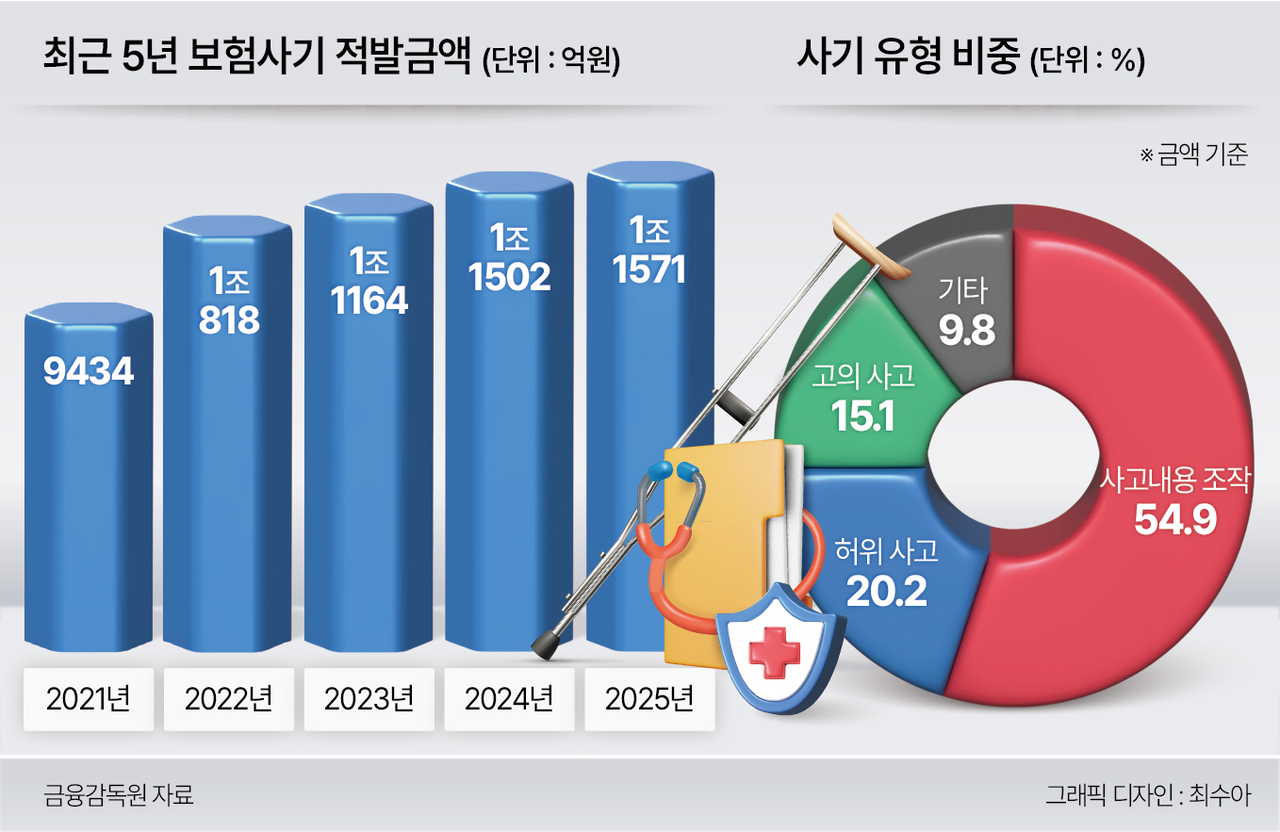
Detected insurance fraud has grown every year, rising from 943.4 billion won in 2021 to 1.16 trillion won last year. Breaking down the figures by type, fraud involving hospitals inflating auto insurance treatment costs surged 6.8-fold, from 4 billion won in 2024 to 27.3 billion won last year. The number of people caught more than quintupled, from 627 to 3,246. That stands in contrast to other document-manipulation categories — falsified medical certificates and inflated hospitalization and surgery claims — which fell 14 percent over the same period.
Even those figures count only what has been caught. The Financial Services Commission estimates the total scale of domestic insurance fraud, including undetected cases, at around 9 trillion won — nearly eight times the amount actually detected. Fraud involving hospitals is particularly hard to catch through document review alone, because the medical records themselves are fabricated. That is why the upcoming investigation will use insider tips as its starting point.
Hospitals recruiting patients
Cases disclosed by the FSS illustrate how brazen the schemes have become. Last year, the head of one traditional Korean medicine hospital sent messages to an insurance agent reading: "You referred six patients this month, so I've sent you six 50,000-won department store gift vouchers," and "Please send me the patient's information so I can prepare the medical records in advance." The records were to be written before the patient even walked through the door. The agent received the vouchers along with herbal tonics and free treatment coupons.
Brokers told patients they could be admitted to hospital without seeing a doctor in person — just by phone — and that hospitalization would lead to a larger settlement. They also promised that admitted patients would receive herbal tonics and pre-prepared herbal medicine. One patient who had been rear-ended in a minor accident while making deliveries was processed as having been hospitalized for 14 days while freely coming and going and continuing to work. The hospital falsified the patient's outing records.
Private health insurance fraud follows the same pattern. Doctors who ask patients about their insurance coverage during consultations and then encourage fraudulent claims are subject to criminal penalties under the Special Act on Prevention of Insurance Fraud. Tips received during the special reporting period show that one clinic administered obesity drugs to patients while recording the visits as treatment for other conditions. Another clinic provided treatment before a patient's insurance took effect, then issued a false diagnosis so the patient could file a claim once the exclusion period had passed.
The quality of the hospitalizations filled through such schemes has been laid bare in court. In a case contested by a non-life insurer, three members of a family — including a three-year-old child — were each admitted for four days after a parked car's side mirror was grazed. The court found it difficult to conclude that the accident had caused any injury and declined to award treatment costs or lost income, granting only 150,000 won each in consolation damages.
Hospitals fabricating records
Records are sometimes created before treatment even begins. One traditional Korean medicine hospital gave traffic accident patients a pain-assessment form with scores from zero to 10, but had physically blacked out the options from zero to four. A score of zero means no pain; four means discomfort in daily life. With those options removed, even a patient with mild pain had no choice but to select five or higher. That score then served as the basis for claiming "severe pain" when billing for treatment, and justified hospitalization and MRI scans. Patients who might otherwise have been treated as outpatients were admitted instead, multiplying treatment costs several times over.
One hospital director caught last year had set up the medical institution specifically to collect private insurance payouts. The hospital operated four internal units: a finance team, a patient-referral and counseling team, an insurance team and a prescription team. Brokers in the counseling team recruited patients by telling them cosmetic procedures were covered by insurance, while the insurance team — which included a claims adjuster — prepared falsified medical records tailored to items covered under private health insurance. The prescription team, staffed by a pharmacist, filed false claims for national health insurance reimbursements, while the finance team managed accounts and distributed incentives. A total of 1,105 patients who had received high-cost cosmetic procedures such as hair transplants and filler injections were made to appear as pain-treatment patients, netting 4 billion won.
When one door closes, another opens
Even as regulations are applied, workarounds keep emerging. When the government designated manual therapy and two other treatments as managed benefits in December last year, the per-session fee for manual therapy dropped from 200,000–300,000 won to around 70,000 won. Medical institutions have since shifted to spinal decompression therapy, extracorporeal shock wave therapy and other treatments not yet subject to managed pricing, repricing them to match private insurance coverage limits. Claims inflating treatments that should cost a few thousand won by dozens of times have also been confirmed.
The FSS established dispute-resolution standards for extracorporeal shock wave therapy in June, and the fifth-generation private health insurance product launched in May raised the patient co-payment rate for non-critical, non-covered treatments from 30 percent to 50 percent. Concerns persist, however, that regulation cannot keep pace with the speed at which new treatment categories emerge.
What documents alone cannot catch
Despite the announced crackdown, the FSS has no investigative authority. All it can do is compile evidence of suspected fraud and hand it to police. A plan included in the announcement to introduce special judicial police for consumer protection covers only additions to the scope of the Moneylending Act and the Debt Collection Act — insurance fraud is excluded.
Meanwhile, falsified documents are becoming harder to detect. One person in their 20s uploaded hospital admission and discharge certificates to a generative AI tool, extended the stated hospitalization period, and then filed repeated claims with 11 insurers over one year, collecting 150 million won. A court sentenced the person to two years in prison for violating the Special Act on Prevention of Insurance Fraud. It is one of the first cases involving AI-assisted insurance fraud to reach trial.
In the past, cutting and pasting receipts or using editing software left traces — mismatched fonts and letter spacing. Generative AI reconstructs images from scratch, leaving no such clues. When a forged file is submitted directly, there is at least some room to examine whether it has been manipulated; but once it is printed on paper, photographed and uploaded to a claims app, even that possibility disappears. What the insurer ultimately receives is a single photograph.
Insurance claims review operates on the assumption that documents issued by hospitals are accurate, but once that assumption breaks down, there is no way to verify the truth from within the documents themselves. In response, the FSC launched a task force in June, bringing together the Ministry of Health and Welfare, the Korean National Police Agency, the National Health Insurance Service and the Health Insurance Review and Assessment Service to build an AI-based insurance fraud prevention system. The TF is set to release a construction plan next month and begin revising relevant laws and regulations from October.
psj@heraldcorp.com