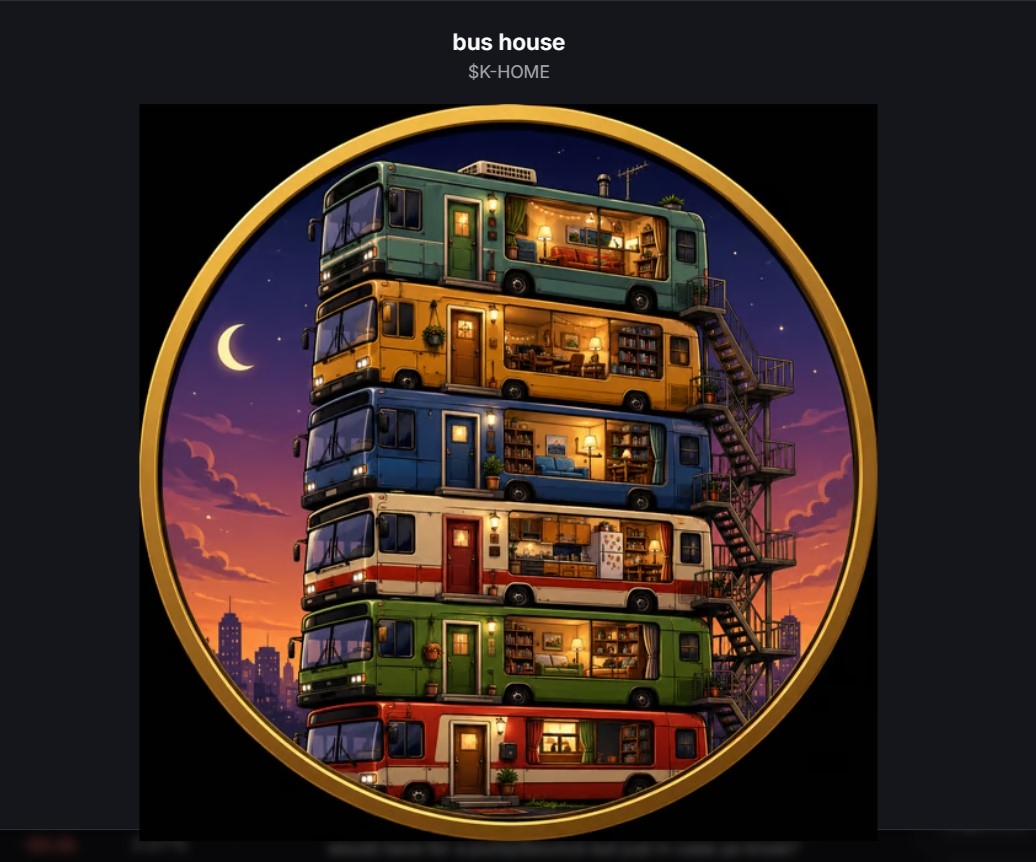
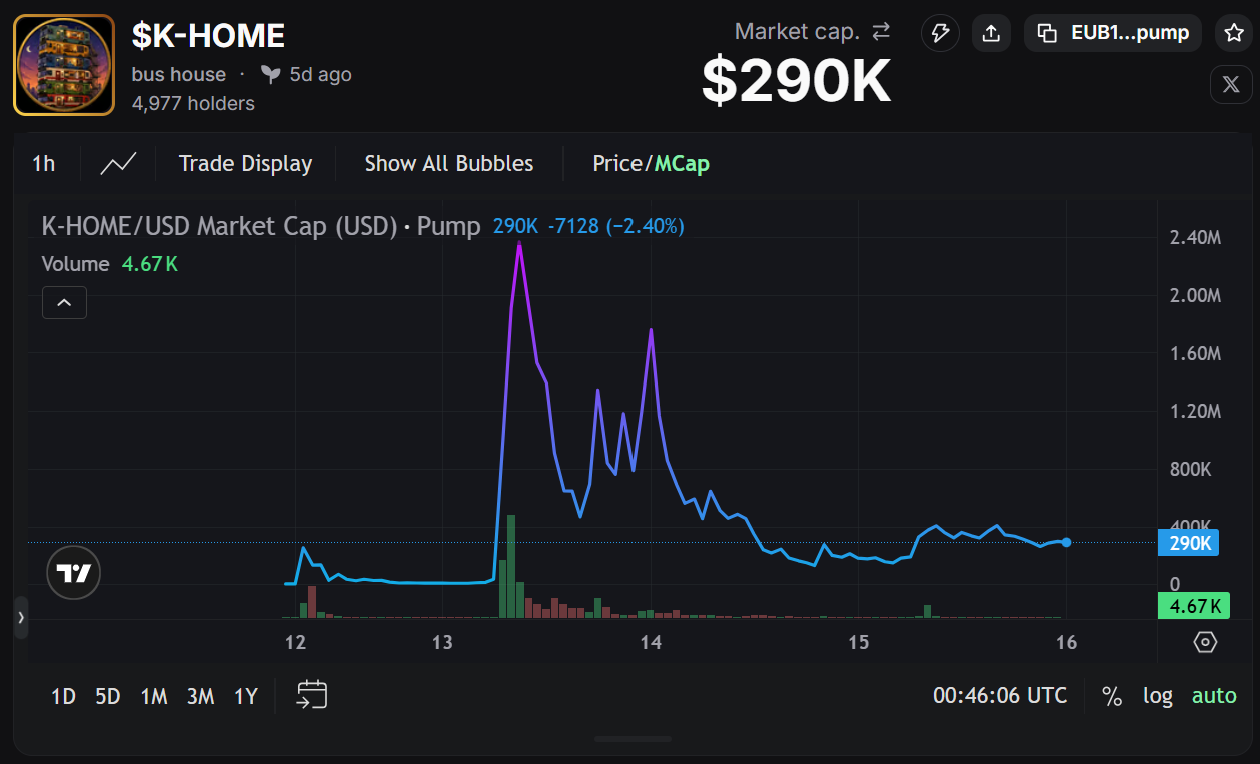
A meme coin satirizing Democratic Party of Korea lawmaker Hwang Hee's "bus house" proposal has shown extreme price volatility since its launch. Its market cap briefly surpassed 3 billion won ($2.12 million) before collapsing roughly 88% to around 400 million won within three days, drawing warnings about the risks of investing in small, illiquid meme coins.
A digital asset called "Bus House" — ticker symbol K-HOME — was listed on Pump.fun, a meme coin issuance platform, on Aug. 11 and has been trading since, according to the digital asset industry Sunday.
On Sunday, the sixth day since its launch, Bus House's market cap stood at $287,000, or about 400 million won — up 43.75% from 24 hours earlier. That figure still represents an approximately 88% drop from its peak of $2.37 million, reached around 9 a.m. Thursday.
Short-term price swings were also sharp. As of 9:09 a.m. Sunday, the token had fallen 13.95% over the previous six hours while recovering 1.98% in the most recent hour.
Bus House emerged amid online controversy after Hwang proposed using decommissioned buses as a youth housing solution. The project description explicitly states that the token is a satirical meme coin with no connection to any actual housing project.
The project description posted on Pump.fun reads: "Weary youth, this is your home," and explains that the coin was created from "the hypothetical idea that if bus-style housing became a reality, a subscription coin might emerge — much like a housing subscription account."
Pump.fun is a leading meme coin issuance platform built on the Solana blockchain that allows anyone to launch a meme coin with minimal effort. It has pulled far ahead of rival platforms in recent months, commanding more than 80% of the meme coin trading fee market.
Among the major meme coins trading on Pump.fun, "Black Bull" (ANSEM) — inspired by well-known crypto influencer Ansem — carries a market cap of $251 million. "Comedian" (BAN), based on Maurizio Cattelan's artwork, stands at $70.4 million, while the meme coin inspired by Moo Deng, Thailand's famous baby hippo, is valued at around $35.4 million.
Meme coins are digital assets built around viral internet figures or content. Aside from the gas fees required to deploy a smart contract, the cost of issuing one is effectively zero. Platforms such as Pump.fun make it possible for anyone to create a token without complex development work.
However, sustaining trading activity and supporting a token's price after launch requires ongoing costs.
Ahn Gwang-ho, a researcher at Tiger Research, said the real expenses come after issuance. "Costs arise from supplying the liquidity needed to support smooth trading and using that liquidity to defend the price," he said.
The ease of issuance is precisely what makes small-cap meme coins vulnerable: with thin market caps and limited liquidity, prices can swing dramatically on just a handful of trades. When trading volume is insufficient, a relatively small amount of capital can push prices sharply up or down.
"When investing in small-cap meme coins, investors should be aware that price manipulation is easy," Ahn said. "Thin trading volume and low liquidity mean prices can move sharply on just a few buy or sell orders." He also warned that entering at an artificially inflated price creates a serious risk of being left holding the bag when the parties behind the manipulation sell their positions and exit.
The appeal of meme coins — despite their lack of intrinsic value — lies in the prospect of outsized short-term gains. Unlike major digital assets listed on centralized exchanges, meme coin prices can move hundreds of percent in a single day, drawing in investors chasing high returns.
"The extreme volatility — with some tokens rising more than 300% in a single day — is what attracts investors," Ahn said. "But prices can fall just as fast. It is a classic high-risk, high-return structure."
kyoung@heraldcorp.com