![A road in Okpo-dong, Geoje, South Gyeongsang Province, is submerged by heavy rain on Monday. [Yonhap]](https://wimg.heraldcorp.com/news/cms/2026/08/18/rcv.YNA.20260817.PYH2026081704780005200_P1.jpg)
Record rainfall that has battered southern South Korea — coming on the heels of an extreme heatwave and drought — is raising alarm over crop damage and grocery prices.
According to the Ministry of Interior and Safety's Central Disaster and Safety Countermeasures Headquarters, cumulative rainfall from Saturday through 5 a.m. Tuesday reached 956.1 millimeters in Geoje, South Gyeongsang Province; 766.9mm in Tongyeong; 518.0mm in Gadeokdo, Busan; 477.0mm in Seongsan, Jeju; 430.5mm in Sacheon, South Gyeongsang Province; and 429.5mm in Goseong.
Heavy rain advisories for Geoje and Tongyeong were lifted as the rain eased, but crop damage is feared in fields and paddies still submerged by floodwater. Losses from the prolonged heatwave and drought that preceded the rains have also been mounting. Between Saturday and Monday, about 1.21 million livestock and about 2.68 million farmed fish died. Emergency releases of rockfish and other species were carried out to prevent further losses.
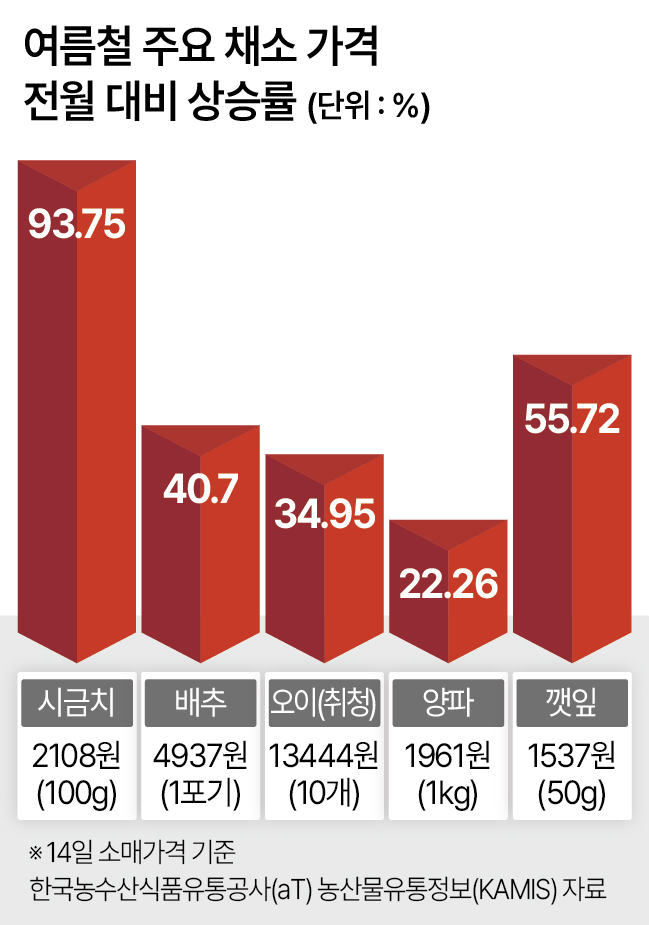
Vegetable prices were already under upward pressure from the extended heatwave. Data from the Korea Agricultural Marketing Information Service (KAMIS) show that as of Aug. 14, the average retail price of spinach stood at 2,108 won per 100 grams — up 93.8 percent from the previous month. Chwijeong cucumbers, grown mainly in southern regions, rose 35.0 percent month-on-month to 13,444 won for a pack of 10. Perilla leaves (up 55.7 percent), napa cabbage (40.7 percent) and onions (22.3 percent) also climbed from a month earlier.
Seafood prices are also trending higher. According to Suhyup Noryangjin Fish Market, the average auction price of wild-caught red sea bream — primarily sourced from waters off Tongyeong, South Gyeongsang Province — was 19,200 won per kilogram in the first week of this month (Aug. 3–8), up 46.6 percent from the previous week and 51.2 percent from the same period last year. Farmed sea bream jumped 43.0 percent year-on-year. Auction prices for wild-caught flounder (up 23.5 percent), wild-caught sea bass (10.7 percent), mackerel (47.4 percent) and shucked oysters (48.2 percent) are also rising.
Livestock prices are stabilizing but remain elevated. Data from the Korea Institute for Animal Products Quality Evaluation show that as of Monday, the average consumer price of beef tenderloin (Grade 1) was 14,830 won per 100 grams — 13.1 percent above the normal-year average. Pork samgyeopsal (per 100 grams) and eggs (30-count) were trading 8.6 percent and 8.8 percent above their respective normal-year averages.
Rising ingredient costs are also feeding through to dining-out prices. According to the Korea Consumer Agency's price-monitoring service, the average price of a kimbap roll in Seoul stood at 3,838 won in June — up 5.9 percent from a year earlier. A bowl of knife-cut noodle soup crossed the 10,000-won mark, rising 3.6 percent over the year, while naengmyeon (up 2.8 percent), samgyetang (2.8 percent) and bibimbap (2.7 percent) all rose as well.
The Agricultural Outlook Center warned that garlic and onion prices are expected to rise above last year's levels as output and stored supplies shrink, reducing shipments. "If the heatwave continues, there are concerns that shipment volumes and price volatility could be significant, making ongoing monitoring necessary," it said.
The government is working to limit the impact of the heatwave and heavy rains on grocery prices. The Ministry of Agriculture, Food and Rural Affairs is maintaining an emergency operations center for agricultural disaster response while running an incident-management support unit. The Ministry of Oceans and Fisheries is conducting on-site inspections to assess damage and stepping up prevention efforts.
![A shopper browses the vegetable section of a hypermarket in Seoul on Thursday. [Herald DB]](https://wimg.heraldcorp.com/news/cms/2026/08/18/news-p.v1.20260813.ba118aa9f7f24b8b846621cfe08550df_P1.jpg)
spa@heraldcorp.com