![The Ministry of Interior and Safety holds an employment briefing for the Serious Crime Investigation Agency at the Seoul High Prosecutors' Office in Seocho-gu, Seoul, on Tuesday. [Yonhap]](https://wimg.heraldcorp.com/news/cms/2026/08/18/rcv.YNA.20260811.PYH2026081105300001300_P1.jpg)
The organizational framework of the Serious Crime Investigation Agency — a newly established body set to absorb the investigative functions of the prosecution — is coming into sharper focus. The Ministry of Interior and Safety said Tuesday that the cabinet approved three foundational legal instruments at its meeting: the enforcement decree of the Serious Crime Investigation Agency Act, the agency's organizational and staffing ordinance, and the appointment ordinance for its investigators.
The instruments approved at Tuesday's cabinet meeting set out the detailed operational standards, organizational structure, staffing levels, and personnel management rules delegated by the Serious Crime Investigation Agency Act, which was enacted in March.
Public can nominate candidates for inaugural director
The enforcement decree spells out the criteria for appointing the agency's director. A candidate recommendation committee must put forward at least three qualified candidates for the post. Notably, the decree includes a public-participation provision allowing ordinary citizens, legal entities, and civic organizations to nominate director candidates.
Kim Min-jae, vice minister of the Interior and Safety Ministry, said at a briefing earlier this month that once the decree was finalized, the candidate recommendation process would move forward promptly. "We are preparing to have the director appointed in time for the agency's opening day of Oct. 2, following a National Assembly confirmation hearing," he said.
Under the enforcement decree, when police or other investigative agencies become aware of a serious crime, they must notify the agency within three days; the agency then has seven days from the date of notification to respond on whether it will take over the investigation directly. However, the notification requirement does not apply to property crimes such as fraud and extortion below a certain scale, crimes falling under the jurisdiction of the Corruption Investigation Office for High-ranking Officials, and cases where the complaint or accusation is unclear or where it is evident that no right to prosecute exists.
The decree also covers the investigative review process for assessing whether agency investigators conducted inquiries lawfully, the standards and procedures for compensating losses to life, physical safety, or property arising from investigators' official duties, and the rules governing the transfer of personal data abroad during international cooperative investigations.
![Euljiro Renaissance Square, which will house the agency's headquarters and the Seoul regional office. [Provided by Hyundai Engineering]](https://wimg.heraldcorp.com/news/cms/2026/08/18/news-p.v1.20260818.dc830a6d1ca042dca6d523d7f1ab5815_P1.png)
Agency to have nationwide staff of 2,874
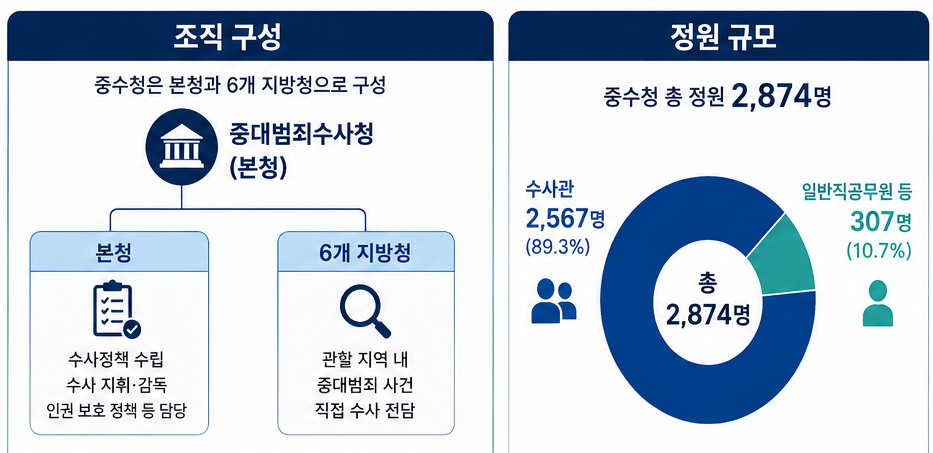
The Interior and Safety Ministry earlier announced that the agency will have a total staff of 2,874 — 2,567 investigators and 307 in general and other positions — organized into a headquarters responsible for setting investigative policy across seven categories of serious crime and six regional offices in Seoul, Suwon, Daejeon, Daegu, Busan and Gwangju.
Scope of the agency's investigations (seven categories of serious crime): corruption, economic crime, defense industry crime, narcotics, national security crimes including insurrection and foreign interference, cybercrime, and obstruction of justice
Each regional office will have dedicated investigative units organized by type of serious crime. The Suwon office will house a defense industry and industrial technology investigation unit, and the Busan office an international economic crime investigation unit, reflecting the particular characteristics of their respective regions.
Five joint investigation units — carrying over the existing framework in which prosecutors, police, and relevant agencies worked together — will also be established. These include a voice-phishing joint investigation unit, a financial crime joint investigation unit, and a virtual assets joint investigation unit at the Seoul office; a narcotics joint investigation unit at the Suwon office; and a national fiscal crime joint investigation unit at the Daejeon office.
A dedicated unit will also be set up to handle supplementary investigation requests from prosecutors at the new public prosecution offices, in line with amendments to the Code of Criminal Procedure. Under those amendments, when a prosecutor requests supplementary investigation into cases involving seven categories of socially vulnerable victims — including sexual violence and abuse targeting women, children, people with disabilities, and the elderly — the agency must take on the work. Regional offices outside Seoul will each have a special investigation team for crimes against vulnerable groups, while the Seoul office, which covers a wider jurisdiction, will have a full special investigation division for such cases.
Investigator appointments to emphasize expertise and competence
The agency's launch preparation team is working to secure roughly 2,500 investigators. Prosecutors and investigative staff currently employed at the prosecution service may transfer to the agency as investigators through a special appointment process — without sitting an exam — if they choose to do so. Prosecutors will be assigned to grades 1 through 4 based on their rank and career experience.
Grade 1 (equivalent to district prosecutors' office chief), Grade 2 (equivalent to deputy chief or division chief prosecutor), Grade 3 (prosecutors with 10 or more years of legal career), Grade 4 (prosecutors with fewer than 10 years of experience). Note: applies on a temporary basis from October this year through the end of April next year.
How many investigators will actually leave the prosecution service to join the agency remains uncertain. The launch preparation team held recruitment briefings at 18 district prosecutors' offices nationwide from Aug. 5 to Aug. 12, but only a fraction of the targeted prosecutors and investigators attended, according to sources. The special appointment application window closes Thursday. The Interior and Safety Ministry plans to assess the level of interest from prosecution staff before drawing up a plan to recruit experienced outside personnel from the police and other agencies.
Concerns about the agency's readiness remain widespread, with observers pointing to difficulties in securing investigators, incomplete systems including the Korea Information System of Criminal Justice Services, and unconfirmed office space for regional branches. The Interior and Safety Ministry insists there will be no problem launching the agency on Oct. 2 as scheduled.
Interior and Safety Minister Yun Ho-jung said the agency would be built into "a specialized investigative body that protects the public without gaps from everyday crimes such as voice phishing, financial crime and virtual asset fraud, as well as crimes targeting vulnerable groups including child abuse and sex crimes." He added that the ministry would "do its utmost to establish the agency as an investigative body trusted by the public and to ensure the criminal justice reform of separating investigation from prosecution takes firm root."
nyang@heraldcorp.com