![Researchers work at the semiconductor fabrication facility of the National NanoFab Center in Yuseong-gu, Daejeon. [Yonhap]](https://wimg.heraldcorp.com/news/cms/2026/08/18/rcv.YNA.20260730.PYH2026073016400001300_P1.jpg)
The Ministry of Trade, Industry and Energy and the Ministry of Employment and Labor remain at odds over whether to ease the 52-hour weekly work cap for research and development personnel under the special act on mega special zones — legislation the Lee Jae Myung administration is pushing to enact this year to accelerate its three flagship mega projects.
Trade Minister Kim Jung-kwan has reaffirmed his position that exemptions from the 52-hour rule are necessary to keep pace with China and other rivals in the semiconductor race, going so far as to put a white-collar exemption on the table. Labor Minister Kim Young-hoon, by contrast, argues that existing rules already allow for additional working hours and has urged a cautious approach.
The disagreement between the two ministries ultimately comes down to how each views the role of time in the global semiconductor technology race.
The Trade Ministry holds that R&D workers must be able to put in intensive hours when needed, given how rapidly China and other competitors are closing the gap. The Labor Ministry counters that it is first necessary to examine whether longer working hours actually translate into stronger industrial competitiveness. President Lee Jae Myung has described the inter-ministry disagreement as a "democratic process" and called for resolution through debate, but the government will ultimately need to reach a conclusion if the special act is to be enacted this year.
The semiconductor race is a time war — a contest over who can develop and mass-produce next-generation products first. The United States imposes no uniform weekly cap on working hours, Japan exempts new-technology R&D from general overtime limits, and Taiwan distributes overtime allowances across rolling periods. Critics argue it is inconsistent to strip away tax, location and licensing barriers while leaving the R&D workers who actually develop the core technology bound by a rigid 52-hour weekly ceiling.
![Trade Minister Kim Jung-kwan answers lawmakers' questions at the first plenary session of the National Assembly's Trade, Industry, Energy, SMEs and Startups Committee on Wednesday. [Yonhap]](https://wimg.heraldcorp.com/news/cms/2026/08/18/rcv.YNA.20260812.PYH2026081208640001300_P1.jpg)
Trade minister says exemption needed; labor minister urges caution
The central flashpoint in the mega special zone bill is the labor exemption clause.
Within the government, officials are weighing a range of options — including a white-collar exemption that would apply different working-hour rules to managers and R&D staff above a certain income threshold, as well as an extension of the settlement period for flexible working-hour arrangements.
The government is also considering expanding the settlement period for flexible working hours in the mega zones from the current one month to six months, according to sources familiar with the discussions. The idea is to maintain an overall cap on total working hours while allowing workers to put in more hours during crunch periods and scale back when workloads ease.
The two ministers laid out their diverging positions side by side at the National Assembly on Wednesday. Kim Jung-kwan told the plenary session of the Trade, Industry, Energy, SMEs and Startups Committee that the government was "discussing various arrangements, including a white-collar exemption and flexible working-hour schemes." Asked whether an exemption from the 52-hour rule was among the options under consideration, he replied simply: "Yes."
Kim had earlier cited the so-called "996" work culture at some Chinese IT companies — working from 9 a.m. to 9 p.m., six days a week — as context for why South Korea needs to revisit its 52-hour cap. The 996 practice is not a legally recognized standard in China, but Kim's reference to it was widely interpreted as an attempt to underscore the intensity of the competition facing South Korean chipmakers.
The business community echoed that view. The Korea Enterprises Federation, in a policy paper released Monday, called on the government to include in the mega special zone bill provisions that would expand the overtime management unit from the current weekly basis to monthly, quarterly, semi-annual or annual periods, and to introduce a white-collar exemption removing R&D professionals and key startup personnel from working-hour regulations altogether. The federation also called for extending the maximum contract period for fixed-term workers beyond the current two years and broadening the scope of jobs eligible for dispatch work.
Lee Dong-geun, the federation's standing vice chairman, said the competition for technological supremacy in the AI and semiconductor era "is ultimately a fight over how quickly and flexibly talent can be deployed," adding that labor flexibility must underpin the mega zones if they are to serve as a launchpad for nurturing strategic national industries.
'Special overtime exists,' critics say — but is government approval really flexibility?
Labor Minister Kim Young-hoon, appearing before the National Assembly's Climate, Energy, Environment and Labor Committee on the same day, said the government should "approach this carefully" and that additional hours could be accommodated "through flexible mechanisms such as special extended work."
In response to further questions from lawmakers, Kim said "there is no innovation possible through bad jobs" and that "the way to outpace China's catch-up is talented people." His remarks were widely read as a signal that simply extending working hours for R&D staff is not the answer in the semiconductor competition with China. Kim added that "creativity and innovation matter more than quantity in research and development" and that "guaranteeing workers' basic labor rights and fostering creativity are not unrelated to corporate innovation."
The Labor Ministry's main argument for caution rests on the fact that the existing system already allows workers to exceed 52 hours a week. Under the special extended work scheme, employees can work beyond the statutory overtime limit with the worker's consent and the labor minister's approval when special circumstances arise. The ministry has already extended the maximum approval period for semiconductor R&D from three months to six months, with re-approval allowing use for up to one year.
![Labor Minister Kim Young-hoon delivers a work report at the plenary session of the National Assembly's Climate, Energy, Environment and Labor Committee on Wednesday. [Yonhap]](https://wimg.heraldcorp.com/news/cms/2026/08/18/rcv.YNA.20260812.PYH2026081206420001300_P1.jpg)
At a recent press briefing, Kim cited the fact that only four applications for six-month special extended work had been filed in the semiconductor R&D sector, questioning whether a separate working-hour exemption is truly necessary if companies are not actively using the flexibility already available to them.
However, data submitted to the National Assembly by the Labor Ministry shows that the overall approval rate for special extended work reached 94.0 percent in 2024, 92.9 percent in 2025 and 92.1 percent through June this year. All 45 applications from chipmakers last year were approved. Samsung Electronics alone saw its applications — all approved — rise from seven in 2023 to 18 in 2024 and 25 in 2025.
The "four cases" Kim cited refer specifically to six-month long-term applications, while the National Assembly data covers all special extended work applications and approvals — the two figures use different counting criteria. Still, the data suggests that semiconductor companies have not been entirely absent from the special extended work system, leaving room for competing interpretations of what "low uptake" actually means.
Critics also argue that the existence of a special exemption is a separate matter from whether companies and workers can allocate time flexibly around R&D schedules. Advanced semiconductor development — including HBM and other cutting-edge chips — involves design, process development, yield stabilization and customer certification phases that naturally concentrate workloads at specific stages.
In a race where bringing a next-generation product to market even a few months ahead of rivals can determine who captures the market, the question is whether requiring government approval each time workloads spike is a workable model for global R&D competition.
Kim Dong-wook, a professor at Korea University School of Law, said the special extended work scheme "leaves too much to the labor minister's discretion, making it difficult for companies to manage their workforce in a predictable and stable way," adding that "rigid legal regulations can actually encourage workarounds that offer workers no protection either."
Kim said the AI and semiconductor rivalry "is fundamentally a race against time," and that if South Korean companies fall behind because of constraints on workforce deployment speed, "the damage falls on the workers already employed by those companies — and on those who should have been hired." He said the moment calls not for a binary choice between companies and workers, but for "a social dialogue on a predictable and rational labor law framework."
US has no weekly cap; Japan exempts new-tech R&D from overtime limits
![A TSMC sign is displayed at a booth during Sedex 2024, the 26th Korea Electronics Show, held at COEX in Gangnam-gu, Seoul. [Yonhap]](https://wimg.heraldcorp.com/news/cms/2026/08/18/rcv.YNA.20241023.PYH2024102306850001300_P1.jpg)
A look at South Korea's semiconductor rivals abroad makes the contrast in working-hour regimes sharper.
The United States, home to Intel and Micron, has no federal law under the Fair Labor Standards Act that uniformly caps the maximum number of hours an adult may work in a week. The 40-hour threshold is not a ceiling on working time but a trigger for overtime pay. Professionals who meet certain job-duty and salary requirements can be exempt from overtime pay rules altogether, and workers applying advanced scientific or engineering expertise can also qualify for exemption if they meet the statutory criteria.
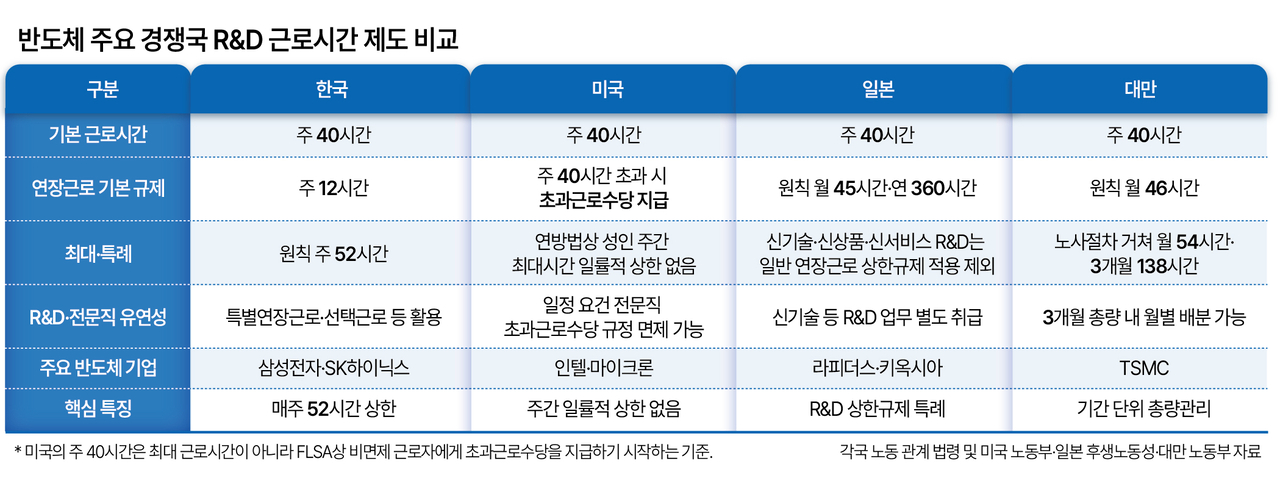
Japan's statutory working hours are also eight hours a day and 40 hours a week, and overtime for general workers is in principle capped at 45 hours a month and 360 hours a year. However, R&D work on new technologies, products and services is excluded from those general overtime limits — a provision that draws direct comparisons with South Korea as Japan pours investment into reviving its advanced semiconductor industry through companies such as Rapidus.
Taiwan, home to TSMC, the world's largest foundry, also sets a baseline of eight hours a day and 40 hours a week, but overtime is in principle permitted up to 46 hours a month. With the appropriate labor-management procedures, that ceiling can rise to 54 hours a month, subject to a total overtime cap of 138 hours over any three-month period — allowing companies to front-load hours in a busy month and scale back in quieter ones.
The systems in the United States, Japan and Taiwan differ from one another. But all three share a common feature: they leave room to accommodate periods of concentrated work, either by recognizing the distinct nature of professional and R&D roles or by managing total hours over a rolling period rather than a fixed weekly cap.
Experts propose mega zones as testbed, with broader expansion if results hold
Experts suggest using the mega special zones as a testbed for greater flexibility in working hours and employment conditions — verifying the effects before any broader overhaul of the 52-hour framework across the whole economy, while keeping an overall cap on total working hours and increasing flexibility in how those hours are distributed.
![Activists calling for a just transition in the semiconductor industry hold a press conference in front of the fountain at Cheong Wa Dae in Jongno-gu, Seoul, on Tuesday, demanding the immediate withdrawal of the mega special zone bill. [Yonhap]](https://wimg.heraldcorp.com/news/cms/2026/08/18/rcv.YNA.20260811.PYH2026081109200001300_P1.jpg)
Labor opposition, however, remains a formidable obstacle. Jeong Heung-jun, a business administration professor at Seoul National University of Science and Technology, said labor groups find it hard to accept "why the government is stepping in to create bad jobs when the industry isn't even in a downturn that would require forced job creation," warning that "this is not an issue labor will back down on, so conflict is expected — and ultimately the core purpose of the project itself could be undermined."
President Lee addressed the inter-ministry disagreement at a Cabinet meeting on Tuesday, saying it "should be seen as a democratic process" and that "when Cabinet members argue — even fiercely, even heatedly — the public doesn't have to." A senior Cheong Wa Dae official also said the process of winning consent from local communities and labor groups takes time, adding that the government is "taking time to deliberate carefully."
The inter-ministry debate may be a normal part of policymaking. But with the government committed to enacting the special act this year, and with investment and development speed at the heart of the mega project concept, the discussion cannot drag on indefinitely. If tax, location and licensing barriers are removed while the one variable that most directly governs development speed — how R&D workers manage their time — is left untouched, the very rationale for the mega special zones could be called into question.
Against that backdrop, the option gaining traction as an alternative is not an across-the-board removal of the 52-hour cap, but a system that maintains an overall ceiling on total working hours while allowing flexible distribution during intensive work periods — mirroring, in different ways, the professional exemptions in the United States, Japan's R&D carve-out and Taiwan's rolling three-month total management approach.
Park Ji-soon, a professor at Korea University School of Law, said there would be no problem "if the direction is toward flexible operation" — meaning a defined ceiling with flexible scheduling — rather than setting different working conditions between mega zone areas and the rest of the country. "It can serve as an opportunity to assess the results and then discuss whether to extend the approach to industry as a whole," Park said.
fact0514@heraldcorp.com