![Minister of Employment and Labor Kim Young-hoon [Ministry of Employment and Labor]](https://wimg.heraldcorp.com/news/cms/2026/08/19/news-p.v1.20250902.88529859984f47c5a4884c3414f2b0fa_P1.jpg)
The government will expand coverage of insolvency wage substitute payments — state payments made on behalf of bankrupt employers to workers who have not received their wages — from the final three months of unpaid wages to the final six months.
As a result, the maximum amount a single worker can receive will rise from 21 million won ($14,900) to 31.5 million won. The loan ceiling for employers seeking to voluntarily clear their wage arrears will also be raised to a maximum of 1 billion won.
The Ministry of Employment and Labor announced Tuesday that the revised Wage Claims Guarantee Act and its implementing regulations will take effect Thursday. The government said it aims to strengthen protections for workers facing hardship due to prolonged wage arrears, while supporting employers who have fallen into arrears because of temporary financial difficulties and wish to settle their debts voluntarily.
The most significant change is a major expansion of insolvency wage substitute payment coverage. The system allows the state to pay workers a set portion of their unpaid wages in place of an insolvent employer.
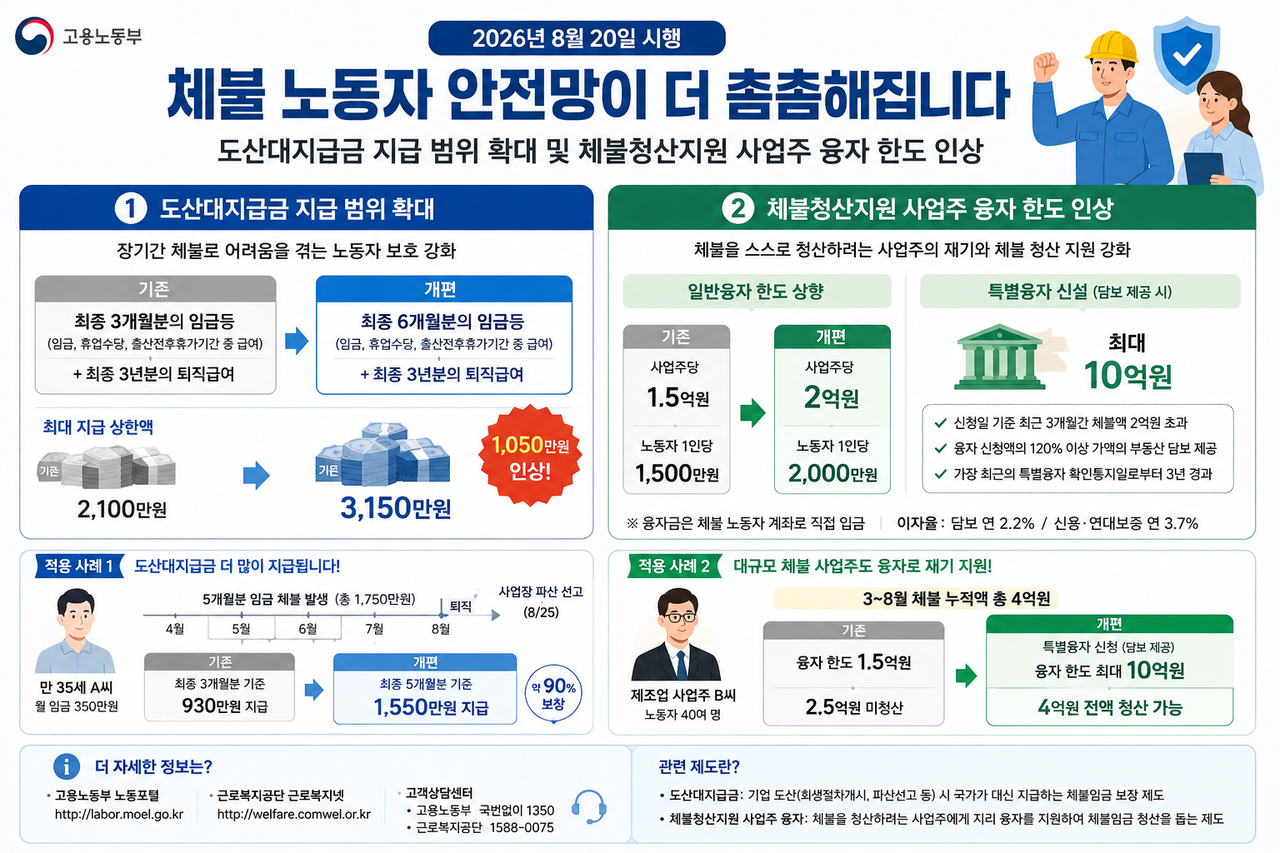
Under the previous rules, the state covered the final three months of unpaid wages, furlough allowances and maternity leave pay, along with the final three years of severance pay. Going forward, coverage for wages and related payments will extend to the final six months, doubling the guarantee period.
The maximum insolvency wage substitute payment will accordingly increase by 10.5 million won, from 21 million won to 31.5 million won. However, the actual amount paid will vary depending on age-bracket and monthly caps. Simplified substitute payments remain unchanged: up to 10 million won for former employees and up to 7 million won for current employees.
Under the old system, a 35-year-old worker owed 17.5 million won in unpaid wages — 3.5 million won a month over five months — whose company went bankrupt would have been eligible for only the final three months, receiving 9.3 million won after age-based caps were applied. Under the revised system, all five months are covered, allowing the worker to receive 15.5 million won and recover roughly 90 percent of the total amount owed.
Financial support for employers seeking to clear wage arrears will also be expanded.
The general loan ceiling under the arrears-clearance employer loan program will rise from 150 million won per employer to 200 million won. The per-worker loan limit will also increase, from 15 million won to 20 million won.
A new special loan of up to 1 billion won will also be introduced for employers with large-scale arrears. To qualify, an employer must have accumulated more than 200 million won in unpaid wages in the three months preceding the application date and must provide real estate collateral worth at least 120 percent of the loan amount requested, among other requirements.
Loan funds will be deposited directly into the accounts of workers owed wages. Interest rates are set at 2.2 percent per year for secured loans and 3.7 percent per year for unsecured or jointly guaranteed loans. General loans are capped at 200 million won per employer and special loans at 1 billion won, with a per-worker limit of 20 million won under each category.
The government expects the revamped system to help companies that have accumulated large-scale arrears due to deteriorating business conditions settle their debts. Once an employer applies for a loan, a loan agreement is drawn up within the scope of the outstanding arrears, and the funds are paid directly to the workers.
"While we will respond strictly to employers who withhold wages, we have significantly expanded both the insolvency wage substitute payment and the arrears-clearance employer loan system to protect workers owed wages," Minister of Employment and Labor Kim Young-hoon said. "We will continue to strengthen government support so that workers who did their jobs faithfully but were not paid what they were owed on time can rebuild their daily lives as quickly as possible."
fact0514@heraldcorp.com