![Samsung Electronics headquarters. [The Herald Business DB]](https://wimg.heraldcorp.com/news/cms/2026/08/13/news-p.v1.20260802.83cf703da3334750bc3e4dd1422898b0_P1.jpg)
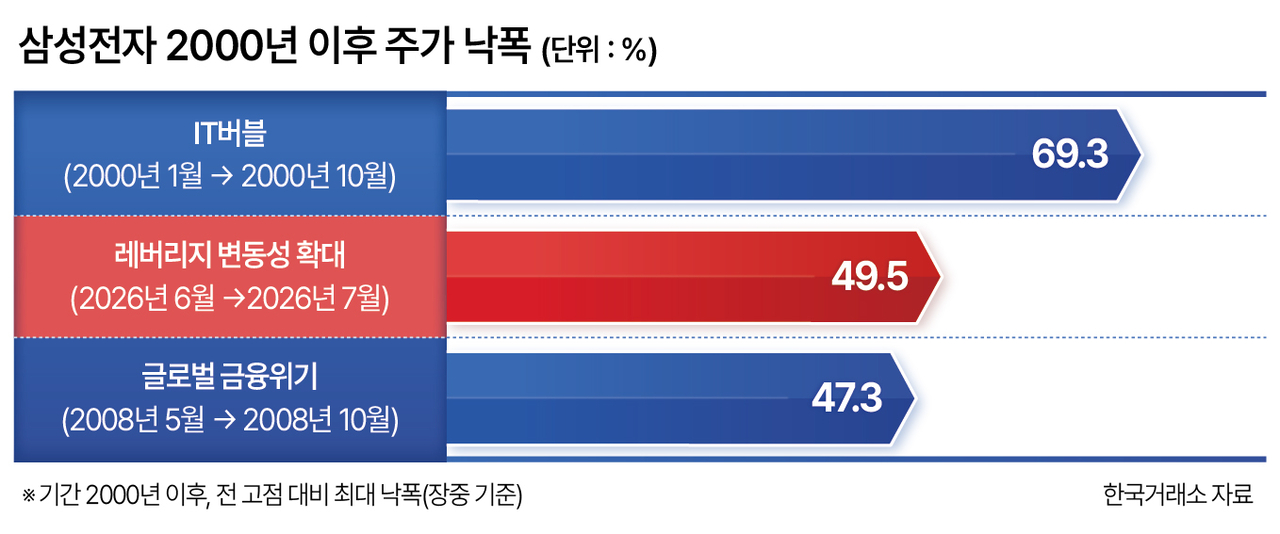
After Samsung Electronics' share price fell as much as 49.5% from its previous peak during intraday trading late last month, analysts have begun calling the bottom. The decline is the steepest correction since 2000, excluding the dot-com bubble. With the company's announced shareholder return expansion and improving expectations for the memory chip market, easing leverage-driven volatility is reinforcing forecasts of a rebound.
Samsung Electronics shares had been climbing steadily this year before hitting an all-time intraday high of 374,500 won ($265) on June 19. The stock then reversed course, falling as much as 49.5% from that peak by the end of last month. The only time the stock shed more than 50% from a prior high since 2000 was during the dot-com bubble, when it fell as much as 69.3% from its intraday peak on Jan. 4, 2000, through Oct. 13 of that year.
With the decline reaching exceptional levels, analysts say the current correction may be approaching a floor. Samsung Electronics' announced plans to expand shareholder returns are seen as a positive catalyst for the stock going forward. The company said Wednesday it is reviewing ways to expand shareholder returns and will disclose specifics soon.
Analysts say the company's annual shareholder return program, currently around 9.8 trillion won, could grow to more than 100 trillion won under the new policy. Kim Dong-won, head of research at KB Securities, said the new shareholder return policy expected to be announced soon "is likely to be more than 10 times larger than the current annual program." He added that total shareholder returns over the next three years could reach at least 600 trillion to 700 trillion won, with a cash dividend yield of 7 to 15 percent.
Beyond shareholder return expectations, the sustainability of AI investment is also a key factor in judging whether the correction has run its course. Nvidia recently announced it is building a financial platform with Apollo, BlackRock, Blackstone, Brookfield, Goldman Sachs and KKR to mobilize more than $500 billion in capital for AI infrastructure over the long term. While actual deployment of funds remains to be seen, the move raises confidence in the durability of AI investment, as major global financial institutions have begun participating in the large-scale fundraising needed to sustain AI expansion.
Since AI investment will shape future semiconductor demand, the memory chip supply outlook is directly tied to Samsung Electronics' earnings prospects. Some analysts say a memory chip supply shortage is likely to persist through 2027–2028. In a research note published July 31, Nomura analyst C.W. Chung said "the probability of a memory supply shortage materializing in 2027–2028 is quite high," adding that stronger-than-expected long-term supply agreements would reduce earnings volatility and business risk, lowering the risk premium the market demands.
Leverage-driven pressure that had amplified volatility in the domestic stock market is also stabilizing. Samsung Electronics shares swung from a single-day loss of as much as 13.4% to a gain of as much as 26.8% last month. After new margin lending for individual investors was capped at 30 million won per person starting July 31, daily price swings narrowed to single digits in August. Analysts say a significant portion of the leveraged positions built up during the sell-off has been unwound, easing near-term supply-demand pressure.
Historical patterns following sharp declines in Samsung Electronics shares also offer a reference point for judging whether the stock is near a bottom. Kim said that between 2000 and 2026, Samsung Electronics fell more than 40% from a prior peak on three occasions — by 47% in 2008, 47% again in 2022, and 44% in 2024 — and that in every case the stock rebounded one month, three months and six months after forming a bottom, with a maximum gain of 60%.

kacew@heraldcorp.com