
![A view of the Children's Garden site inside Yongsan Park in Yongsan-gu, Seoul, on Tuesday afternoon. [The Herald Business DB]](https://wimg.heraldcorp.com/news/cms/2026/08/20/news-p.v1.20260818.ce09a09faa7e48ee9f5c9c69ba3bb565_P1.jpg)
As the government weighs using parts of Yongsan Park — including the Children's Garden site — for housing supply, the Seoul Metropolitan Government has pushed back hard, drawing attention to the question of who actually holds the authority to move the project forward. Seoul has maintained a non-negotiable stance against housing inside Yongsan Park, and if the two sides cannot agree on the scale and direction of development, whether the government will pursue a legislative amendment through the National Assembly is also drawing scrutiny.
Article 4 of the current Yongsan Park Act stipulates that the entire main base site shall in principle be developed as Yongsan Park, and prohibits changing the use of the main site for non-park purposes or selling it.
The government has acknowledged these legal constraints. Kim I-tak, first vice minister of the Ministry of Land, Infrastructure and Transport, said in a radio appearance in January that apartment construction on the Yongsan Park site "cannot happen without a legal amendment."
If the National Assembly amends the special act to allow part of the main site to be used for housing, however, the balance of authority would shift.
Under current law, core planning authority over Yongsan Park is concentrated in the Ministry of Land, Infrastructure and Transport. The minister sets and revises the Yongsan Park improvement zone, the comprehensive master plan and the park development plan, and also serves as the park management authority. While the minister must consult with relevant agencies including the Seoul mayor and go through a review by the Yongsan Park Development Promotion Committee when establishing or revising the park development plan, no provision requires separate consent or approval from the Seoul mayor.
The ministry's authority is equally strong at the project implementation stage. Implementation plans drawn up by project operators must receive the minister's approval. Once the ministry completes consultations with relevant administrative agencies in that process, the approved implementation plan is deemed to carry the force of related permits, including building permits.
A Seoul city official said that because special acts take precedence over general law, "there is in effect no means for Seoul to put the brakes on" if the government pursues housing supply under a special act. The official added, however, that "it is still a problem that Seoul is being excluded from discussions and the process of pushing the special act forward."
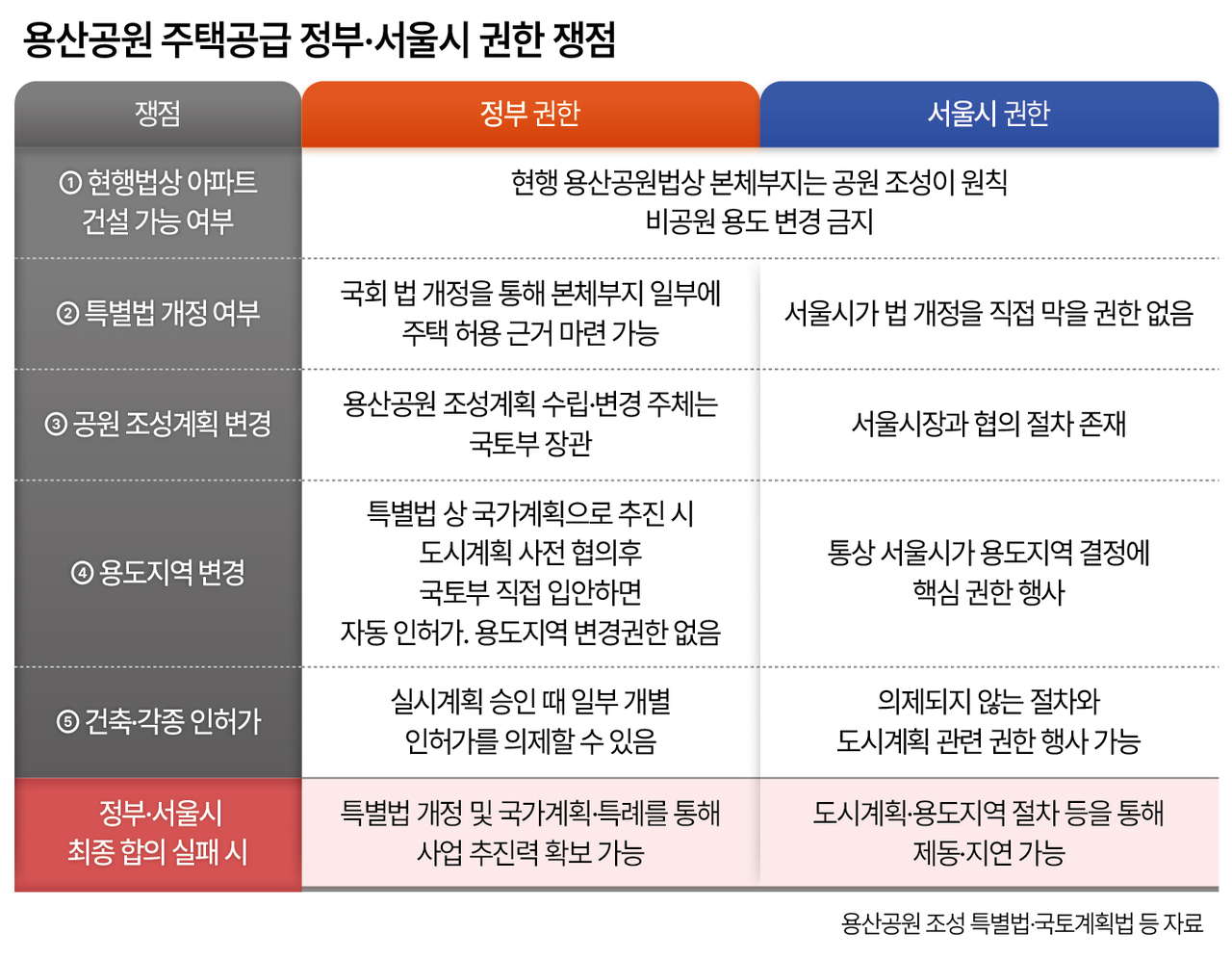
Amending the special act would not, however, resolve all legal disputes with Seoul. The most prominent variable is zoning.
Article 14 of the Yongsan Park Act provides that when the minister of land announces a park development plan, matters that would otherwise require a decision under an urban and county management plan are deemed decided and announced simultaneously. Zoning designation and changes under the National Land Planning Act are explicitly excluded from this deemed-approval mechanism. If a zoning change is needed to permit housing construction, a separate urban and county management plan procedure would have to be followed.
Under the National Land Planning Act, the authority to designate or change zoning rests with the minister of land and metropolitan or provincial governors, among others. Ordinarily, the Seoul mayor initiates urban and county management plans for areas under the city's jurisdiction. When plans are "related to a national plan," however, the minister of land may initiate them directly — in which case the minister must still hear the opinions of the Seoul mayor and others and go through a review by the Central Urban Planning Committee.
Whether Seoul could block the project simply by opposing a zoning change — if housing supply at Yongsan Park were formalized as a national-level project through a legal amendment and pursued in a manner qualifying as a national plan under the National Land Planning Act — would itself become a separate legal question. Conversely, if the government fails to meet the conditions for direct initiation or does not include a separate special provision in the amended law, Seoul's urban planning authority would remain a critical variable.
Ultimately, how the amended law is designed will determine the balance of authority going forward. If the revision does no more than lift the ban on housing construction on the main site while leaving the existing urban planning and permitting framework intact, Seoul and Yongsan-gu would retain considerable influence.
An amendment to the Yongsan Park Act has been mentioned as a possible item for a plenary session vote that day. The bill currently pending in the Assembly, however, is not legislation aimed at building apartments around the Children's Garden. The amendment that cleared the Assembly's Land, Infrastructure and Transport Committee in May would allow parks to be developed in phases starting from already-returned sites, strengthen environmental management requirements, and flexibly apply park and green-space standards to "mixed-use development zones" such as Camp Kim to expand housing supply.
Meanwhile, as the debate over housing supply at Yongsan Park has intensified, some within the ruling camp are said to be considering a separate public opinion survey before pressing ahead with the policy.
Seo Jin-hyung, a professor in the real estate law department at Kwangwoon University, said supplying housing at Yongsan Park "would require amending or repealing the law under the current legal framework," but added that "if Seoul does not cooperate on urban planning or zoning changes, the project could become difficult to advance, and Yongsan-gu also has a role in administrative procedures such as project plan approval and building permits."
He added that "it can be a significant burden in practice for a local government to block central government policy through administrative procedures," and forecast that "even if the law is amended, the path to actual development will not be easy, given the complex interplay of soil contamination cleanup costs, questions of US military liability, and controversy over legal consistency."
Environmental issues are another variable that will affect the timing of any housing supply. The pending amendment itself reflects criticism that environmental cleanup and hazard-reduction measures were inadequate during the temporary opening of the former US military base, and includes provisions to strengthen environmental management obligations for returned sites. Even after a target site and scale for housing construction are determined, environmental surveys, soil remediation and related plan revisions would all be required — meaning ground-breaking within a short timeframe would not be straightforward.
quq@heraldcorp.com
lucky@heraldcorp.com





