
![President Lee Jae Myung shakes hands with Supreme Court Chief Justice Jo Hee-dae at the 107th March 1 Independence Movement Day ceremony held at COEX in Gangnam-gu, Seoul, on March 1. [Yonhap]](https://wimg.heraldcorp.com/news/cms/2026/08/20/rcv.YNA.20260301.PYH2026030102740001300_P1.jpg)
Calls to impeach Supreme Court Chief Justice Jo Hee-dae are flaring up again within the ruling camp, this time over his decision to submit written nominations for two Supreme Court justices. The Democratic Party of Korea has escalated its attacks, accusing Jo of bypassing President Lee Jae Myung by breaking with the longstanding practice of meeting the president in person before forwarding nominees.
Because there was no precedent for a written nomination without a face-to-face meeting, the ruling camp's backlash was entirely foreseeable — and even within the judiciary, some voices describe Jo's decision as an unfortunate choice that handed critics more ammunition to attack the entire court system.
Yet legal experts and constitutional scholars argue that Jo was exercising a nomination power explicitly granted by the Constitution and statute, making the impeachment calls from the ruling camp an overreach. Critics also question the "customary consultation" practice itself, arguing that private meetings between the chief justice and the president to discuss nominees amounted to opaque, behind-closed-doors personnel decisions — not a procedure worthy of being called a respected convention.
Prof. Han Sang-hee: 'Has the public ever been told what was discussed? The term "opaque appointments" barely does it justice'
Han Sang-hee, an emeritus professor at Konkuk University School of Law, posted a lengthy comment on his Facebook account Wednesday night, asking: "On what political principle does one stand to call it a protected 'consultation' — in this 'democratic society' — when Supreme Court justices who will shape the daily lives of the people are appointed through back-room exchanges among insiders, with no one, meaning the public, knowing anything about it?"
Han said that public institutions pursuing the common good are naturally obligated to consult and coordinate with one another to find the best outcome, even before invoking constitutional arguments, and that Chief Justice Jo's conduct deserved every bit of criticism it received. At the same time, he said, it was equally hard to overlook the ruling camp's loud condemnation of Jo simply for not consulting the president.
He then argued that allowing the chief justice to nominate Supreme Court justices unilaterally — rather than requiring the consent of a judicial recommendation council — dated back to the notorious Yushin Constitution, calling it "a remnant of that era." He said the nature of the "consultation" between the chief justice and the president under that system was self-evident, and that the current Constitution had carried the arrangement forward, adding only a National Assembly consent clause, thereby entrenching an imperial chief justice system with the president as its silent backer.
Han asked whether the so-called "customary consultation" was simply the chief justice and the president trading names behind closed doors and settling on a candidate — and whether the substance and process of those consultations had ever been disclosed to the public.
He went further, asking whether the public had ever been told whether a newly appointed justice was "the president's pick or the chief justice's pick," or whether either party to the consultation had ever once acknowledged responsibility for a justice who issued a questionable ruling. "In a word," he said, "the term 'opaque appointments' barely did it justice."
Han said Jo may have snubbed the president, but the years of "consultation" and "custom" had continuously snubbed the entire Korean public. "The public's right to know, their interest in the process, their right to monitor and check the exercise of state power — all of that was left to rot in the background while insiders ran their own private league, built their own back-room customs, and did nothing but squabble over who played by the rules," he said.
Ruling camp intensifies attacks on Jo, revives impeachment talk; legal community says 'not grounds for impeachment at all'
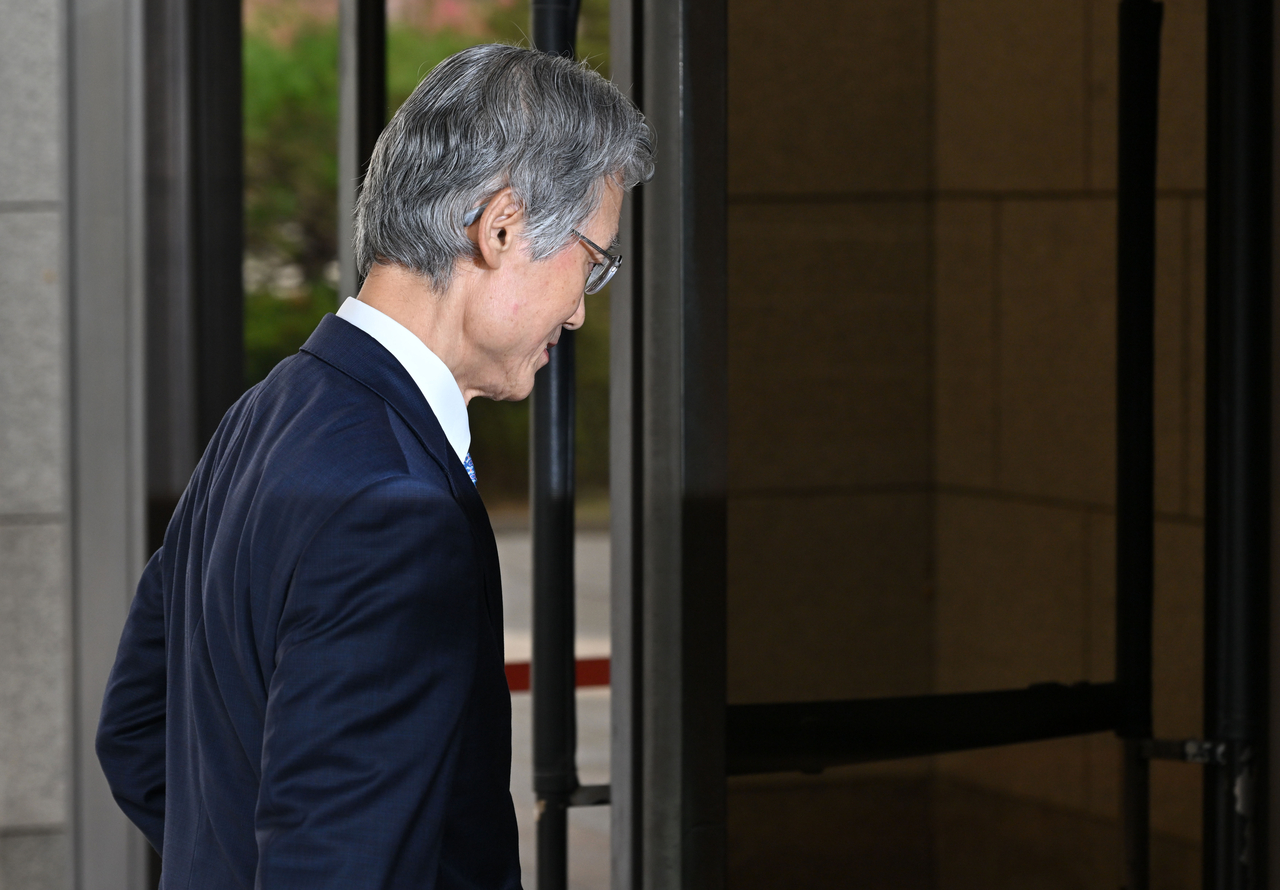
The ruling camp has unleashed a barrage of criticism at Jo. At the Democratic Party's supreme council meeting Wednesday — the first held after news of the written nomination broke Tuesday — calls for Jo to step down were repeated. Supreme council member Rep. Choi Min-hee said Jo's nomination, which bypassed Cheong Wa Dae, was "an act beyond imagination and beyond tolerance that fills me with rage," adding that "the chief justice and the judiciary must face the public's judgment" and that the National Assembly should immediately begin discussing Jo's future, including the possibility of impeachment.
The Democratic Party has been locked in a confrontation with Jo and the judiciary since the Supreme Court's en banc panel last year overturned President Lee's acquittal on Public Official Election Act charges and remanded the case with instructions to convict. In March, the party pushed through what it called three judicial reform bills — introducing a system of constitutional appeals against court rulings, expanding the number of Supreme Court justices, and creating a new offense of judicial distortion — over strong objections from the judiciary.
Analysts say, however, that the Democratic Party would find it difficult to actually pursue impeachment against Jo. Even if the party, which holds 161 seats, were to pass an impeachment motion in the National Assembly, the Constitutional Court would in effect have no basis to order Jo's removal from office — and the party cannot ignore the risk of a political backlash. The Constitutional Court has established, through presidential impeachment cases and others, that removal requires a finding that the official violated the Constitution or statute in the course of carrying out official duties, and that the violation must be serious.
In Jo's case, the legal and academic communities are united in saying he committed no legal violation — he simply submitted his nominations in writing rather than in person, a lawful exercise of his constitutional and statutory authority. Both the Constitution and the Court Organization Act state that Supreme Court justices are appointed by the president upon the recommendation of the chief justice and with the consent of the National Assembly.
Jeon Hak-seon, a professor at Hankuk University of Foreign Studies School of Law, said the written nomination was "not grounds for impeachment at all," asking what constitutional violation Jo had committed. Jo Yong-hyeon, a lawyer at law firm Class Hankyul and a former senior judge at Seoul High Court, said it was "excessive" to treat a departure from past practice as a legal problem or grounds for impeachment, adding that "there is no issue whatsoever under the constitutional provisions, and the argument that this is an opportunity to break free from an outdated custom is also valid."
The Supreme Court announced Wednesday afternoon that Chief Justice Jo had, under Article 104, Paragraph 2 of the Constitution, formally nominated Son Bong-gi, a senior judge at Daegu District Court, as the successor to Justice Noh Tae-ak, who is retiring upon the expiration of his term, and Kim Seong-su, a senior judge at Seoul High Court, as the successor to Justice Lee Heung-gu, who is also retiring. The Supreme Court and Cheong Wa Dae are said to have reached agreement on Kim but not on Son.
The search for a successor to Justice Noh, who retired in March, had been deadlocked between the Supreme Court and Cheong Wa Dae for months. A judicial nomination advisory committee had narrowed the field to four candidates in January and forwarded them to Jo, but no nomination followed — sources said the court and the presidential office each had a different first choice and could not agree. Months passed without the gap narrowing, and it was against that backdrop that news of the written nomination emerged.
The Supreme Court, however, maintains that it had been in continuous consultation with Cheong Wa Dae throughout.
Noh Gyeong-pil, the court administrator and a sitting Supreme Court justice, told the National Assembly's Legislation and Judiciary Committee on Wednesday that the court had kept up consultations with Cheong Wa Dae on the successor to Justice Noh until the very end. When Democratic Party lawmaker Kim Yong-min asked whose idea it was to proceed with a written nomination rather than a face-to-face meeting, Noh said: "To be precise, there was no opportunity for a meeting. We requested one, but it did not happen."
Courts grow more subdued as tensions with ruling camp persist; some judges say better coordination was needed
With the judiciary's already strained relationship with the ruling camp showing no sign of easing, the written nomination controversy has deepened the sense of unease within the courts.
One senior judge said there was "a lingering sense of regret" over the episode, noting that a written nomination without a face-to-face meeting was without precedent and was bound to expose the conflict openly. "This was something that needed a bit more coordination between the two sides," the judge said.
At the same time, other voices within the judiciary say the chief justice's decision is not entirely incomprehensible, given that the vacancy on the Supreme Court could not be left unfilled indefinitely.
Another senior judge said it was hard to see what other option the chief justice had. "Was there really any alternative?" the judge asked.
The same judge added that the underlying problem was one for the legislature to fix through statutory reform. "Each side exercises its own authority, and checks and balances are supposed to work through that process — but I do wonder whether it should have been done this way from the outset," the judge said.
dandy@heraldcorp.com
bell@heraldcorp.com





