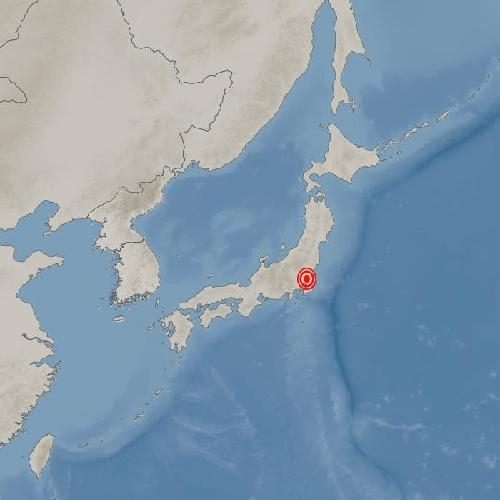
A magnitude 5.9 earthquake struck southern Ibaraki Prefecture in southeastern Honshu, Japan, early Sunday, sending strong tremors across Tokyo and the surrounding metropolitan area.
According to the Japan Meteorological Agency, the quake struck at around 2 a.m. and originated at a depth of approximately 68 kilometers. No tsunami warning was issued.
Ibaraki, Saitama and Chiba prefectures, as well as Adachi Ward in Tokyo, recorded a maximum seismic intensity of lower 5 on the Japan Meteorological Agency scale.
An intensity of lower 5 is strong enough that most people feel fear, and objects such as dishes on shelves or books in bookcases can fall.
According to NHK, it was the first time in about five years that seismic intensity of lower 5 or higher had been recorded in Tokyo's 23 wards — the last occurrence being a magnitude 5.9 earthquake that struck northwestern Chiba Prefecture on Oct. 7, 2021.
An intensity of 4 was recorded in Tokyo's Chiyoda and Setagaya wards, Naka Ward in Yokohama, Urawa Ward in Saitama, Chuo Ward in Chiba, and Utsunomiya in Tochigi Prefecture.
Parts of Fukushima and Gunma prefectures also registered intensity 4, while Miyagi, Niigata, Yamanashi, Nagano and Shizuoka prefectures recorded intensity 3.
Long-period ground motion — slow, prolonged swaying that particularly affects high-rise buildings — was observed at class 2 levels in Tokyo's 23 wards, Saitama Prefecture and Chiba Prefecture. At class 2, occupants of tall buildings can feel strong swaying and may need to hold onto nearby objects to move around.
Sakai Shinichi, a professor at the University of Tokyo's Earthquake Research Institute, told NHK that southern Ibaraki is a region with consistently high seismic activity. He added that the relatively deep focus of the quake allowed strong shaking to spread across a wide area.
The Japan Meteorological Agency warned that another earthquake of up to lower 5 intensity could occur within the next week and urged the public to remain prepared for aftershocks.
No abnormalities have been detected at nuclear power plants. The Fukushima No. 1 and No. 2 nuclear power plants and related facilities showed no irregularities as a result of the quake.
There were some injuries. In Sagamihara, Kanagawa Prefecture, a woman in her 60s fell on a staircase during the shaking and was injured.
The Japanese government set up an emergency response office at the prime minister's crisis management center immediately after the quake to assess damage across the country.
The risk of secondary damage is a particular concern in areas that have recently experienced heavy rainfall. The Japan Meteorological Agency warned that parts of Chiba Prefecture, which received record rainfall, have weakened ground conditions, making landslides and slope collapses a serious risk following the earthquake.
On Saturday, parts of the greater Tokyo area including Itabashi Ward received more than 120 millimeters of rain per hour, and Japanese authorities are closely monitoring the situation for any additional ground damage in the wake of the quake.
go@heraldcorp.com