Nearly one in two children living in Seoul's residential care facilities has been found to struggle with borderline intellectual functioning, attention deficit hyperactivity disorder (ADHD), depression, anxiety or other emotional and behavioral difficulties. The Seoul Metropolitan Government, concluding that basic counseling and short-term treatment alone are insufficient, plans to build a comprehensive child protection system linking early detection through specialized treatment, recovery and follow-up care.
The city announced Sunday that starting in 2027 it will restructure its child welfare center into a metropolitan-level child protection control tower encompassing intensive treatment for high-risk children, public adoption services, child abuse response and temporary protective custody.
As of 2025, 719 of the 1,497 children living in Seoul's residential care facilities — 48 percent — were identified as experiencing emotional or behavioral problems including borderline intellectual functioning, ADHD, depression and anxiety. Even as the overall child population declines, psychological and emotional difficulties among children in care remain persistent, the city said, making a support system that connects early detection to specialized treatment and stable recovery essential.
Practitioners in the field say it is important to look beyond a child's behavior and understand the underlying causes and needs, rather than simply labeling the behavior a "problem."
A facility worker who used Seoul's hub psychological support service said, "I used to think a child's behavior was dangerous and problematic, but now I understand it as a signal that they are struggling and I look into what needs they might have." The worker added that after counseling, the child's daily life had stabilized and positive changes had appeared in peer relationships.
There have also been cases in which children with developmental delays received regular psychological services to monitor their play development and adjustment, helping them settle into new facilities and peer relationships.
District-based mental health treatment network to cover children, staff and caregivers
To meet this demand from the field, Seoul will expand its hub psychological treatment center — currently operating at a single child welfare center — to four locations across the city's districts. Three additional psychological counseling centers will be designated on top of the existing one, with plans to provide specialized psychological services to children and their families from the abuse investigation and assessment stage onward.
Children experiencing ADHD, depression, anxiety, or developmental, emotional and behavioral difficulties will be connected to programs tailored to their needs, including play therapy, art therapy, emotional coaching and social skills training.
The city will also address the problem of support being cut off after treatment ends. The Seoul Children's Healing Center in Dongdaemun-gu currently runs a residential treatment program called T-CARE for children aged 10 to 17 who require intensive care for ADHD, depression or anxiety, with each cohort receiving six months of live-in therapeutic support.
Going forward, Seoul will continuously monitor how children adjust after leaving the center and returning to their original care facilities, and will connect them to additional psychological treatment if needed.
A new two-night, three-day residential "Mind Healing Camp" will also be introduced to support emotional recovery and peer relationship building. The program goes beyond simple rest activities, focusing on helping children develop the ability to regulate their emotions and form healthy relationships with peers.
The scope of support will extend beyond children to include facility staff and caregivers. The city will introduce an integrated support model called CARE-ONE, providing facility workers with psychological assessments, expert consultation, burnout prevention and empathy-building programs.
The model ensures that staff handling complex cases are not left to make difficult judgments alone, connecting them instead with expert consultation, psychological counseling and peer support programs.
A "Seoul-type Caregiver Mental Health Counseling Room" will also be operated for parents and foster parents. It will offer step-by-step support linking self-assessment, parenting coaching and both online and in-person counseling, aimed at reducing parenting stress and fostering a healthy caregiving environment.
Public adoption and abuse response to be integrated; sibling separation in protective custody to be addressed
Public adoption support will also become a core function of the child welfare center. A July 2025 overhaul of the public adoption system shifted domestic and international adoption services from a privately led model to one centered on public institutions — including the Ministry of Health and Welfare, local governments and the Child Rights Guarantee Agency — but practitioners have continued to raise concerns about insufficient information before and after adoption, procedural delays and inadequate follow-up care.
In response, Seoul will establish an integrated adoption and foster care service. The system will connect pre-adoption procedures — including consultations with prospective parents, education and document preparation — through to post-adoption child development management, parenting support and self-help groups for adoptive families, all within a single framework.
In the area of child abuse response, the city will focus on reducing disparities across districts. Case review meetings on child abuse are currently held at the district level, but concerns have persisted that differences in staffing and specialist resources lead to uneven response capacity across areas.
The child welfare center will support district offices, child protection agencies and shelters for abuse victims in handling complex cases through solution conferences and supervision. Practical conferences for frontline workers and emotional recovery programs for staff will also be offered.
The city will also address the problem of siblings being sent to separate facilities based on age during the child protection process. Currently, infants and toddlers are placed in temporary care at the child welfare center, while children and adolescents from elementary school age up to 18 are housed at the Seoul Children's Blue Center.
Last year, a 10-year-old and a 5-year-old sibling separated from their parents due to abuse were placed in different facilities — the older child at the Seoul Children's Blue Center and the younger at the child welfare center — solely because of the age criteria.
Seoul will consolidate temporary protective custody under the Seoul Children's Blue Center and launch an integrated, all-ages temporary care system from January 2027. To that end, the city plans to set up a dedicated living space for infants and toddlers at the center and expand staffing within this year.
The child welfare center opened in 1963 and was renamed in 1965 as Seoul's first municipal child counseling center. It has since handled child protection work across the city, including abuse reporting and investigation, professional counseling and psychological treatment.
The overhaul expands the center's role beyond the protective functions it has carried out for more than 60 years, repositioning it as a metropolitan child protection hub encompassing prevention, treatment, recovery and follow-up care.
Ma Chae-suk, head of the Seoul Metropolitan Government's Women and Family Bureau, said, "Through improvements to the child welfare center's functions, Seoul will take the lead in advancing the public protection system by one step so that not a single child is left behind." She added, "We will do everything in our power to build a Seoul where children are happy — paying close attention not only to their safety and healthy growth, but also to the frontline workers and caregivers who support them."
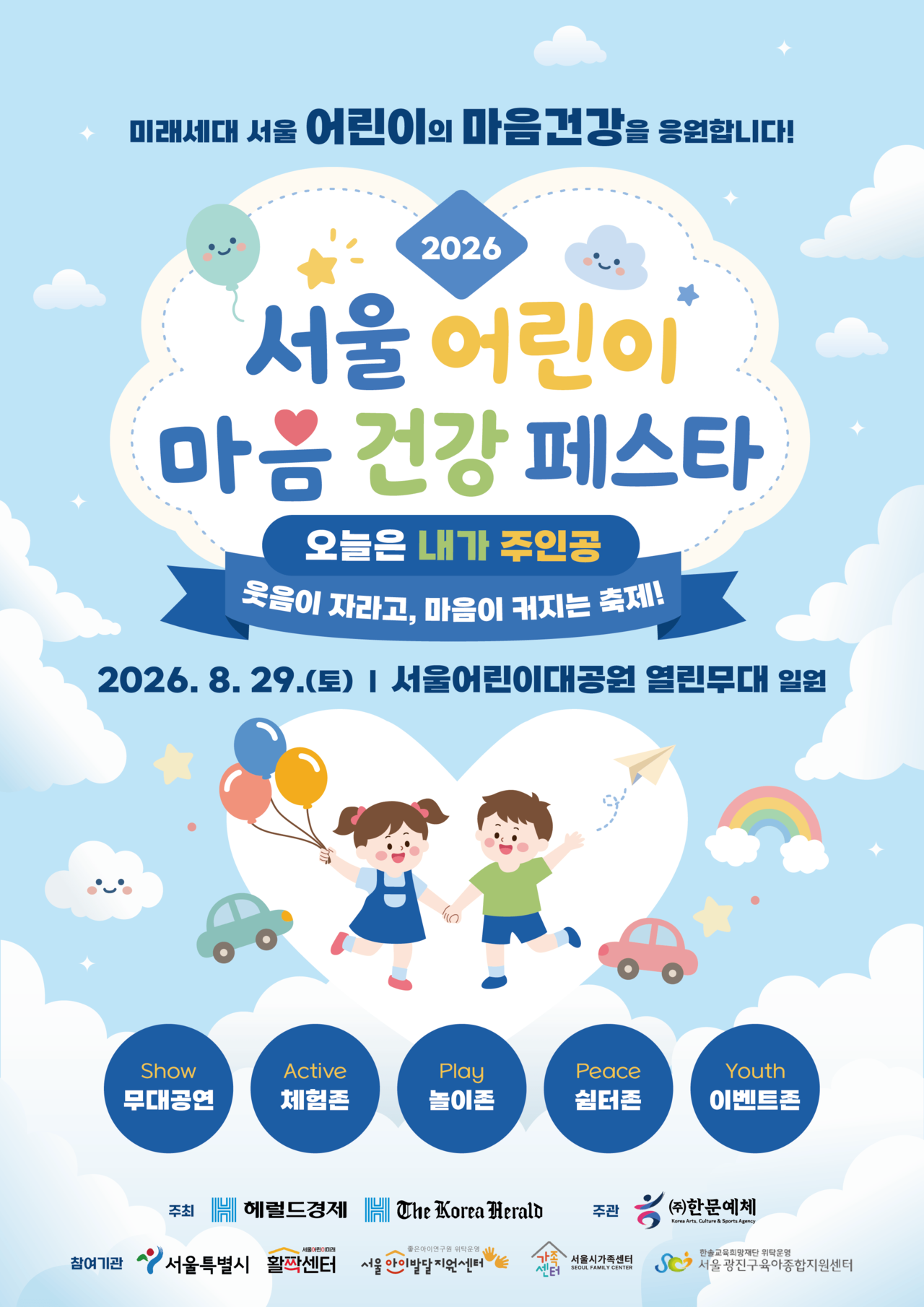
'Seoul Children's Mental Health Festa' to offer mind-recovery and emotional-regulation programs at Seoul Children's Grand Park
Meanwhile, the 2026 Seoul Children's Mental Health Festa will be held Saturday at the open-air stage area of Seoul Children's Grand Park to support children's emotional health and well-being. Organized by Herald Media Group and co-hosted by the Seoul Metropolitan Government, the Seoul Children's Future Bright Center, the Seoul Child Development Support Center, the Seoul Family Center and the Gwangjin-gu Comprehensive Childcare Support Center, the event is themed "Today, I Am the Star."
The festival is designed as a preventive event to check on children's mental health and help them build emotional resilience in everyday life. A range of participatory programs covering stress relief, emotional regulation, mind recovery and peer relationship building will be offered so children can naturally express and understand their own emotions through play and hands-on activities. Parents and caregivers will also receive counseling and educational information to help them understand their children's emotional state and learn healthy communication skills.
The event places particular emphasis on dispelling prejudice against children with emotional and behavioral difficulties, identifying mental health issues early and connecting children to appropriate counseling and professional support. Beyond a one-time event, it reflects Seoul's commitment to broadening the foundation for integrated support involving children, families, specialist agencies and the community, and to expanding children's mental health policy from a treatment-centered approach toward prevention and early intervention.
Special performances will include a Seoul Children's Traditional Music and Folk Games Festival and a Seoul Fusion Gugak Festival. A variety of stages have been arranged so children can encounter traditional Korean culture and the lively rhythms of gugak, relieving stress through performance and play and finding emotional stability and vitality.
The festival runs from 9:30 a.m. to 5 p.m. Saturday and is free and open to all.
7toy7@heraldcorp.com