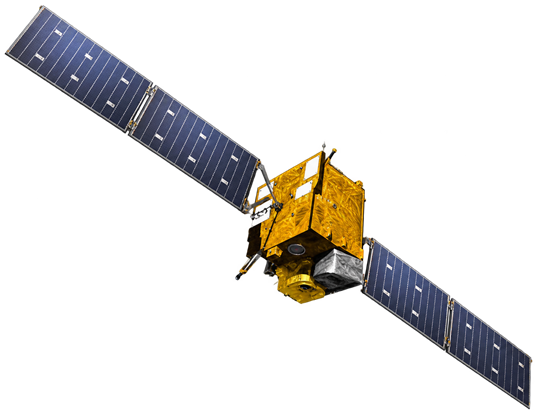
South Korea will invest about 770 billion won ($557 million) to develop Chollian-6, a next-generation geostationary satellite that will monitor atmospheric and marine conditions over the Korean Peninsula and surrounding waters. The satellite will carry more observation channels and higher resolution than the currently operating Chollian-2B, giving the country a sharper "eye in space" to track fine dust, red tides, oil spills and other environmental changes.
The Ministry of Oceans and Fisheries, Korea AeroSpace Administration (KASA) and the Ministry of Climate, Environment and Energy announced Tuesday that their jointly planned Geostationary Environmental and Maritime Satellite (Chollian-6) Development Project had passed a national research and development preliminary feasibility review.
Chollian-6 will take over the atmospheric and marine observation mission of Chollian-2B, which was launched in 2020. Development will begin next year and run for seven years, with a 2033 launch target. Total project costs are estimated at about 770 billion won.
The new satellite will expand its observation channels and improve resolution compared with its predecessor. On the atmospheric side, it will monitor fine particulate matter and ground-level ozone harmful to human health, as well as the atmospheric impact of disasters such as wildfires.
For marine observation, it will track changes in ocean conditions — including red tides, oil spills and low-salinity water intrusions — with greater precision. The data will help relevant agencies respond more quickly to deteriorating air quality or maritime disasters and support public safety.
The project will also push to domestically develop key geostationary satellite payloads that have long depended on foreign suppliers. Plans call for building the environmental and maritime payloads at home and securing a hybrid propulsion system combining chemical and electric propulsion, along with technology for simultaneous observation by both payloads. The government said the effort will raise South Korea's technological self-reliance in geostationary satellites and strengthen its foothold in overseas markets.
Once Chollian-6 takes over the mission, continuous ocean observation around the Korean Peninsula — begun with Chollian-1 — will extend to more than 30 years. The long-term accumulated data are expected to inform maritime and fisheries policy decisions and support climate change response.
The Ministry of Oceans and Fisheries, KASA and the Ministry of Climate, Energy and Environment plan to draw up detailed project plans and proceed with follow-up steps, including securing a budget and selecting research and development institutions.
Jang Myo-in, head of the Korea Hydrographic and Oceanographic Agency, said the data gathered over more than 30 years of continuous ocean observation — from Chollian-1 through Chollian-6 — "will serve as core material for maritime and fisheries policy decisions and climate change response." He added that the agency would use Chollian-6 "to more accurately understand environmental changes in our seas and support maritime disaster response and the safe marine activities of the public."
adastra@heraldcorp.com