
![A traditional market [Herald DB]](https://wimg.heraldcorp.com/news/cms/2026/08/25/news-p.v1.20260503.570c1986eaa6496c9ff267f1352eb151_P1.jpg)
South Korean business sentiment has turned positive for the first time in six months, with domestic demand confidence returning to the baseline for the first time in four years and three months — a sign that the economic recovery is spreading from a handful of sectors to the broader economy.
The Federation of Korean Industries said Tuesday that its Business Survey Index for September came in at 102.0, based on a survey of the country's 600 largest companies by sales conducted from Aug. 6 to Aug. 13. The reading marks the first time the index has crossed the 100 baseline in six months, since it posted 102.7 in March — before the outbreak of the US-Iran crisis. A BSI above 100 means more companies expect conditions to improve compared with the previous month than those expecting a deterioration.
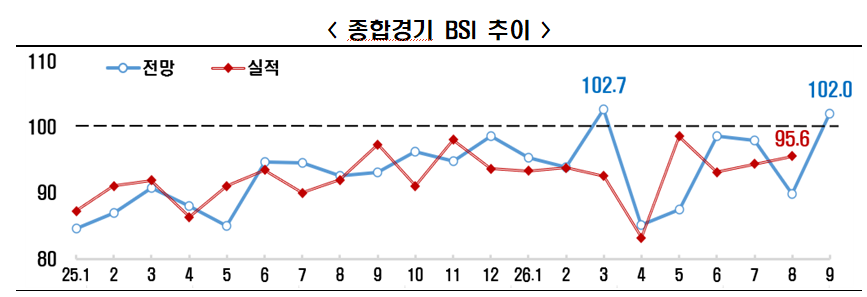
Both manufacturing and non-manufacturing sectors turned positive simultaneously. The September manufacturing BSI rose 13.3 points to 101.7 from 88.4 the previous month, while the non-manufacturing index climbed 10.9 points to 102.4 from 91.5. It is the first time both sectors have posted positive readings at the same time since October 2021 — nearly five years ago.
Within manufacturing, pharmaceuticals posted the highest outlook at 125.0. Six other sub-sectors also came in above the baseline: wood, furniture and paper (116.7); textiles, apparel, leather and footwear (115.4); non-metallic materials and products (114.3); automobiles and other transport equipment (109.7); and general and precision machinery and equipment (109.5). Electronics and communications equipment came in exactly at 100.0.
On the negative side, food, beverages and tobacco (77.8), petroleum refining and chemicals (92.0), and metals and metal products (92.6) all remained below the baseline. The FKI noted that unlike the previous recovery phase — which was concentrated in a few key sectors such as semiconductors and healthcare — the improvement this time has spread to a wider range of industries, including parts and materials. The group attributed part of the shift to a recent stabilization in the won-dollar exchange rate, which eased concerns about the cost of imported raw materials and components and the burden of foreign-currency payments.
In non-manufacturing, wholesale and retail posted an outlook of 115.6, while transportation and warehousing came in at 104.2, both reflecting expectations of stronger consumer spending and logistics demand ahead of the Chuseok holiday. However, professional, scientific and business support services (91.7), leisure, accommodation and food service (92.3), utilities (94.1) and construction (97.6) all remained below the baseline.
A particularly notable development was the recovery in domestic demand sentiment after a prolonged slump. The September domestic demand BSI reached 100.3 — the first time it has cleared the 100 baseline since June 2022, when it stood at 102.2, ending a gap of four years and three months. The exports BSI also held at 100.9, maintaining a reading above 100 for four consecutive months since June. The FKI said the easing of exchange rate pressures and Chuseok holiday demand had lifted domestic sentiment.
The investment outlook index remained below the baseline at 98.3, but reached its highest level since July 2022 — a gap of four years and two months. Financial conditions came in at 94.5, while employment and profitability each stood at 97.7, indicating that companies remain cautious about their overall operating environment.
"It is encouraging that the improvement in business sentiment, which had been confined to exports and semiconductors, is now spreading to domestic demand and a wider range of industries," said Lee Sang-ho, head of the FKI's economic division. He added that institutional support — including expanding the scope of domestic production tax credits and enacting a basic law for the development of the service industry — would be needed to ensure the improvement in business sentiment translates into actual investment and consumption.
go@heraldcorp.com





