FKI's October BSI outlook falls to 98.6
Index dips below baseline after surpassing it for first time in 6 months
Middle East tensions, global rate hike moves weigh on corporate mood
Group calls for labor exemptions in mega special zones to lift sentiment
![A cargo ship is anchored in the Strait of Hormuz near Bandar Abbas, Iran, on Sept. 6 (local time). [AP]](https://wimg.heraldcorp.com/news/cms/2026/09/28/news-p.v1.20260927.8cf5f898bdbd4f1586908484d28592ca_P1.png)
Business sentiment among South Korea's major companies has turned negative again within a month, as raw material price instability from heightened Middle East tensions and moves toward global interest rate hikes weigh on corporate confidence.
The Federation of Korean Industries said Monday its Business Survey Index for October came in at 98.6, based on a survey of the country's 600 largest companies by sales. The September BSI outlook had reached 102.0 — the first time the index had surpassed the baseline of 100 in six months, since the March reading of 102.7 taken before the outbreak of the US-Iran crisis.
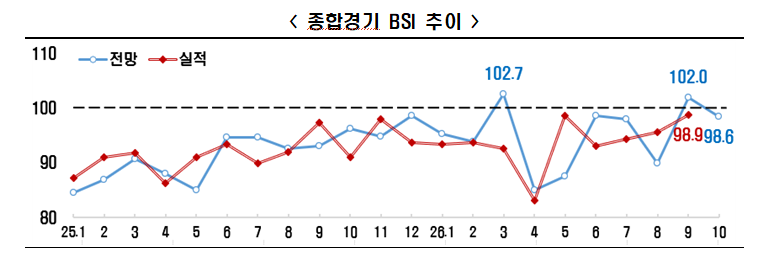
The September BSI performance reading came in at 98.9, marking 56 consecutive months below the baseline since February 2022.
By sector, manufacturing and non-manufacturing outlooks diverged. The October manufacturing BSI fell to 95.6 from 101.7 the previous month, slipping back into negative territory. Non-manufacturing, by contrast, held at 101.8 — above the baseline for a second consecutive month after September's 102.4.
Among manufacturing subsectors, metals and metal products posted an outlook of 107.7 and automobiles and other transport equipment came in at 106.1, both signaling positive expectations. Non-metallic materials and products, along with electronics and communications equipment, each landed exactly at the 100 baseline. Six other subsectors fell below it: pharmaceuticals (75.0), wood, furniture and paper (83.3), food and beverages and tobacco (84.2), textiles, apparel, leather and footwear (84.6), petroleum refining and chemicals (85.2), and general and precision machinery and equipment (95.0).
The FKI attributed the positive metals outlook to growing demand from the shipbuilding industry, while noting that the food and beverage sector was feeling the drag of fading holiday-season demand and that petroleum refining and chemicals continued to struggle amid rising oil prices and oversupply.
In non-manufacturing, wholesale and retail posted the highest reading at 108.5, followed by professional, scientific, technology and business support services at 108.3, and utilities at 105.6. Construction (95.3) and transportation and warehousing (95.5) both fell below the baseline. The FKI said easing import price pressures and expectations of a domestic demand recovery contributed positively to non-manufacturing sentiment.
By component, domestic demand and exports moved in opposite directions. The domestic demand BSI came in at 101.4, staying above the baseline for a second consecutive month after last month's 100.3. The export BSI, however, slipped to 99.7, turning negative for the first time in five months since May.
The FKI said the recent strengthening of the won has hurt export-oriented companies by eroding price competitiveness and generating foreign-currency translation losses, while benefiting domestic-demand-focused companies by lowering the cost of imported raw materials, components and foreign-currency payments.
The employment BSI rose to 100.3, turning positive for the first time in 49 months since September 2022. Investment (97.4), profitability (97.7) and liquidity (98.3), however, all remained below the baseline. The inventory BSI came in at 102.9 — a reading above 100 for inventory signals excess stock and is interpreted negatively.
"There is a risk that corporate sentiment will remain subdued due to raw material price instability from renewed Middle East tensions and moves toward global interest rate hikes," said Lee Sang-ho, head of the FKI's economic research division. "It is necessary to stimulate domestic industrial production by expanding eligibility for domestic production tax credits and to improve business sentiment through labor exemption support within mega special economic zones."
go@heraldcorp.com