Korea Enterprises Federation survey on second-half new hiring plans
51.2% respond positively
Up 14.0 percentage points from second half of last year (37.2%)
Half of firms with plans to maintain last year's hiring levels
Clear gap across industries
![[Getty Images Bank]](https://wimg.heraldcorp.com/news/cms/2026/09/28/news-p.v1.20260928.96e2884db04948378e11d900b9f2cb64_P1.jpg)
Hiring conditions at large South Korean companies improved somewhat in the second half of this year compared with last year, though some sectors — including retail and construction — remain cautious about taking on new staff. Companies identified deregulation as the single most important policy lever for boosting youth employment.
The Korea Enterprises Federation said Tuesday that 51.2 percent of respondents to its survey of the top 500 companies by revenue had drawn up second-half hiring plans for 2026 — up 14.0 percentage points from 37.2 percent in the same period last year.
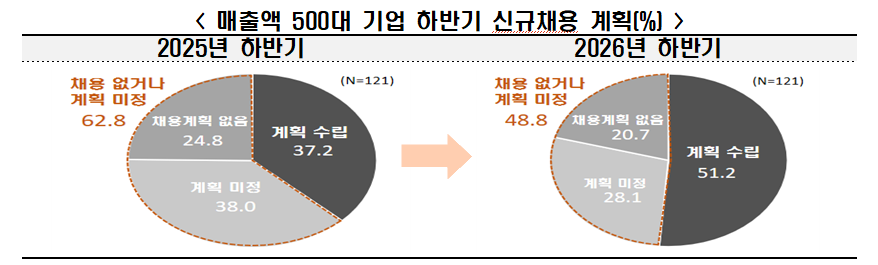
The share of companies that said their hiring plans were "undecided" fell to 28.1 percent from 38.0 percent a year earlier, a drop of 9.9 percentage points. The proportion saying they had no hiring plans also shrank, from 24.8 percent to 20.7 percent.
Among companies that had set hiring plans, half said they would keep recruitment at roughly the same level as last year. Some 24.2 percent said they would hire more, while 25.8 percent said they would hire less — a figure down 12.0 percentage points from a year ago.
The gap across industries, however, was stark. The share of companies that had yet to finalize plans or said they would not hire at all was highest in wholesale and retail at 71.5 percent, followed by construction and civil engineering at 61.5 percent and distribution and logistics at 55.5 percent.
"Hiring market conditions have improved somewhat from last year, but the economic recovery has been relatively slow in domestic demand-driven sectors such as retail and distribution, as well as in construction, and a cautious approach to new hiring persists in those areas," the federation said.
The survey also pointed to a revival of large-scale open recruitment drives. The share of companies planning to run both open recruitment and rolling recruitment in parallel rose 17.1 percentage points year on year to 54.9 percent. Among those firms, the share of hires coming through open recruitment climbed from 43.5 percent last year to 62.7 percent this year, a gain of 19.2 percentage points.
By contrast, the share of companies with hiring plans that said they would rely solely on rolling recruitment fell 9.9 percentage points to 14.5 percent. The proportion planning to use only open recruitment also declined, dropping 7.2 percentage points to 30.6 percent.
The federation said the recent expansion of open recruitment reflects companies' desire to select candidates not only for the specific skills a role requires but also for their ability to collaborate and adapt within the organization — a priority consistent with firms' ranking of "organizational fit" as the top evaluation criterion for new hires.
The survey bore that out: organizational fit was cited as the most important factor when hiring new university graduates, at 23.4 percent, followed by work experience and general job competency, each at 18.4 percent, and job-related expertise at 12.4 percent.
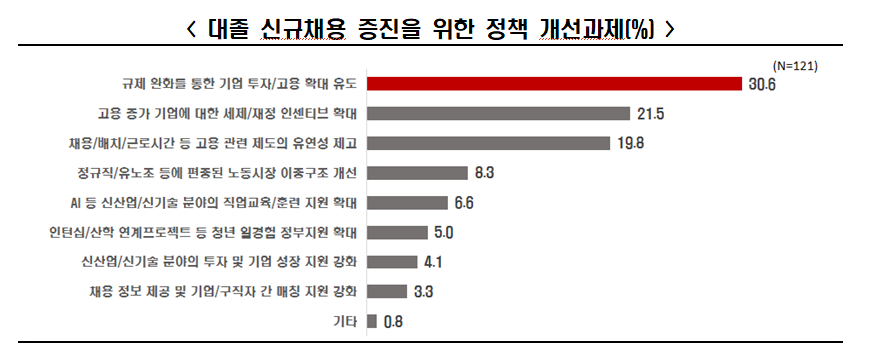
On policy priorities for expanding youth employment, companies most frequently cited "encouraging corporate investment and hiring through deregulation" at 30.6 percent, followed by expanding tax and fiscal incentives for companies that increase employment at 21.5 percent, and improving flexibility in hiring, placement and working-hours rules at 19.8 percent.
Lee Sang-ho, head of the federation's economic bureau, called it "a positive sign" that major companies' new hiring activity in the second half of this year had expanded somewhat from last year. He added, however, that a significant share of firms in some sectors still had no plans or undecided plans, and called for tax support — including an expansion of the integrated employment tax credit that gives qualifying companies a partial tax deduction when their full-time workforce, including young workers, grows year on year — as well as deregulation to give companies more room to invest and hire.
go@heraldcorp.com