![Hyundai Motor's headquarters in Yangjae, Seoul [Hyundai Motor]](https://wimg.heraldcorp.com/news/cms/2026/08/25/news-p.v1.20260713.d85d6e18e1f14bc194b7aa624321e864_P1.jpg)
Hyundai Motor and its union have narrowly reached a tentative agreement on this year's wages and collective bargaining, averting a prolonged strike. But the business community is watching with unease. The deal includes language stipulating that any legally mandated extension of the retirement age would be applied immediately — and without expanding the current wage-peak system. While the retirement age has not been raised yet, the agreement is drawing concern that it could set a precedent for extending the retirement age without adjusting pay.
According to industry sources, Hyundai Motor's labor and management began their 17th round of collective bargaining at the Ulsan factory on Monday and continued past midnight, reaching a tentative agreement on this year's wage and collective bargaining terms at around 1:30 a.m. Tuesday.
The tentative agreement includes a 100,000 won ($72) increase in base pay, a performance bonus of 400 percent, a one-time payment of 12.7 million won, 15 shares of company stock and 500,000 won in welfare points. It also covers the addition of 500 new positions, the withdrawal of damage claims and provisional seizures, and an increase in summer vacation pay. Each worker stands to receive roughly 40 million won in total.
The most notable element is the retirement-related clause. Labor and management agreed that any legislation raising the mandatory retirement age would be applied immediately, and that even a phased increase would be implemented without expanding the current wage-peak system. The Hyundai Motor union described the clause as a preemptive move to "block any attempt to worsen conditions by expanding the wage-peak system alongside a retirement age extension."
Wage adjustment is key to any retirement age extension — Hyundai Motor carved out an exception
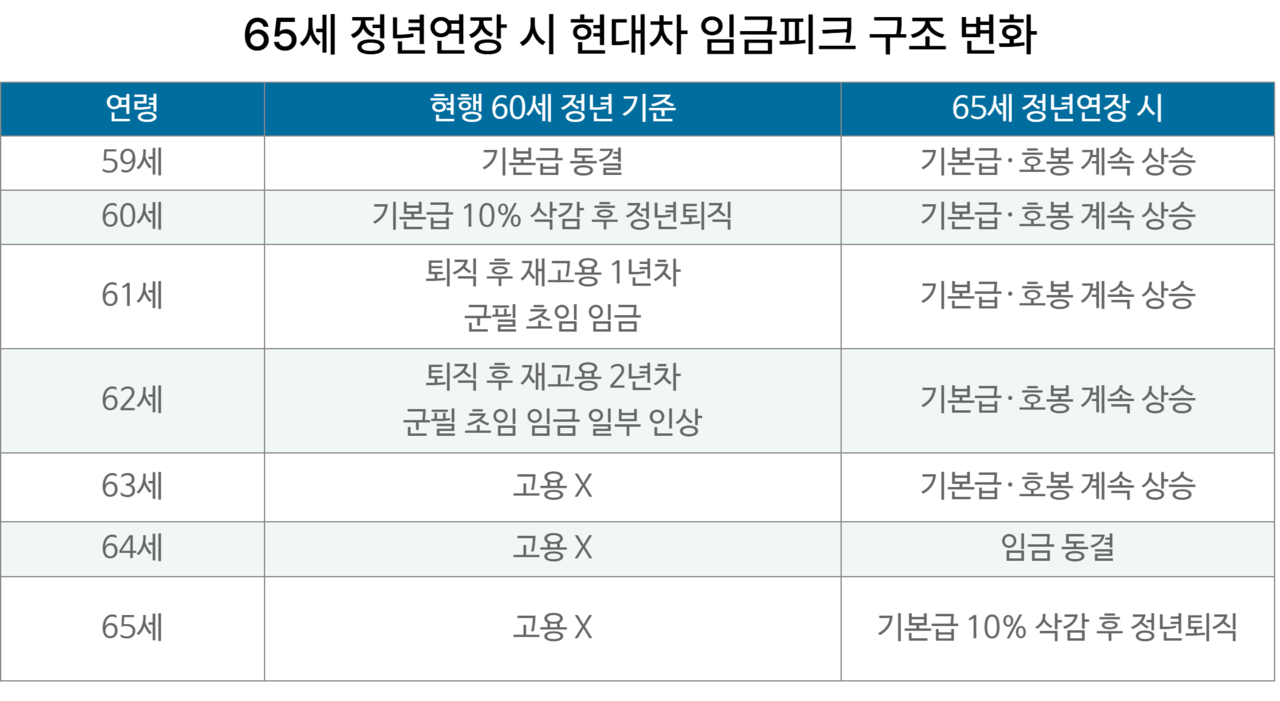
Hyundai Motor's current wage-peak system is built around a mandatory retirement age of 60. For general production workers, base pay is frozen at age 59 and cut by 10 percent at age 60 — a structure that guarantees employment until 60 while trimming wages in the final years.
Business groups have long argued that any discussion of raising the retirement age must be accompanied by a reform of the wage structure. Their concern is that extending the retirement age while keeping the current seniority-based pay system intact would prolong the employment of highly paid older workers, significantly increasing costs for companies.
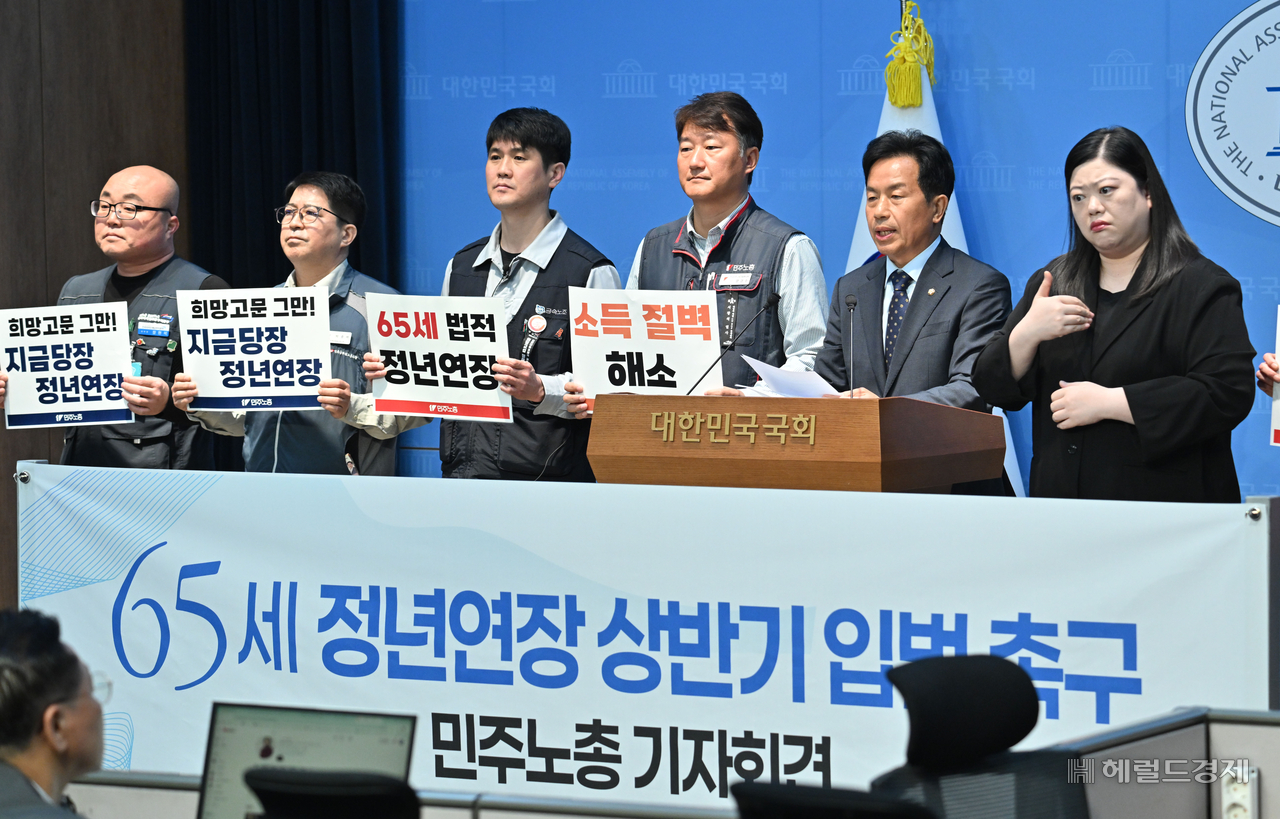
The business community's position has been that rather than uniformly raising the retirement age, companies should combine wage restructuring with flexible employment arrangements such as post-retirement rehiring. Business groups have also warned that forcing companies to extend the retirement age amid high global economic uncertainty could dampen investment and new hiring.
The Hyundai Motor agreement, however, points in the opposite direction. If the statutory retirement age rises to 65, workers aged 61 to 63 would continue to receive base pay increases negotiated in annual wage talks as well as raises under the existing seniority pay scale. Pay would then be frozen at 64, with a 10 percent cut to base pay at 65.
Wage-peak threshold expected to shift from age 60 to 63 or 64
Rather than extending the current "freeze at 59, cut 10 percent at 60" structure across the entire extended retirement period, the agreement leaves open the possibility of continued wage increases at ages 61 through 63 — years that fall beyond the current retirement age. Under this arrangement, the wage peak would occur not at 60 but somewhere between 63 and 64. With the retirement age rising to 65 but pay adjustments confined to the final two years, companies would face a longer period of carrying the cost of highly paid older workers.
The broader concern is that this language is unlikely to remain confined to Hyundai Motor. Raising the retirement age is a long-term goal being pushed simultaneously by politicians and organized labor. The Hyundai Motor chapter of the Korean Metal Workers' Union is widely regarded as one of the most powerful and influential bargaining units within the union. It has long served as a benchmark for labor relations across the manufacturing sector — covering not only automakers but also parts suppliers, steelmakers, shipbuilders and refiners — and there are fears that the language in this agreement could be used as a reference point in industry-wide negotiations going forward.
Raising the retirement age was in fact the central demand the Korean Metal Workers' Union put forward throughout this round of negotiations. The Hyundai Motor chapter pushed hard for a retirement age extension and against any expansion of the wage-peak system, in line with its parent union's position, and ultimately secured the relevant language in the tentative agreement. Management is widely seen as having conceded reluctantly to prevent a prolonged strike from disrupting production.
Union pushes for retirement age extension despite 99% rehire rate
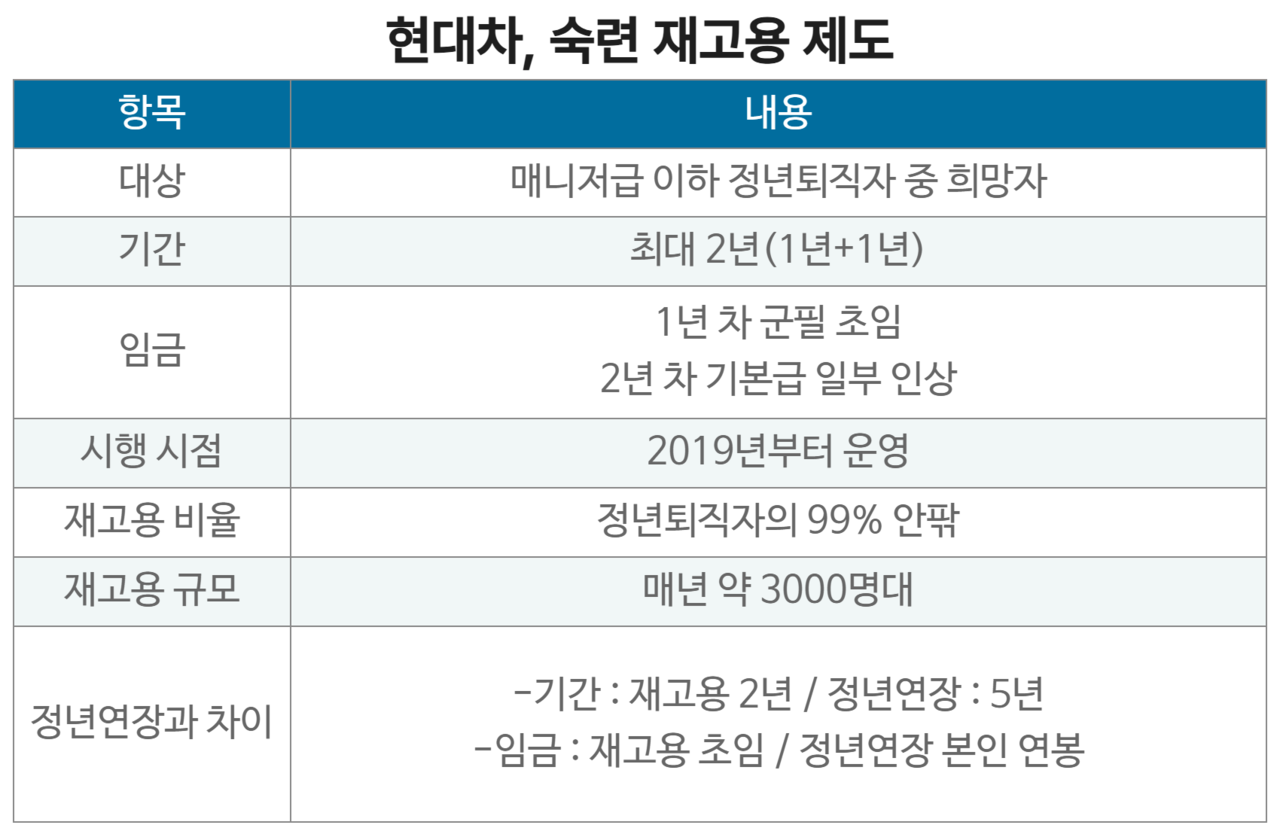
Hyundai Motor already operates one of the largest post-retirement rehiring programs among domestic companies. Since 2019, it has run a skilled worker rehiring program that brings back retired employees on fixed-term contracts. The program is open to retirees below the manager level who wish to continue working and have no disqualifying employment record, allowing them to work for up to two years on one-year renewable contracts.
Rehiring, however, differs significantly from a formal retirement age extension, which would preserve a worker's regular employee status. In the first year of rehiring, compensation is set at the level of a newly enlisted military veteran's starting pay, with a partial base pay increase in the second year. While the program guarantees the opportunity to keep working after retirement, it does not maintain the worker's previous pay level.
![Workers on the morning shift leave early from the Myeongchon gate of Hyundai Motor's Ulsan factory in Buk-gu, Ulsan, on Thursday, after a four-hour partial strike. [Yonhap]](https://wimg.heraldcorp.com/news/cms/2026/08/25/rcv.YNA.20260820.PYH2026082010410005700_P1.jpg)
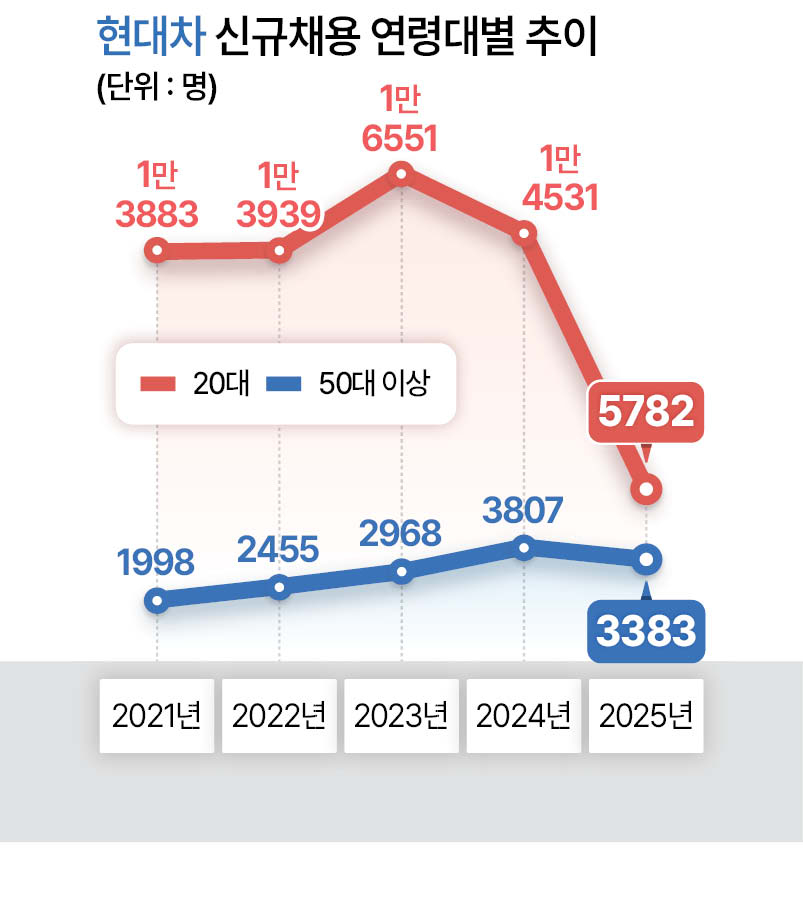
The rehire rate is in effect close to 99 percent. The number of workers in their 50s and older newly hired by Hyundai Motor has hovered around 3,000 per year — 2,968 in 2023, 3,807 in 2024 and 3,383 last year — with the vast majority being skilled retirees brought back under the rehiring program.
Meanwhile, hiring of younger workers has been declining. New hires in their 20s at Hyundai Motor held steady between 13,000 and 16,000 from 2021 to 2024, but plunged to 5,782 last year — a drop of 60.2 percent from the previous year and roughly one-third the level seen in 2023.
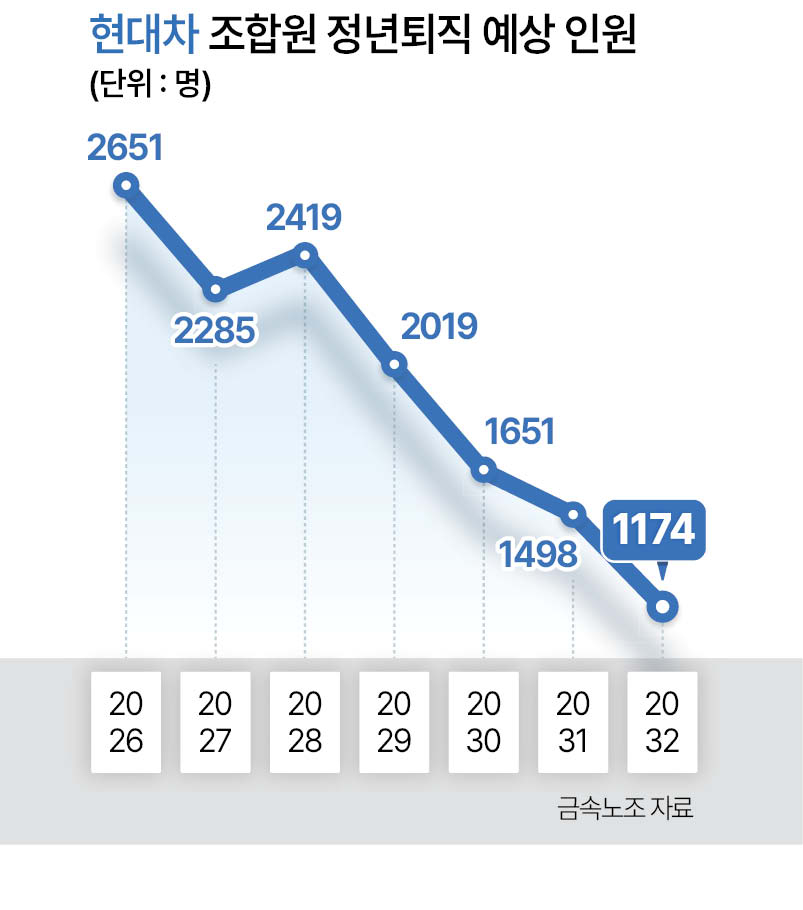
The burden is set to grow further. Some 16,325 union members are scheduled to reach mandatory retirement age over the roughly eight years from last year through 2032, representing 40.2 percent of the 40,592 union members recorded at the end of 2024.
National Assembly weighing 65 by 2037; business groups warn of added burden
The Democratic Party of Korea's special committee on retirement age extension is coordinating the timing of legislation centered on a plan to raise the statutory retirement age from the current 60 to 61 in 2029, then increase it by one year every two years until it reaches 65 in 2037.
There are also concerns that demands to extend the post-retirement rehiring period in step with any increase in the retirement age will follow. Kim Seon-ae, head of the employment policy team at the Korea Enterprises Federation, called the Hyundai Motor agreement "the most extreme case of pushing the wage-peak system further back," adding that "once a retirement age of 65 is secured, the next step will inevitably be discussions about 66 and 67, and demands to extend employment further through post-retirement rehiring are likely to follow."
Oh Gye-taek, a senior research fellow at the Korea Labor Institute, wrote in a contribution to the National Assembly Budget Office's publication "Budget Chunchoo" that "if corporate competitiveness weakens as a result of a retirement age extension, practices encouraging voluntary early retirement — such as voluntary separation programs — could become more widespread."

kwater@heraldcorp.com