A 'hub' to bridge card firms and local currency operators
Korea Financial Telecommunications and Clearings Institute to anchor shared conversion network
Card points, already cashable, set for faster rollout
Airline mileage conversion seen as a tougher challenge
![[Getty Images Bank]](https://wimg.heraldcorp.com/news/cms/2026/08/25/news-p.v1.20260825.40a49a0fdfae4467af169531bb00ad41_P1.jpg)
Financial authorities are pushing to build shared infrastructure connecting card companies and local currency operators, with the Korea Financial Telecommunications and Clearings Institute at the center of the effort. The initiative follows President Lee Jae-myung's directive to allow loyalty points to be converted into local currency. The move marks the first concrete step toward making that conversion a reality, starting with the card industry.
Financial industry sources said Tuesday that the Financial Services Commission is in discussions with the Credit Finance Association, card companies and the Korea Financial Telecommunications and Clearings Institute on how to build a system for converting card points into local currency. The parties plan to continue talks through a task force for now, working out the specifics of how the systems will be linked and what role each institution will play.
The leading option under consideration would have the Korea Financial Telecommunications and Clearings Institute serve as an intermediary, connecting card companies with multiple local currency operators. The arrangement reflects industry feedback that it would be impractical for each card company to build separate system links with every local currency operator. At the first meeting convened by financial authorities last month — which brought together domestic card companies and Credit Finance Association officials — participants reportedly agreed that shared infrastructure was necessary.
Under the proposed structure, card companies would connect to the Korea Financial Telecommunications and Clearings Institute, which would in turn link with roughly 11 local currency operators — including Kona I, the Korea Minting and Security Printing Corp. and the Korea Simple Payment Promotion Institute — to relay point conversion requests. "We are currently at the stage of explaining feasible implementation options and sharing our views at the request of relevant ministries, including the Office for Government Policy Coordination and the FSC," a Korea Financial Telecommunications and Clearings Institute official said. "The specific roles and system structure have not yet been finalized and are still under discussion."
The detailed framework is expected to be confirmed after further inter-agency consultations. Card companies and the Korea Financial Telecommunications and Clearings Institute fall under the FSC's jurisdiction, while local currency operators and local governments are overseen by the Ministry of Interior and Safety. The FSC and the Ministry of Interior and Safety are coordinating through inter-agency talks to determine how points and local currencies will be linked and how responsibilities will be divided.
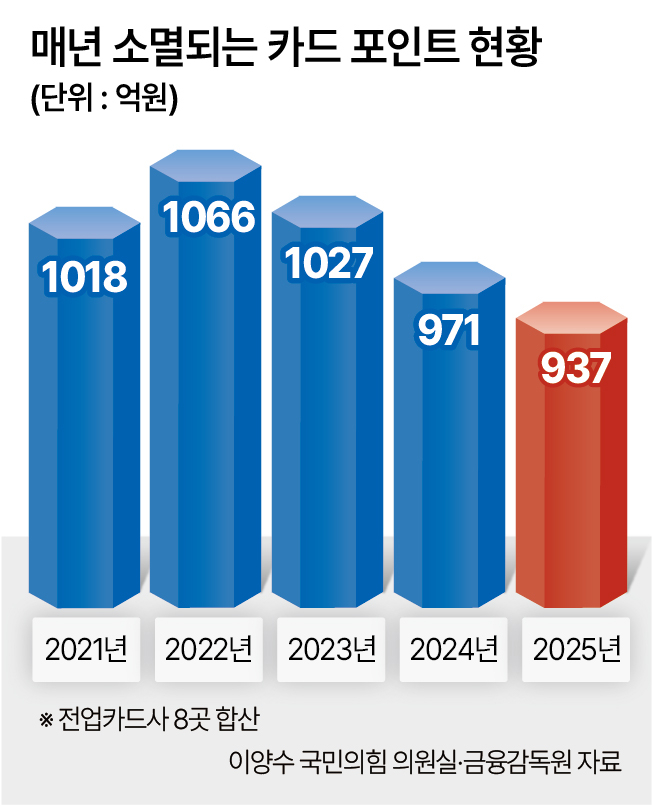
The government expects that converting card points into local currency will help boost sales for small businesses and neighborhood merchants. Around 100 billion won ($72.4 million) in card points expires unused every year. According to the Financial Supervisory Service, the amount of card points that lapsed came to 102.7 billion won in 2023, 97.1 billion won in 2024 and 93.7 billion won in 2025 — consistently hovering around 100 billion won. The total balance of unused card points held by card companies stood at 2.91 trillion won as of the end of June last year.
Because card points already have a cash conversion mechanism in place, that segment is expected to move quickly. Retail and telecom membership points and airline mileage programs, however, are likely to proceed at different speeds. The industry sees significant practical obstacles to converting airline mileage into local currency in the same way as card points or retail and telecom membership rewards.
A central sticking point is how to set an appropriate conversion rate, given that each airline calculates mileage accrual and redemption differently. Even a single mile can carry a different perceived value depending on how and when it is used — whether for a ticket purchase or a seat upgrade — making a uniform monetary conversion difficult.
Some observers also question how much the change would actually benefit consumers. Customers who consistently accumulate airline mileage tend to save it for aviation-related uses such as buying tickets or upgrading seats. Mileage programs have already expanded into non-aviation categories such as shopping and entertainment, but demand for aviation-related redemption remains strong. Whether a local currency conversion option would in practice translate into greater convenience or satisfaction for users is worth examining separately, analysts say.
forest@heraldcorp.com
kwater@heraldcorp.com