![An aerial view of Korea Zinc's Onsan smelter [Korea Zinc]](https://wimg.heraldcorp.com/news/cms/2026/08/26/news-p.v1.20260805.1201f55d90f04f5e94c3741e152bf737_P1.png)
As AI data center investment emerges as a major new force in global metals markets, Korea Zinc's metals portfolio is drawing fresh attention. Copper prices — driven by surging demand for data centers and the power grids that support them — have hit an all-time high, and the rally is now spreading to indium, used in fiber-optic communications, and gallium, a key material for power semiconductors.
London Metal Exchange copper prices climbed to $14,455 per ton on Aug. 6, setting an all-time high, according to industry sources. The metal first broke the $14,000 mark in May and has held at elevated levels since.
Analysts say the recent copper price surge is harder to read simply as a signal of global economic recovery, as it was in the past. A combination of factors is at work: mine supply disruptions, expanding power grid investment, uncertainty over US tariffs and rising electrification demand. The rapid growth of AI-driven investment in data centers and power infrastructure is also cited as a structural driver of demand growth.
"The key backdrop supporting elevated copper prices is demand for data centers and power grids to support the fast-growing AI industry," William Osnato, director of commodity data research and analysis at Barchart, told CNBC.
AI data centers consume enormous amounts of electricity. Copper is used extensively not only in data center equipment itself but also in the transmission and distribution networks and transformers that carry power from generation facilities to the centers. As AI infrastructure investment expands from data center construction to grid upgrades, copper demand grows in tandem.
Korea Zinc is already benefiting from stronger copper sales. In the second quarter of this year, the company sold 9,365 tons of copper, up 23.5% from the previous quarter and 15.9% from a year earlier. Copper sales revenue reached 190 billion won ($138 million) over the same period, a gain of 31.8% quarter-on-quarter and 75.5% year-on-year.
Korea Zinc cited strong zinc and minor-metal prices alongside higher copper sales volumes as key contributors to its second-quarter earnings. The company expects production stability and sales volumes to improve further as its copper recycling facility reaches full operational maturity.
Copper demand is expected to keep growing over the medium to long term. Based on projections from Bloomberg and the International Energy Agency, Korea Zinc estimates global copper demand will rise 48 percent between last year and 2040.
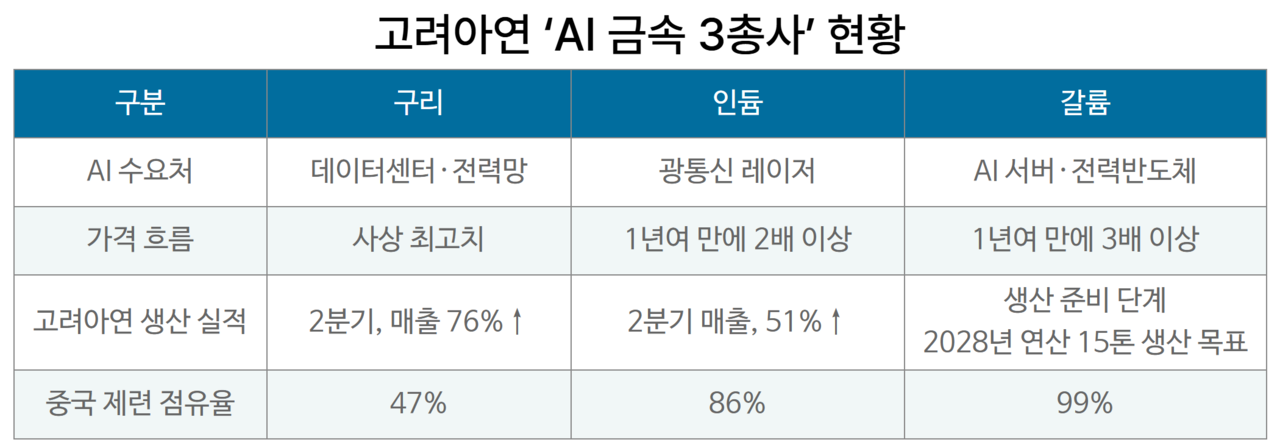
The AI-driven metals rally is extending to minor metals as well. Indium is the second metal in what Korea Zinc calls its trio of AI metals.
Indium is a minor metal recovered as a byproduct of zinc smelting. Transparent electrodes for displays — known as ITO — have long been its largest end market, but its applications are broadening to include indium phosphide (InP)-based fiber-optic lasers. Growing demand for high-capacity optical data transmission between GPUs and servers inside AI data centers is opening up new markets for the metal.
Korea Zinc produces high-purity indium ingots with a purity of 99.99 percent or higher at its Onsan smelter, using byproducts from the zinc smelting process.
Indium sales volume in the second quarter of this year rose 51 percent from the previous quarter. Korea Zinc said proactive inventory management drove the sharp increase. Tighter Chinese export controls, combined with growing AI and fiber-optic demand, pushed the indium price from $355 per kilogram in the first quarter of last year to around $800 per kilogram in the second quarter of this year.
Korea Zinc expects supply shortages to deepen as the AI and fiber-optic markets grow, and plans to maximize production of high-purity indium products in response.
![Korea Zinc Chairman Choi Yun-beom [Korea Zinc]](https://wimg.heraldcorp.com/news/cms/2026/08/26/news-p.v1.20260802.6d0f32cfbcb64425947398d11395a8d7_P1.jpg)
The third metal is gallium. Gallium is a critical material used in AI servers, power semiconductors and radar systems. Demand for next-generation semiconductors that improve power efficiency is rising alongside the proliferation of AI data centers, and the gallium market is expected to accelerate accordingly.
Price gains have been steep. Gallium rose from $625 per kilogram in the first quarter of last year to $2,140 per kilogram in the second quarter of this year — more than tripling — and has since climbed further to around $3,075 per kilogram.
Demand is expected to grow even faster than for copper or indium. Global gallium demand is projected to increase roughly sixfold by 2040, implying an average annual growth rate of 12.7 percent. The challenge is that China controls roughly 99 percent of the world's gallium supply. As AI industry growth and a China-centric supply chain restructuring proceed simultaneously, the strategic value of non-Chinese gallium can only increase.
Korea Zinc plans to invest about 55.7 billion won to build a gallium production system with an annual capacity of 15 tons by 2028. The company's advantage lies in its ability to expand minor-metal output using byproducts from existing zinc and lead smelting operations, without developing new mines. With copper, indium and gallium now all part of its production portfolio, the surge in AI data center investment is opening new demand channels for Korea Zinc's core smelting business.
Beyond these three metals, Korea Zinc is also accelerating the expansion of its minor-metal portfolio by pursuing germanium production — another material heavily dependent on China. Germanium is a key material used in optical fiber, defense, aerospace and advanced communications, with China accounting for more than 90 percent of global output.
"Despite growth in the AI, defense and semiconductor industries, the United States has a critical shortage of refining capacity for key minerals such as gallium, germanium and indium," said Kim Jin-beom, an analyst at Sangsangin Investment & Securities. "This is the point where Korea Zinc's technology and US policy needs align most directly."
kwater@heraldcorp.com