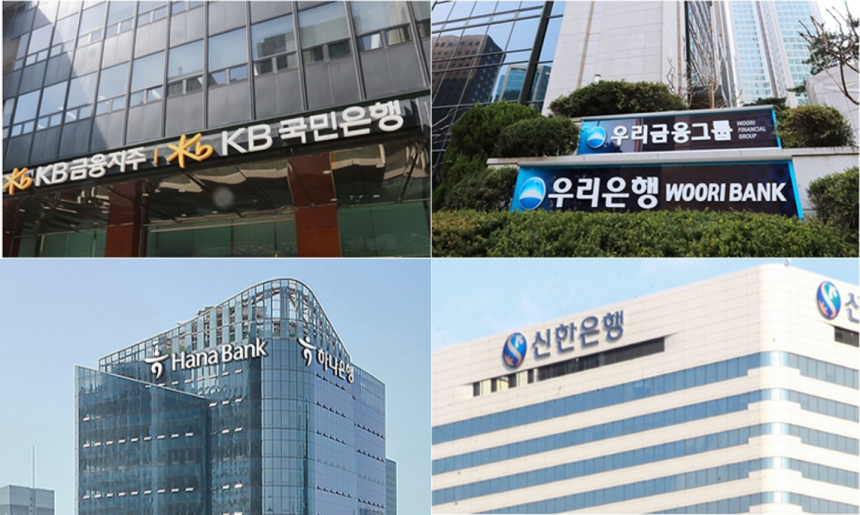
The ruling Democratic Party of Korea and financial authorities have settled on a shift away from legislating a ban on third consecutive terms for financial holding company CEOs, moving instead toward requiring approval through a special shareholder resolution. The change appears driven by concerns within the ruling party over potential unconstitutionality, as well as broader worries that a statutory ban could hurt the stock market.
The Democratic Party of Korea and financial regulators have recently been discussing revisions to the Financial Company Governance Act along these lines, according to reporting Wednesday. The revised approach is expected to be taken up at a party-government consultative council meeting to be held soon.
A ruling party lawmaker said the direction had shifted toward strengthening the requirements for special resolutions at shareholder meetings or board meetings, rather than restricting terms by law. "There does not appear to be significant disagreement within the party about moving away from the statutory approach and toward the special-resolution route," the lawmaker said. Another lawmaker confirmed the discussions were ongoing and said further deliberations were expected. A ruling party official said lawmakers had expressed discomfort with the financial authorities' proposal to legislate a ban on consecutive terms.
The push to restrict third terms by law gained momentum after President Lee Jae Myung criticized what he called the "corrupt inner circle" of financial holding company CEOs who had entrenched themselves through long tenures — a remark he made at the end of last year.
Last month, financial authorities visited members of the National Assembly's Political Affairs Committee to present a draft revision to the Financial Company Governance Act. The draft offered two options: one that would allow financial holding company chairs to serve only one additional term, and a second that would raise the threshold for special shareholder resolutions required for reappointment.
The first option drew a range of objections from ruling party lawmakers, including concerns about unconstitutionality, prompting financial authorities to begin a review. Some within the ruling camp believe the stock market's entry into a correction phase in July also weighed on the deliberations.
Ruling party lawmakers have already introduced bills that would require special shareholder resolutions for the reappointment and third-term renewal of financial holding company chairs. Bills by lawmakers Kim Hyeon-jeong and Park Hong-bae are scheduled to be submitted to the National Assembly's Political Affairs Committee on Wednesday. Park's bill, for instance, explicitly states that the initial appointment of a representative director at a large financial company shall be decided by a general shareholder resolution, while reappointment shall require a special shareholder resolution. Once a government bill is drafted, it is expected to be deliberated alongside the lawmakers' bills in a legislative subcommittee.
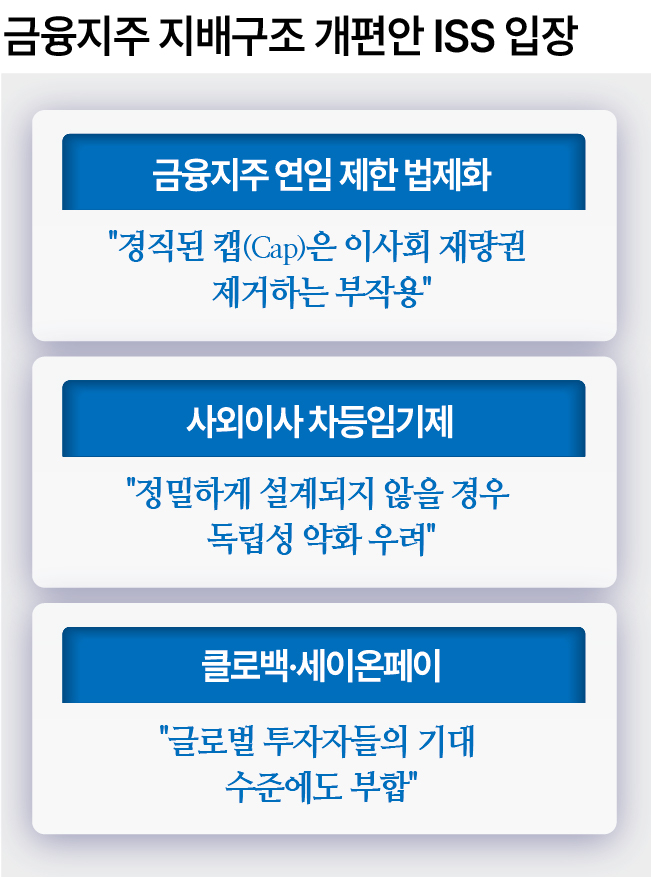
Institutional Shareholder Services, the world's largest proxy advisory firm, has also opposed a statutory prohibition on third terms for financial holding company heads. In a written response in May, ISS said the issue should be addressed through board independence requirements, regular director re-election procedures, and clear accountability to shareholders — rather than fixed regulatory limits on executive tenure. "A rigid cap applied without regard to performance or circumstances has the side effect of removing the important element of board discretion," ISS said. Foreign ownership in domestic financial holding companies reaches as high as 80 percent.
Beyond the third-term requirements, financial authorities are also expected to formally introduce clawback provisions — allowing recovery of executive bonuses when financial misconduct occurs — as well as say-on-pay, which would subject individual executive compensation plans to shareholder oversight. A staggered board term structure to strengthen outside director independence is also expected to be included in the governance reform package.
However, since improving financial company governance is a directive from President Lee, the final plan is expected to be confirmed only after additional consultations with Cheong Wa Dae. Some modifications during the process remain possible. A financial authority official said no decisions had been made on the governance reform package.
hyuk@heraldcorp.com
addressh@heraldcorp.com
rim@heraldcorp.com
forest@heraldcorp.com