Second consecutive rate hike follows July increase
High inflation, stronger-than-expected growth cited
Six of seven Monetary Policy Board members voted for hike
Growth forecast raised from 2.6% to 3.3%
Dot plot signals further increases possible this year
![Bank of Korea Governor Shin Hyun-song gavels open a Monetary Policy Board meeting at the Bank of Korea headquarters in Jung-gu, Seoul, on Thursday. [Yonhap]](https://wimg.heraldcorp.com/news/cms/2026/08/27/rcv.YNA.20260827.PYH2026082703070001300_P1.jpg)
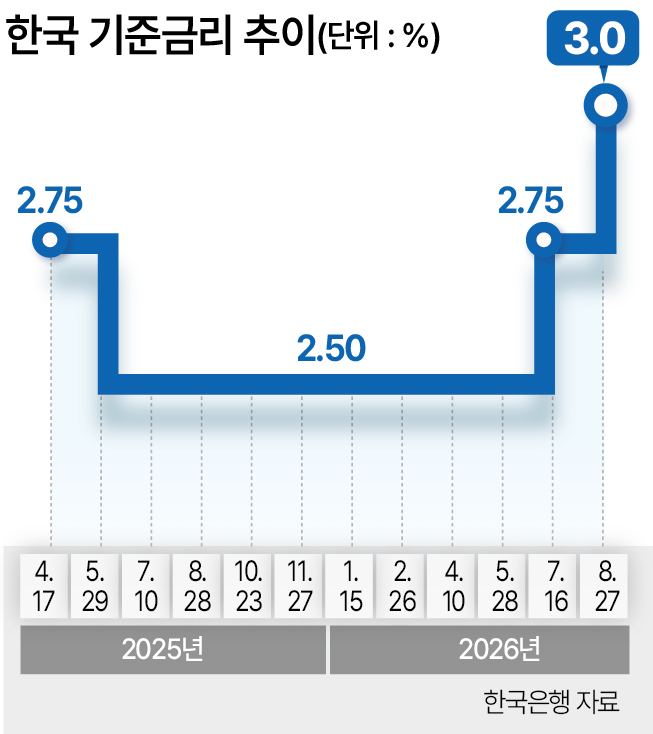
The Bank of Korea's Monetary Policy Board raised the benchmark interest rate by 25 basis points, lifting it from 2.75% to 3%.
The board voted Thursday morning to approve the increase at its monetary policy direction meeting, marking the second consecutive hike after July's move from 2.5% to 2.75%. Six of the seven board members voted in favor of the increase; Hwang Geon-il dissented.
Governor Shin Hyun-song said in the policy statement that "the domestic economy continues to grow at a faster pace than expected, supported by strong exports and a recovery in domestic demand, while inflation is projected to remain above the target level for a considerable period." He added that "in this situation, it is important to prevent the spread of inflationary pressures through preemptive action, and it is also necessary to remain vigilant about financial stability risks — which is why we judged it appropriate to raise the benchmark interest rate by 0.25 percentage points."
The Bank of Korea had officially entered a rate-hiking cycle when it raised rates in July for the first time in roughly three and a half years. Thursday's move marks the first back-to-back rate increase since November 2022 and January 2023 — a gap of about three years and seven months.
The Bank of Korea has now delivered consecutive rate hikes on three separate occasions. It raised rates in July and August 2007 in response to surging asset prices, then again in November 2021 and January 2022 as pandemic-driven inflation took hold. From April 2022 through January 2023, it raised rates seven times in total, including two "big-step" increases of 50 basis points each.
The benchmark rate returning to the 3% level marks the first time it has been that high since February 2025, when it was cut from 3% to 2.75% — a gap of roughly one year and six months.
After halting its tightening cycle following the January 2023 hike, the bank shifted to easing in October 2024, cutting rates through last November and again in February and May this year before holding steady for eight consecutive meetings. The July hike marked a reversal, and Thursday's follow-up move — coming just over a month later — has now firmly established a new tightening stance.
The back-to-back decision appears to have been driven largely by persistently high inflation and growth that has exceeded expectations.
Consumer price inflation fell back to the 2 percent range last month for the first time in three months, but core inflation — which strips out volatile items — rose 2.6 percent, its highest reading in two years and seven months. While supply-side price pressures have eased somewhat, the Bank of Korea believes demand-side pressures stemming from strong economic growth will push inflation higher going forward. Second-quarter real GDP also expanded 0.6 percent quarter-on-quarter, three times the bank's own forecast of 0.2 percent.
Real estate prices and household debt remain sources of concern. The won-dollar exchange rate has recently shifted toward a downward stabilization trend, but still sits above levels justified by economic fundamentals. Thursday's hike narrowed the gap between South Korean and US benchmark rates — measured at the upper bound — from 1 percentage point to 0.75 percentage points.
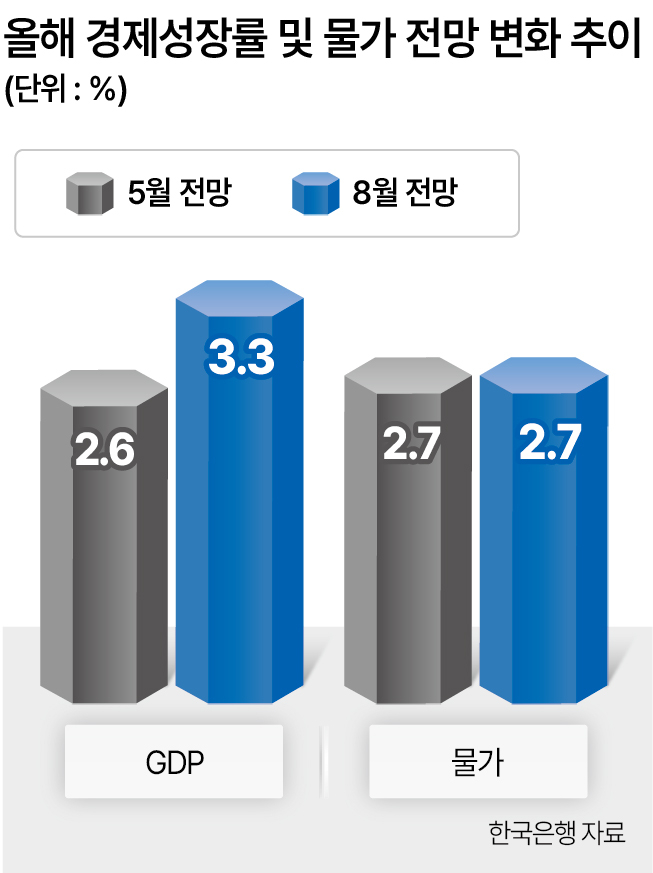
The Monetary Policy Board also released updated economic projections Thursday. It raised its full-year GDP growth forecast for this year by 0.7 percentage points to 3.3% from 2.6%, while keeping its consumer price inflation forecast unchanged at 2.7%. For next year, the board lifted its GDP growth outlook by 0.8 percentage points to 2.9% from 2.1%, and held its consumer price inflation forecast steady at 2.3%.
With back-to-back hikes now delivered, market attention is turning to the timing and terminal level of further increases. The dot plot released Thursday showed the highest projected rate among the 21 dots stood at 3.5%, up 0.25 percentage points from the May reading of 3.25%. Each of the seven board members, including Governor Shin, submits three projections for the benchmark rate six months out, for a total of 21 dots. The average and median values also rose over the same period, from 2.89% to 3.26% and from 3% to 3.25%, respectively.
Shin said future monetary policy decisions on "the timing and pace of additional rate increases will be made after carefully monitoring inflation, economic conditions and financial stability."
kimstar@heraldcorp.com
forest@heraldcorp.com