Samsung's in-house loan rate set at 1.5% annually, half the benchmark rate of 3%
Employees can stack in-house and bank loans for up to 900 million won in total financing
Apartment prices in semiconductor belt areas such as Bundang and Dongtan seen rising toward 2.5 billion won ceiling

With Samsung Electronics set to launch an in-house housing loan program for its employees, analysts expect apartment prices in the semiconductor belt spanning southeastern Seoul and southern Gyeonggi Province to climb further. Unlike ordinary borrowers facing higher lending barriers after the latest interest rate hike, a significant number of Samsung employees will be able to secure an additional 500 million won ($361,000) at a low rate. Analysts particularly note that the mortgage ceiling stands at 400 million won for homes priced at or below 2.5 billion won — dropping to 200 million won above that threshold — and expect demand and prices to converge on the 2.5 billion won mark, the last point at which borrowers can maximize their loan.
Samsung employees can borrow 500 million won more, even with a senior mortgage lien
According to financial industry sources Thursday, Samsung Electronics employees who take out an in-house housing loan starting Sept. 1 can still borrow up to about 400 million won additionally from banks. Because the in-house loan draws on the company's own fund, it is not directly subject to the financial sector's debt service ratio regulation and is not registered with Korea Credit Information Services — which is why employees can take out further bank loans on top of the in-house loan.
Samsung Electronics agreed to introduce the in-house housing loan system through a labor-management wage agreement on May 27. In the Greater Seoul area and six metropolitan cities, employees can borrow up to 500 million won to purchase a home or officetel priced at or below 2.5 billion won with an exclusive use area of no more than 84 square meters. Contracts signed after May 27 are the primary target, though earlier contracts with a final payment date of Sept. 1 or later are also eligible.
The interest rate is as attractive as the loan ceiling. Samsung Electronics' in-house loan carries an annual rate of 1.5% — roughly half the benchmark interest rate of 3% per year that the Bank of Korea's Monetary Policy Board set Wednesday with a 0.25 percentage point hike.
Samsung Electronics plans to register a first-priority collateral mortgage at 110% of the loan amount when disbursing the in-house loan. For example, if an employee buys a 2.5 billion won home in a speculative overheating zone and borrows the full 500 million won, the collateral mortgage would be set at about 550 million won — 110% of the loan. Applying the 40% loan-to-value ratio to the 2.5 billion won home gives a ceiling of 1 billion won; subtracting the 550 million won collateral mortgage leaves roughly 450 million won available from banks.
However, government lending regulations cap bank loans at 400 million won for homes priced between 1.5 billion won and 2.5 billion won. In practice, while an ordinary borrower can access only 400 million won, a Samsung Electronics employee can borrow up to 900 million won in total.
Notably, while the in-house loan targets applicants who do not own a home, the program also permits a simultaneous sale-and-purchase transaction — selling an existing home and buying a new one on the same day. Both the applicant and their spouse must be without a home to qualify, but that simultaneous transaction is allowed.
Transactions above 2 billion won emerging in Bundang, Dongtan and Wirye — will prices align at 2.5 billion won?
Market watchers believe the in-house loan benefit could trigger a "price alignment" phenomenon toward 2.5 billion won in areas where Samsung Electronics employees can live close to work. Ham Young-jin, head of the real estate research lab at Woori Bank, said prices in the semiconductor belt have already surged sharply this year — driven by bonus payouts that boosted liquidity — with standard-size units near Dongtan reaching 2.2 billion won. "There is a reasonable chance prices will rise a bit further due to the loan," he said.
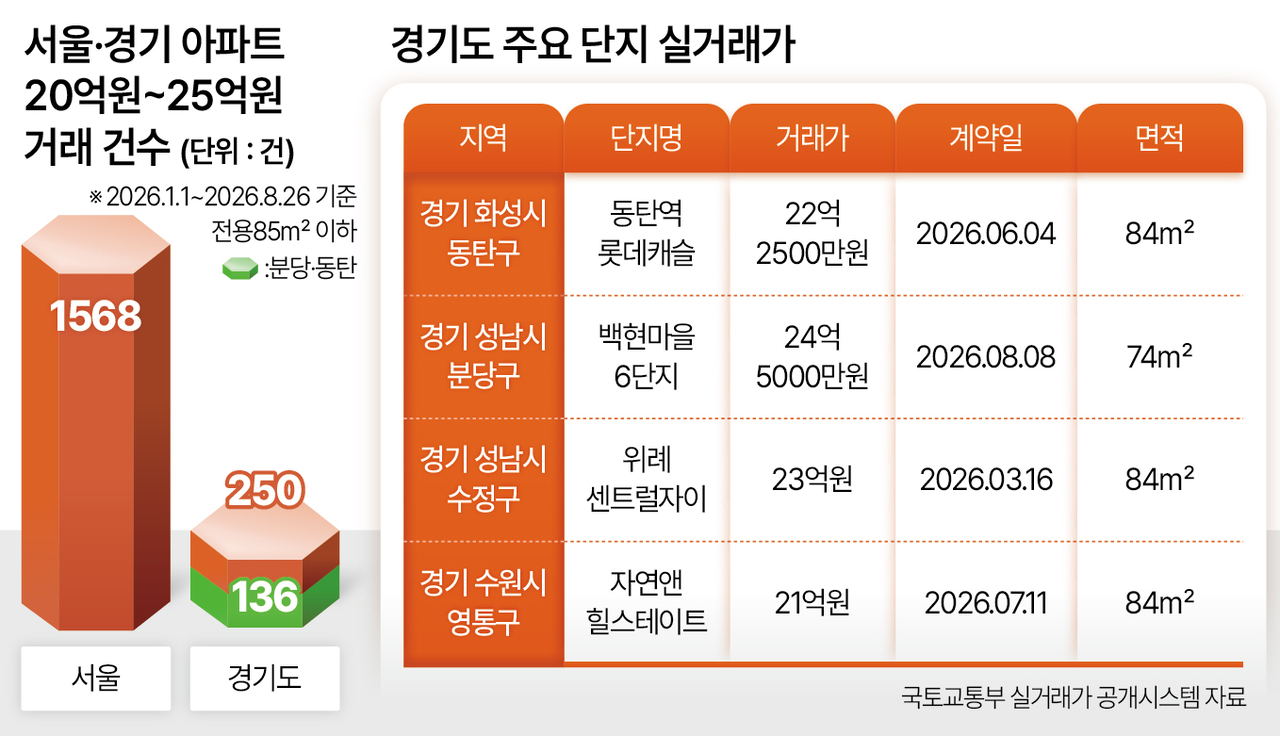
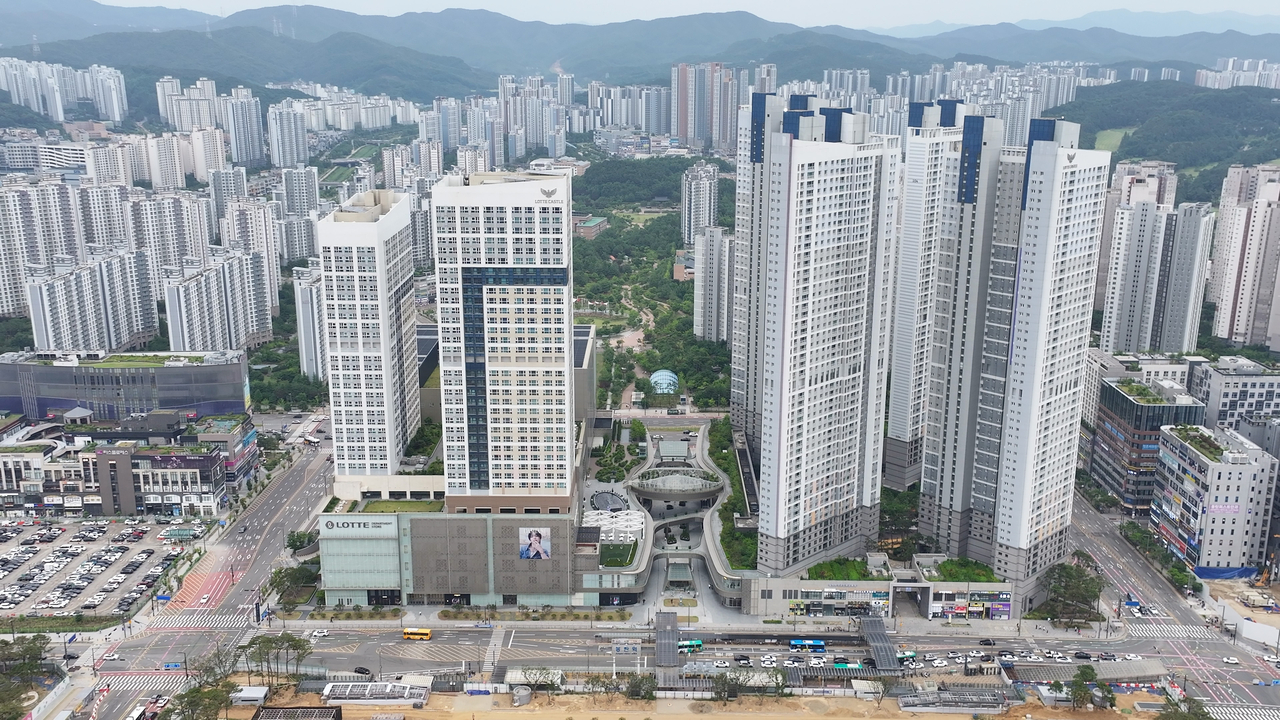
Smaller and mid-size apartments of 85 square meters or less in the semiconductor belt are already crossing the 2 billion won mark one after another. According to the Ministry of Land, Infrastructure and Transport's actual transaction price disclosure system, an 84-square-meter unit at Dongtan-yeok Lotte Castle in Dongtan-gu, Hwaseong, Gyeonggi Province sold for a record 2.23 billion won on June 4.
In Bundang-gu, Seongnam, Gyeonggi Province, 132 transactions involving small and mid-size apartments priced between 2 billion won and 2.5 billion won were recorded this year alone as of Wednesday. A 74-square-meter unit at Baekhyeon Village Complex 6 sold for 2.45 billion won on Aug. 8, while a 74-square-meter unit at the adjacent Baekhyeon Village Complex 5 set a record of 2.49 billion won on July 3 — a jump of 140 million won from the previous record of 2.35 billion won set on May 7, in roughly two months.
Transactions above 2 billion won are also beginning to appear in other parts of southern Gyeonggi Province farther from the semiconductor belt. A 84-square-meter unit at Wirye Central Xi in Sujeong-gu, Seongnam sold for 2.3 billion won on March 16, while a standard-size unit at Jayeon & Hillstate in Yeongtong-gu, Suwon changed hands at a record 2.1 billion won on July 11.
A similar price-alignment dynamic played out last year, when the government imposed tiered mortgage caps based on home prices. At the time, loans of up to 600 million won were available for homes priced at or below 1.5 billion won, concentrating demand at that ceiling. Analysts say the same pattern could repeat now that semiconductor belt apartment prices have risen into the 2 billion won range, with prices gravitating toward the 2.5 billion won threshold at which the in-house loan remains available.
Ham said fear of missing out among buyers in their 30s could push prices higher as surrounding areas rise in tandem, but added that "whether prices will actually reach 2.5 billion won specifically remains to be seen."
Park Won-gap, a senior real estate specialist at KB Kookmin Bank, said the in-house loan would clearly add upward price pressure by expanding the pool of effective buyers with purchasing power, but cautioned that the countervailing effect of the interest rate hike must also be weighed. "Home prices have surged sharply recently, particularly around Dongtan, and buyers should be careful to check whether they are paying a premium before purchasing," he said.
hss@heraldcorp.com
shy@heraldcorp.com