
Aerospace sales up 55% in first half
Military MRO backlog reaches 1.82 trillion won
Airlines extend aircraft lifespans amid new-jet shortage
Engine MRO targets 5 trillion won in sales by 2030
580 billion won engine maintenance factory under way in Incheon
Engine testing capacity seen topping 100 units a year after 2027
![A Korean Air Boeing 747-8i aircraft. [Korean Air]](https://wimg.heraldcorp.com/news/cms/2026/08/28/news-p.v1.20260814.17b99a458c52422ea4da0d8b10ed9f3b_P1.jpg)
Korean Air is rapidly expanding its footprint in the aerospace business, driven by a growing defense workload and a global shortage of new aircraft that is pushing airlines to keep older jets flying longer. With the integration of Asiana Airlines also on the horizon, the carrier is simultaneously building its in-house maintenance capacity and broadening its external order base.
In the first half of this year, Korean Air's aerospace business posted sales of 462.3 billion won ($335 million), up 55.4 percent from 297.4 billion won in the same period last year, according to industry sources Friday. Operating profit rose more than sevenfold over the same period, surging from 4.98 billion won to 36.71 billion won.
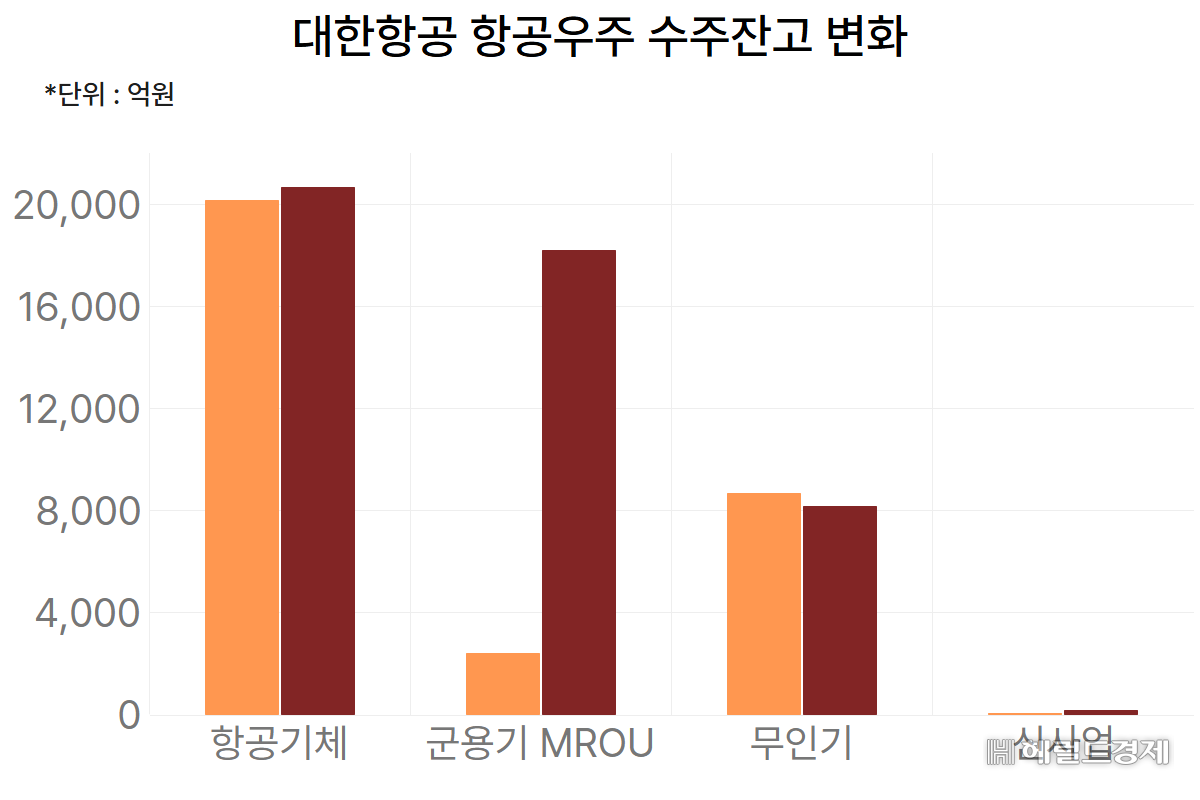
The Korean Air Aerospace Division handles military aircraft maintenance, repair, overhaul and upgrade (MROU), airframe structure manufacturing, and unmanned aerial vehicle development and production. The division has been accelerating its defense business expansion, with military MROU and UAVs as its two main pillars. At the current pace, annual sales are expected to exceed 1 trillion won.
Growth in defense orders has been particularly striking. The military MROU backlog stood at 1.82 trillion won at the end of June, a 7.6-fold increase from 239 billion won in the same period last year and up 18.2 percent from the end of last year.
As a result, the total aerospace order backlog reached 4.72 trillion won, a 51.0 percent increase from a year earlier. Over the same period, the airframe backlog grew just 2.6 percent, while the UAV backlog fell 5.9 percent.
![An AI-generated concept image showing the expected operational use of military advanced air mobility vehicles. [Korean Air]](https://wimg.heraldcorp.com/news/cms/2026/08/28/news-p.v1.20260803.d8bc53fba69c4da7917849fc8b71fdaf_P1.jpg)
A string of major defense contracts has fueled the growth. In August last year, Korean Air signed an 830.2 billion won contract with the Defense Acquisition Program Administration covering 60 items, including performance upgrades for UH and HH-60 helicopters. That November, it signed a 631.8 billion won contract to jointly develop four additional air command-and-control aircraft with US firm L3Harris. This year, the company has continued to win contracts, including a Korean military electronic warfare system development project.
The external environment is also favorable. As conflicts in Russia and the Middle East drag on, the global defense market is expanding, opening up more opportunities for the aerospace division. Korean Air is leveraging roughly 50 years of experience performing depot-level maintenance and upgrades on South Korean and US military aircraft to capture a growing share of related contracts.
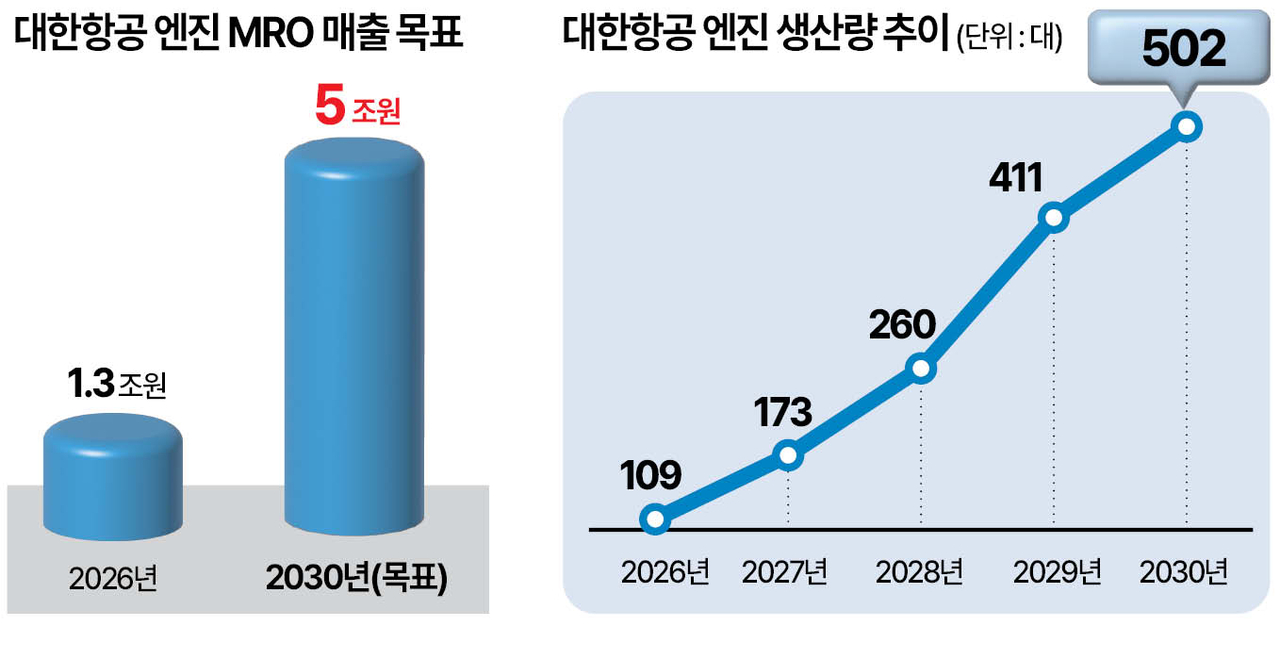
Korean Air is also scaling up its commercial aircraft engine MRO (maintenance, repair and overhaul) business. The airline projects engine maintenance sales of around 1.3 trillion won this year, with an annual maintenance plan covering 116 engines — of which 28, or about 24 percent, come from third-party customers such as other airlines and leasing companies. Korean Air aims to grow annual engine maintenance volume to more than 500 units by 2030 and raise the share of external customers to 60 percent.
Market conditions are working in Korean Air's favor. Airlines are operating existing aircraft longer as new-jet deliveries continue to be delayed. At the end of last year, Boeing and Airbus had a combined commercial aircraft backlog of roughly 15,000 planes, yet annual deliveries reached only 600 and 793 units, respectively. The International Air Transport Association does not expect aircraft supply to normalize until the early 2030s at the earliest.
The longer aircraft remain in service, the greater the demand for heavy maintenance, parts replacement and engine overhauls. Korean Air's strategy is to build its own maintenance capabilities while simultaneously expanding orders from external airlines and leasing companies.
![A final performance test is conducted on an engine that has completed maintenance at Korean Air's engine test cell. [Korean Air]](https://wimg.heraldcorp.com/news/cms/2026/08/28/news-p.v1.20260416.c22dccc3219f414f8a54eb7db3920dcb_P1.jpg)
The pending integration of Asiana Airlines is adding further urgency to expanding maintenance capacity. The combined fleet is expected to grow to around 300 aircraft, requiring a redistribution of heavy maintenance and engine overhaul workloads as well as the efficient consolidation of personnel, hangars and parts inventories.
To meet that need, Korean Air is investing about 580 billion won to build an engine maintenance factory in the Unbuk area of Yeongjongdo, Incheon. Once the Unbuk engine maintenance cluster is completed early next year, annual engine MRO capacity will rise to 360 units. The company plans to integrate maintenance functions currently spread across Bucheon and other locations, targeting capacity of more than 500 units by 2030. The new facility will handle the entire engine overhaul process — from disassembly and cleaning through inspection, repair, reassembly and performance testing — under one roof.
Korean Air is also expanding its heavy airframe maintenance space. It plans to invest 176 billion won to build a facility on a roughly 69,299-square-meter site near Terminal 2 of Incheon International Airport, capable of simultaneously servicing two wide-body aircraft and one narrow-body. Ground-breaking is targeted for 2027, with operations set to begin by the end of 2029.
![Construction of the Korean Air engine test cell and new engine maintenance factory expansion at the Unbuk district of Yeongjongdo, Incheon. [Korean Air]](https://wimg.heraldcorp.com/news/cms/2026/08/28/news-p.v1.20260416.00692a60dab74843b7283840d8c0f0e1_P1.jpg)
Engine testing volume is also expected to grow alongside the MRO expansion. IAT, Korean Air's engine testing subsidiary, projects that annual engine test volume will exceed 100 units after 2027, when the new MRO factory reaches full operation. This year's engine testing plan calls for 41 units, of which 29 were completed in the first half.
The global commercial aircraft engine MRO market is expected to grow consistently in the years ahead. Consulting firm Oliver Wyman projects the market will expand from $70 billion this year to $102.6 billion by 2036. Demand for engine maintenance is rising rapidly, but a shortage of parts and maintenance facilities is lengthening turnaround times — a trend expected to create growing business opportunities for operators that have secured capacity ahead of the curve.
"Given Korean Air's target of 5 trillion won in engine maintenance sales by 2030, a 60 percent external order share, and typical engine MRO operator margins, we can expect an annual operating profit contribution of around 200 billion won," said Choi Min-gi, a senior analyst at Shinhan Investment.
kwater@heraldcorp.com





