![An aerial view of the Posco Argentina lithium evaporation ponds at the Hombre Muerto salt flat in Argentina. The upstream facility concentrates lithium by allowing brine to evaporate naturally. [Posco Holdings]](https://wimg.heraldcorp.com/news/cms/2026/08/25/9/news-p.v1.20260824.a6a175f5ddd2464784cbdeaf10ad3e00_P1.jpg)
"Was it a scene like this when Pohang Steel broke ground at Yeongil Bay in 1970?"
The barren wasteland 4,000 meters up in the Andes evoked the tidal flats of Yeongil Bay, where Pohang Steel took its first steps toward industrialization half a century ago. The ochre desert had not a single tree. Unpaved roads stretched in every direction. Vicuñas — wild relatives of the camel — outnumbered people. Even a short walk left a visitor gasping for breath, and the fierce ultraviolet rays bit into exposed skin. Beneath this inhospitable land, stripped of water and electricity, Posco is drawing up the key raw material for South Korea's future industries.
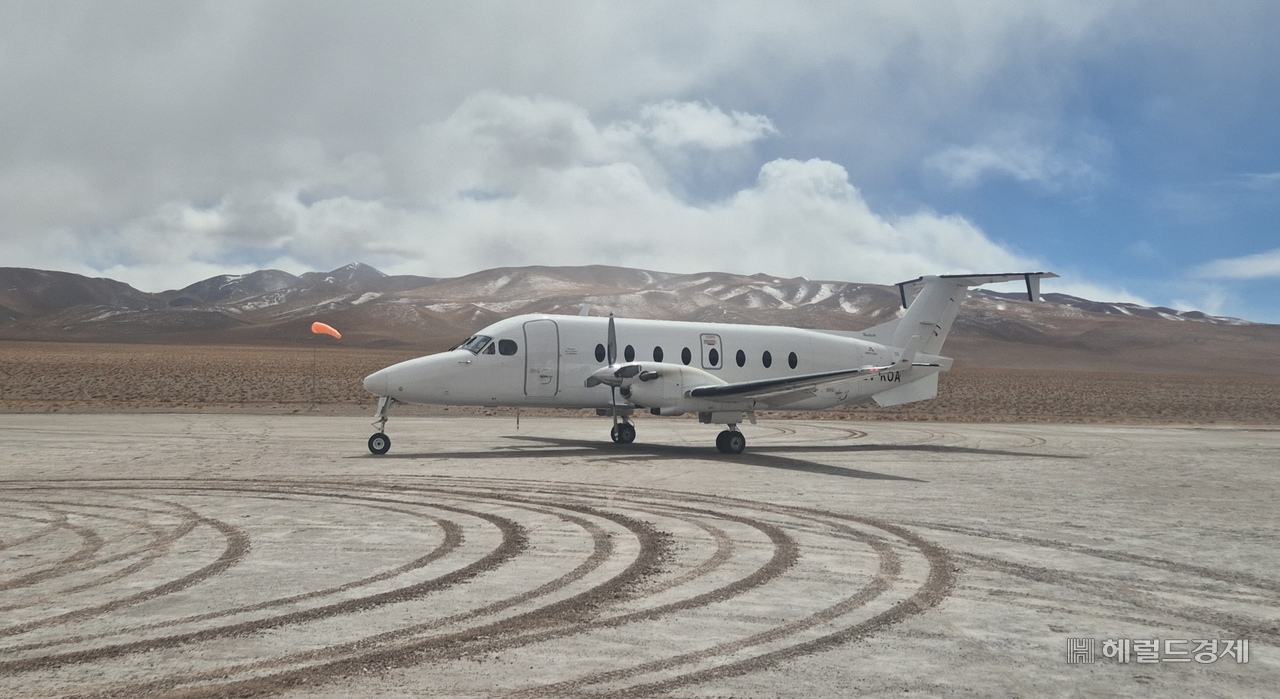
On Wednesday (local time), a 16-seat light aircraft took off from Salta Airport and climbed for 35 minutes. As it punched through the clouds and gained altitude, the endless ridgeline of the Andes came into view. When the clouds finally parted, emerald lakes filled the horizon.
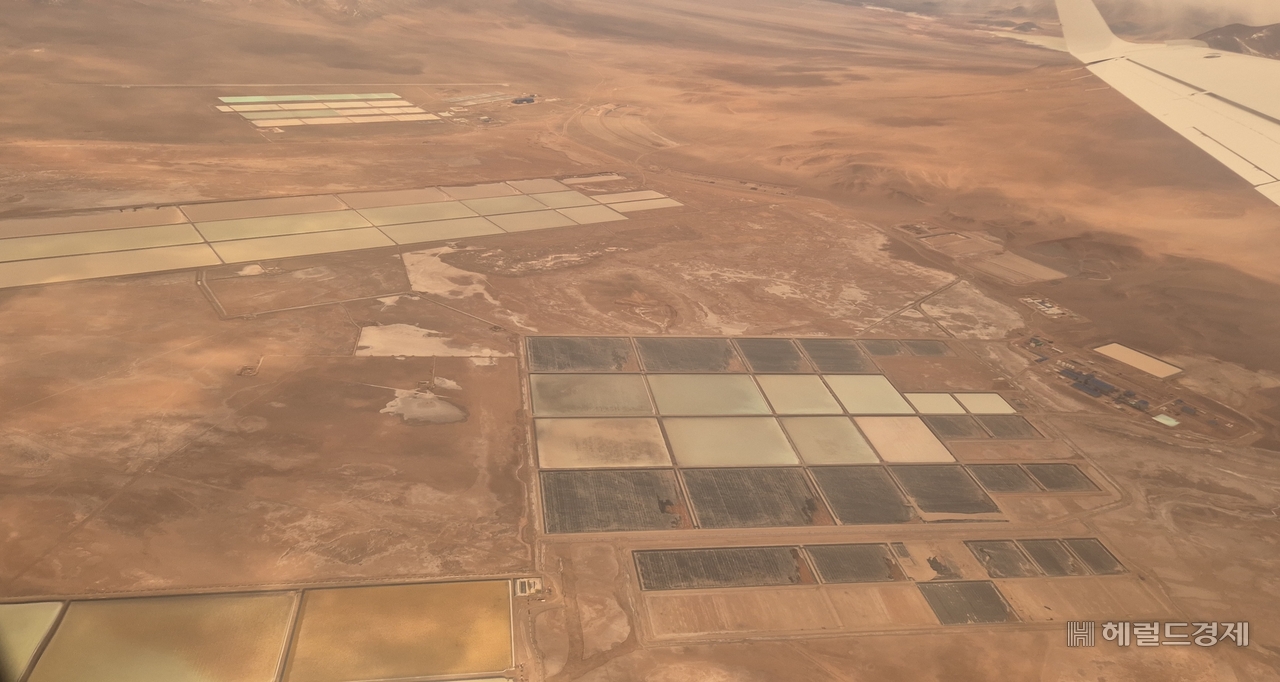
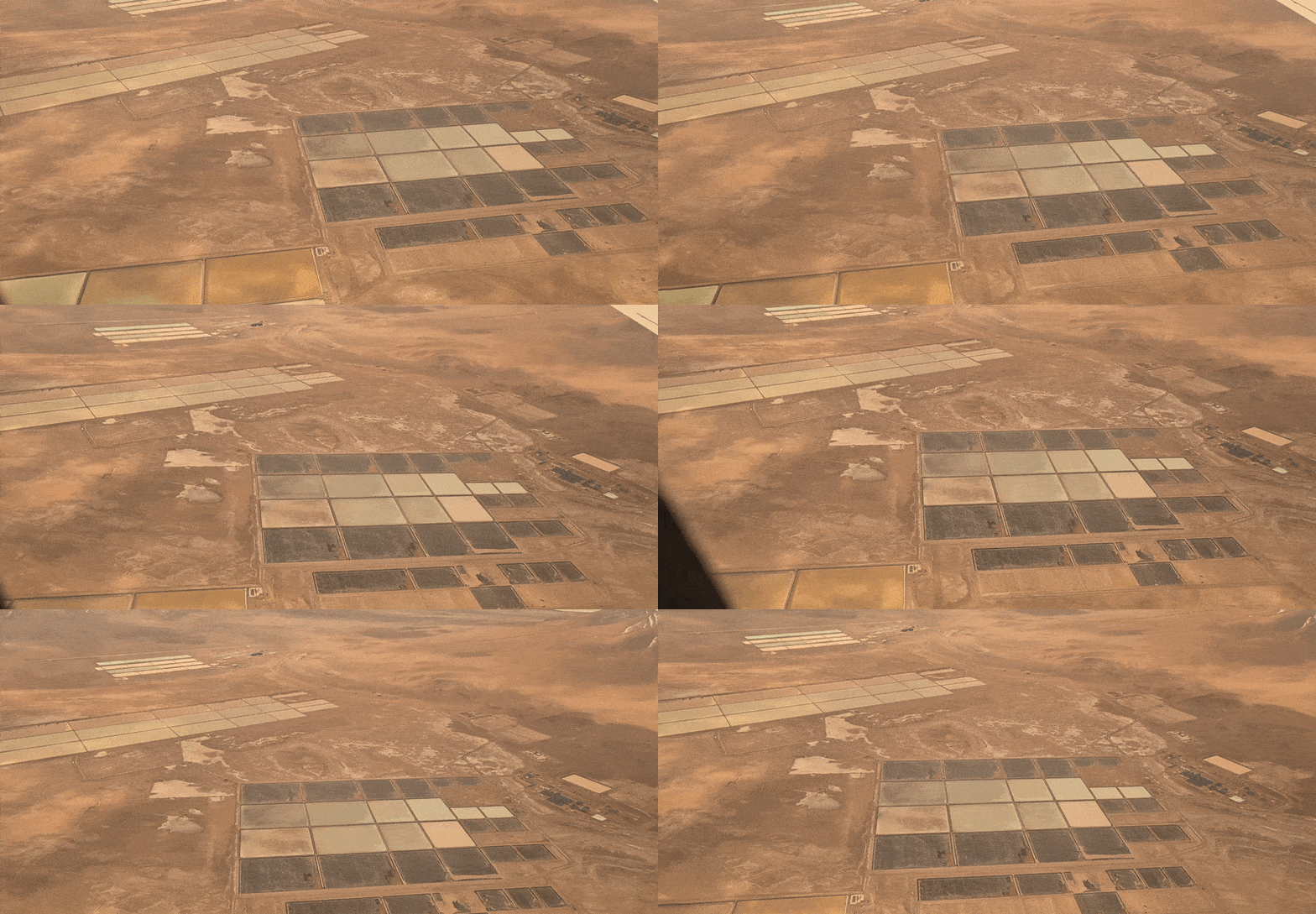
What looked like lakes were all evaporation ponds used to concentrate lithium. They form the upstream operation of Posco Holdings' "golden salt" project at the Hombre Muerto salt flat, one of the world's premier lithium deposits. Brine pumped up from 400 to 500 meters underground spends about four months here undergoing natural evaporation, raising its lithium concentration fivefold.
The ponds stretch as far as the eye can see — roughly three times the area of Yeouido and equivalent to 1,250 soccer fields combined. The site is barely habitable for humans, yet it offers ideal conditions for lithium production. The Andes' intense solar radiation and arid climate act as a natural concentrator, allowing the brine to be enriched through evaporation alone, with no additional energy input. The deposit ranks among the world's highest-grade salt flats and is considered on a par with Chile's Atacama salt flat as a top-tier lithium resource.
Park Hyeon, head of the Posco Argentina subsidiary, said the competitiveness of a lithium operation comes down to how good a brine source a company can secure and how economically it can do so. "Because Posco secures the brine directly, raw material costs account for less than 1 percent of total manufacturing costs," he said. "That cost competitiveness is the single greatest strength of our lithium business."
![An exterior view of Posco Argentina's Lithium Plant 2, located near the Hombre Muerto salt flat in Argentina. [Posco Holdings]](https://wimg.heraldcorp.com/news/cms/2026/08/25/9/news-p.v1.20260824.afb5ade9001840dfbe006b8029245aff_P1.jpg)
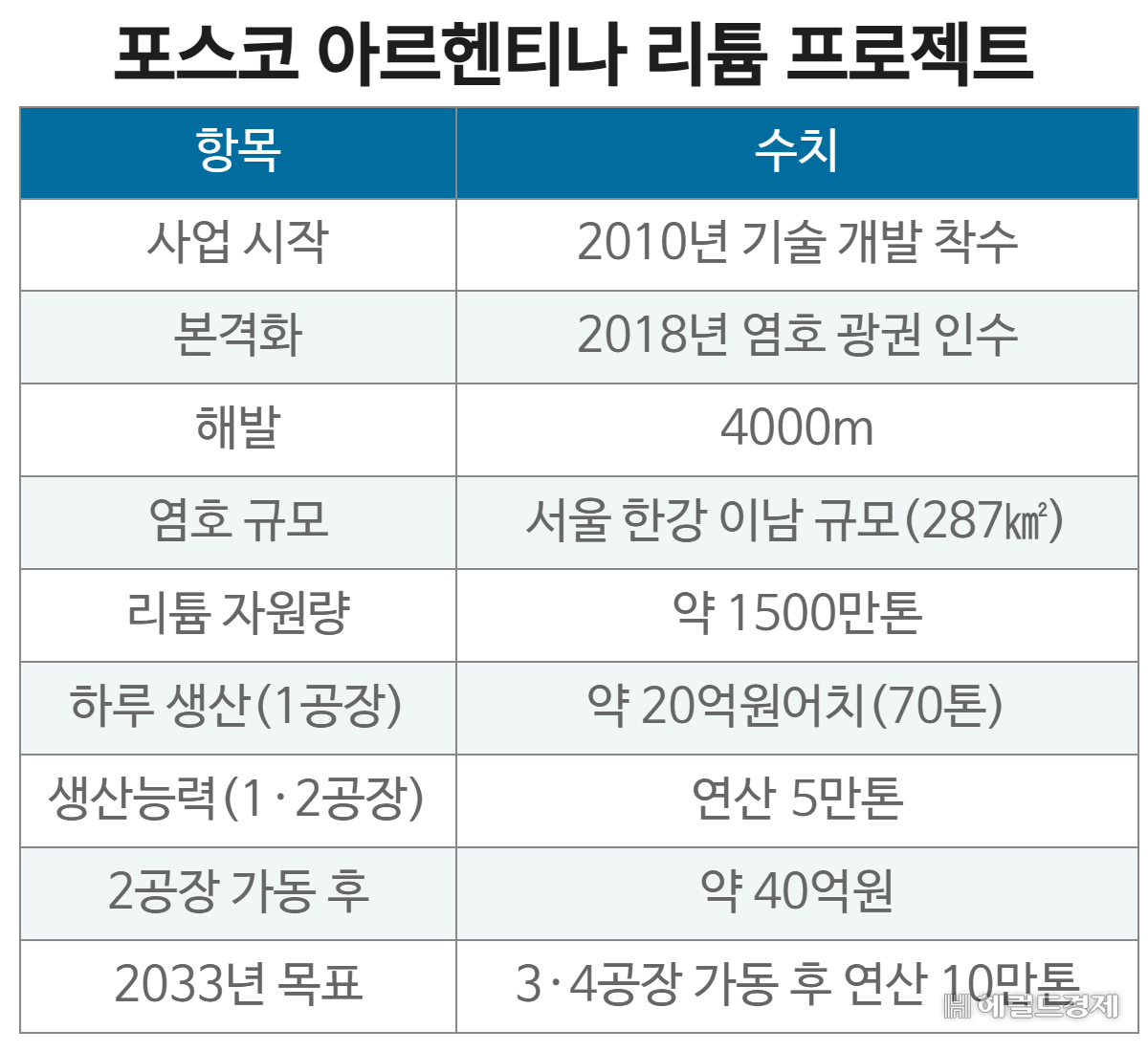
Mining rights as vast as Seoul south of the Han River — enough lithium for 100 years
Posco holds mining rights covering a total of 287 square kilometers at the salt flat — an area comparable to the portion of Seoul south of the Han River. The deposit contains an estimated 15 million metric tons of lithium resources, of which roughly 5 million metric tons are considered recoverable under current technology and economic conditions. At the combined annual production capacity of Plants 1 and 2 — 50,000 metric tons — that is enough to sustain output for at least 100 years. As lithium recovery technology advances, the recoverable volume is expected to grow further.
The economics are compelling. Plant 1, now running at full capacity, produces about 70 metric tons of battery-grade lithium hydroxide a day. At the current international market price of roughly $20,000 per metric ton, that translates to daily output worth about 2 billion won ($1.45 million). When Plant 2 — with an annual capacity of 25,000 metric tons — comes online in October, production capacity will double, pushing daily output value to around 4 billion won.
Posco plans to complete Plants 3 and 4 as well, targeting annual brine-lithium production capacity of 100,000 metric tons by 2033. At current market prices, that would put daily output value in the range of 8 billion to 10 billion won.
![Seo Seok-jong, head of construction and infrastructure at Posco Argentina, explains the production process at the Hombre Muerto salt flat lithium evaporation ponds on Wednesday (local time). [Photo by Jeong Gyeong-su]](https://wimg.heraldcorp.com/news/cms/2026/08/25/9/news-p.v1.20260824.6efa197560e74079a20410ce2edf7c83_P1.jpg)
No water, no power — 16 years of perseverance built a lithium city in the wilderness
Posco's 16-year determination to transform a desolate plain into a world-class lithium production hub was evident at every turn.
On the day of the visit, about 800 people were working at the high-altitude upstream site — 180 Posco employees and the rest from partner companies. Despite temperatures of minus 8 degrees Celsius, they kept the plant running in two 12-hour shifts around the clock. The evaporation ponds, like a blast furnace at a steel mill, cannot be allowed to stop even for a moment. Rain or shine, in subzero cold, workers walked the ponds every day to measure brine concentration.
![A map showing the location of the Hombre Muerto salt flat and the Posco Argentina lithium plants in Argentina. [Posco Holdings]](https://wimg.heraldcorp.com/news/cms/2026/08/25/9/news-p.v1.20260824.81b594d9b7d94455af34aa2629438380_P1.png)
Workers at this altitude — roughly 1.5 times the height of Baekdusan — work a rotation of 7 to 14 days at the high-altitude site before descending to lower ground for rest and then returning. The commute itself is grueling. The unpredictable high-altitude weather grounds about three in every 10 flights. When that happens, workers make the journey by bus along unpaved mountain roads, a trip of roughly eight hours each way.
![A map showing the locations of Posco Holdings' lithium operations in Salta and Catamarca provinces, Argentina. [Posco Holdings]](https://wimg.heraldcorp.com/news/cms/2026/08/25/9/news-p.v1.20260824.961c930d27b24752bce9b99d6e1c098d_P1.png)
Conditions have at least improved from what they once were. When Posco acquired the salt flat mining rights in 2018, there were no roads, no electricity and no water. Workers first built a camp where people could stay, then laid a pipeline to bring in fresh water from 30 to 40 kilometers away and erected an LNG power plant. Construction never stopped, even through winds gusting up to 150 kilometers per hour and temperatures as low as minus 20 degrees Celsius. At the peak of construction, nearly 2,000 workers lived on this wasteland to keep the work going.
Seo Seok-jong, head of construction and infrastructure at Posco Argentina, recalled: "There is not a single facility here that was easy to build. Bringing in even one piece of equipment took several times longer than it would on flat ground, and whenever strong winds hit, all work stopped and we had to reschedule construction from scratch — over and over again. The fact that we finished at all was close to a miracle."
![An aerial view of the Posco Argentina lithium evaporation ponds at the Hombre Muerto salt flat in Argentina. The upstream facility concentrates lithium by allowing brine to evaporate naturally. [Posco Holdings]](https://wimg.heraldcorp.com/news/cms/2026/08/25/9/news-p.v1.20260824.855427ba1b9c428f871e0547e2292fe0_P1.jpg)
'A battlefield of resource diplomacy' — from steel nation to materials nation
Plant 1, completed in 2024, spent about two years in a ramp-up phase to stabilize production and recently reached 100 percent utilization. Mining projects typically take two to five years to stabilize output, but Posco wrapped up the ramp-up this month.
Lithium phosphate produced at the round-the-clock upstream operation is loaded onto 25-metric-ton trucks and transported roughly 250 kilometers to a downstream processing facility in Güemes, Salta Province. There, the material undergoes a further purification step and a bipolar electrodialysis process before emerging as battery-grade lithium hydroxide. The finished product is sealed and packaged in 450-kilogram bulk bags, then shipped through port to South Korea, Europe and other markets worldwide.
![An aerial view of the Posco Argentina lithium evaporation ponds at the Hombre Muerto salt flat, photographed from the aircraft. The upstream facility concentrates lithium through natural brine evaporation. [Posco Holdings]](https://wimg.heraldcorp.com/news/cms/2026/08/25/news-p.v1.20260824.5fcde011deb84c359d489548a474801e_P1.jpg)
Around the plant, production bases operated by global lithium companies — China's Ganfeng Lithium, Zijin Mining and France's Eramet — line up one after another. Park gestured beyond the plant fence and said, "This is a battlefield of resource diplomacy," adding that employees work with a sense of mission and pride in defending South Korea's critical mineral supply chain.
The 16 years of technology development, mining-rights acquisition and plant construction that followed Posco's decision to develop its own lithium extraction technology in 2010 have given workers on the ground deep confidence. The operation posted its first quarterly profit this year, a sign that decades of effort are beginning to bear fruit.

Park said he believes Posco Argentina's competitiveness has been fully proven. "We have been refining our processes for more than a decade, and we will keep developing better technologies and processes to further strengthen the national critical mineral supply chain and the group's materials business foundation," he said.
kwater@heraldcorp.com