Industrial regional electricity pricing regime set for rollout this year
Business community welcomes move as relief for corporate burden
Heavy power users urge consideration of sector-specific characteristics
Infrastructure and workforce concerns cloud hopes of easing Seoul-area concentration
"It's welcome that they're lowering electricity bills when times are hard. But when you think about how much rates have risen over the past few years, it feels like putting a bandage on a broken leg."
One manufacturer has been paying around 40 million won ($29,000) a month in electricity bills even as the broader economy has slowed. Korea Electric Power Corporation raised industrial electricity rates seven times between 2022 and last year, pushing them up roughly 80 percent over that period. "The electricity burden has grown so large that this cut will give us some breathing room, but whether we'll actually feel the difference remains to be seen," a company official said.
At another export-focused manufacturer, energy costs account for about 14 percent of monthly sales of roughly 2.5 billion won — up from around 10 percent before the rate hikes. With business conditions also weakening recently, the cost pressure has been significant. The company estimates the new regime will trim its electricity bill by 2 to 5 percent. "Business is so tough that a small reduction in electricity costs won't change things dramatically," its chief executive said, "but since about 70 percent of our sales come from exports, it will definitely help our cost competitiveness."
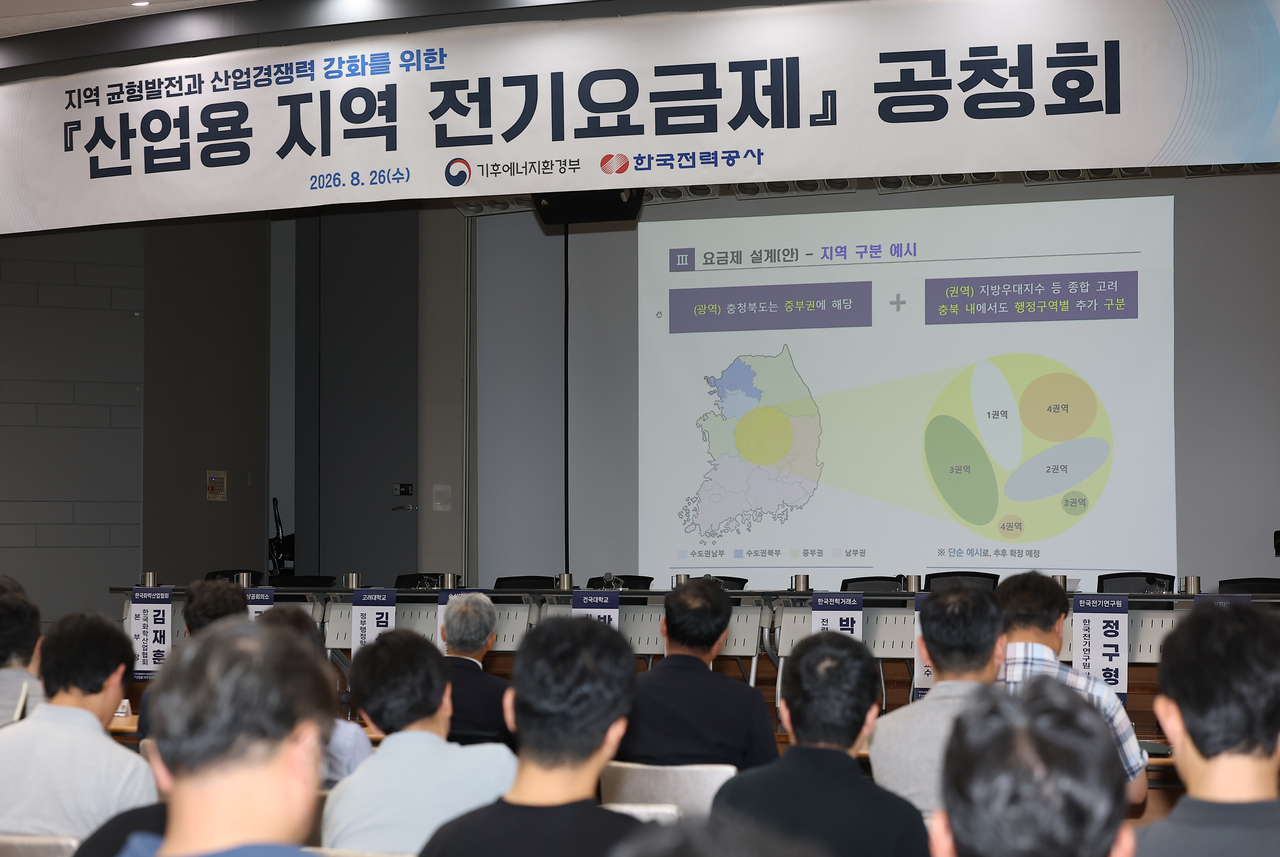
Those are the reactions from small and medium-sized enterprise factory floors to the industrial regional electricity pricing plan the government unveiled Wednesday. The Ministry of Climate, Environment and Energy and Korea Electric Power Corporation proposed cutting rates from last year's industrial average selling price of 181.9 won per kilowatt-hour — by 6 to 10 won (3 to 5.5 percent) in the northern Greater Seoul area, 10 to 15 won (5.5 to 8 percent) in the central region, and 13 to 18 won (7 to 10 percent) in the southern region. The government estimated the plan would reduce the industrial sector's total annual electricity bill by about 2.8 trillion won.
The business community offered an initial welcome. The Korea Federation of SMEs, the Korea Federation of Mid-sized Enterprises and 19 other economic and industry groups — including associations representing the machinery, textile and steel sectors — issued a joint statement the same day expressing hope that the plan would ease corporate electricity costs and spur investment. The government also envisions dispersing businesses and power demand to regions outside Greater Seoul, where electricity rates would be relatively cheaper.
On the ground, however, voices are calling for the plan to account not only for geography but also for the power-consumption characteristics of individual industries. The foundry sector, which requires large amounts of electricity to melt scrap metal, is a prime example of a heavy power-consuming industry. "Depending on the sector, energy costs can be as low as 5 to 6 percent of sales, but in foundry and steel they can reach 13 to 18 percent," one foundry company official said. "Since the burden differs even within the same region, a tiered rate structure that takes high power-consuming industries into account could be more effective."
There is also a gap in sentiment depending on how much rates fall in each region. Incheon is classified under the northern Greater Seoul zone, where industrial rates will drop by up to 5.5 percent, while the southern region will see cuts of up to 10 percent. "The Gyeonggi-Incheon area has high labor costs and heavy regulatory burdens on manufacturers, yet we have to compete in the same market as companies in other regions," said an official at an Incheon manufacturer. "If regional companies get even lower electricity rates on top of that, businesses in the Gyeonggi-Incheon area can't help but feel shortchanged."
Industry insiders are more cautious than the government about whether the plan will actually prompt companies to relocate to other regions. The cost of moving or building a factory, and the existing industrial infrastructure in place, weigh more heavily on location decisions than electricity rates. "The cost of relocating a factory is two or three times what it used to be, and with the economy in poor shape there's almost no capacity for new investment," one company official said. "In sectors like automotive and machinery, related firms have already clustered in specific regions and built their own infrastructure — almost no one will decide where to put a factory based on electricity rates alone."
Securing workers is another obstacle. "If you visit factory floors in places like Changwon, Ulsan and Pohang, the youngest worker is often in their 60s, with no young people coming up behind them," said an official at one manufacturer. "Young people aren't leaving the Greater Seoul area, so it's realistically very difficult for companies alone to move to the regions just because electricity is a little cheaper."
hong@heraldcorp.com
snsd@heraldcorp.com