'Consultation is custom, not a constitutional requirement'
Party demands immediate submission of appointment consent motion
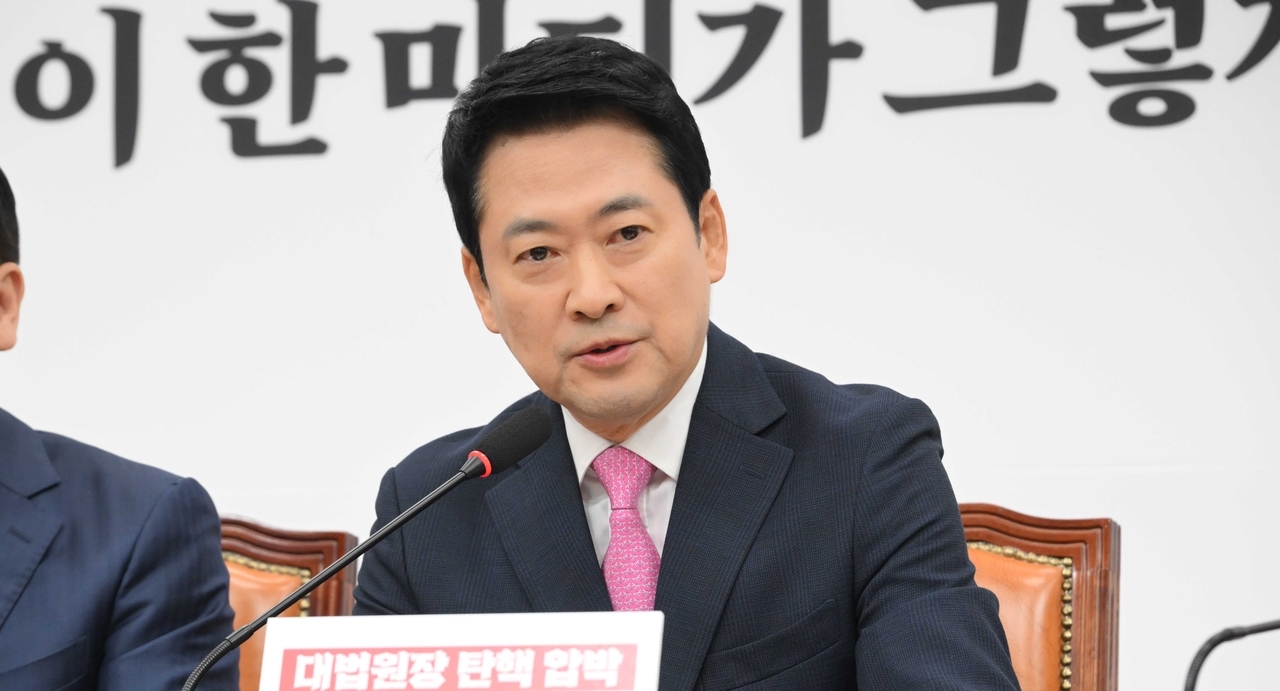
The People Power Party on Friday criticized President Lee Jae Myung's decision not to submit a National Assembly consent motion for Supreme Court justice nominee Son Bong-gi, saying "judicial independence and the separation of powers are not subjects for bargaining."
PPP chief spokesperson Park Chung-kwon said in a statement that Cheong Wa Dae had argued the chief justice's nomination authority was merely a subordinate power supporting the president's appointment power. Article 104 of the Constitution, he said, explicitly requires Supreme Court justices to be appointed "upon the recommendation of the Chief Justice of the Supreme Court." Subordinating the nomination power to the appointment power, Park said, "is an arbitrary interpretation with no basis in the constitutional text."
Park also pushed back on Cheong Wa Dae's position that the prior-consultation practice had broken down. "Consultation is custom, not a constitutional requirement," he said.
He added that a failure to follow customary practice could not be used to deny a constitutional body the right to exercise its nomination authority altogether. Cheong Wa Dae was also "obscuring the substance of the issue by piling on baseless allegations that the Court Administration Office had made individual contact with the nominees," he said. "The core of the problem is the simple fact that Cheong Wa Dae did not send the consent motion to the National Assembly," he added.
Park characterized the episode as an attempt by Lee to build "his own judiciary." He said scrutiny and assessment of nominees should be carried out through National Assembly confirmation hearings and a vote, and that withholding the consent motion from the Assembly altogether amounted to "the president arbitrarily stripping the Assembly of its constitutionally guaranteed right of consent."
The PPP also said the public would not accept the decision to withhold the consent motion. Floor spokesperson Choi Eun-seok issued a separate statement, noting that Cheong Wa Dae had said the first Supreme Court justice selection under "a government of popular sovereignty must be acceptable to the people in terms of procedural legitimacy before outcomes." Choi called that "a truly shameless thing to say."
"What the public finds unacceptable right now is not the chief justice's nomination," Choi said, "but Cheong Wa Dae's conduct in refusing a constitutionally grounded recommendation."
Choi said the chief justice's nomination authority "was not created to serve the president's wishes," but is a power the Constitution grants to guarantee judicial independence and check the arbitrary exercise of the president's personnel authority.
"The moment you subordinate that nomination power to the president's appointment power, checks and balances collapse, and the nomination right is reduced to a rubber-stamp exercise for picking candidates who suit the president's taste," Choi added.
The PPP called on Cheong Wa Dae to "submit the appointment consent motion to the National Assembly in accordance with established procedure."
raining@heraldcorp.com