Budget for peace-unification education commissioners rises 138-fold
North Korean human rights foundation sees 90% cut after decade of delays
The Ministry of Unification has set its budget proposal for next year at 1.25 trillion won ($914 million), a 0.82 percent increase from the previous year. Of that total, 23.7 billion won has been allocated to restore the South Korean section of the Gyeongwon Line — between Baengmagoji and Woljeong-ri — resuming construction that stalled 11 years ago.
According to the ministry's "Key Details of the 2027 Ministry of Unification Budget and Fund Plan," released Tuesday, the total comprises 1.01 trillion won from the Inter-Korean Cooperation Fund, established for inter-Korean exchange and cooperation, and 243.4 billion won from the general account used for standard policy and administrative programs.
The Inter-Korean Cooperation Fund, which accounts for the bulk of the budget, saw a modest increase of 0.91 percent.
Three items — humanitarian aid (95.39 billion won), livelihood cooperation support (472.11 billion won) and grant-based economic cooperation infrastructure (187.77 billion won) — together make up 74.8 percent of the cooperation fund, but all three were cut by 15 percent each. The Ministry of Planning and Budget, which oversees government budget planning, had flagged the fund's low execution rate.
However, the ministry raised the "economic cooperation infrastructure (loans)" line item by 237.7 percent to 199.43 billion won, reflecting its commitment to improving inter-Korean relations. The funds are set aside to provide loans should inter-Korean economic cooperation projects in rail and road — areas where the two sides have reached agreements — resume.
Within the grant-based economic cooperation category, 23.7 billion won was designated for the Gyeongwon Line restoration project, which the ministry reported to Cheong Wa Dae in early August. The project broke ground in August 2015 as a fund-financed initiative but was suspended in May 2016 following North Korea's fourth nuclear test. The ministry said it aims to resume construction next year and complete it by 2029.
Budgets for peace, unification and democratic citizenship education targeting the "future generation" received a sharp boost.
The ministry plans to expand the corps of peace-unification-democracy education commissioners — currently 4,000, drawn mainly from teachers — to 10,000, investing 7.15 billion won in capacity building and activity support. That represents a 138-fold increase from this year's allocation of 52 million won.
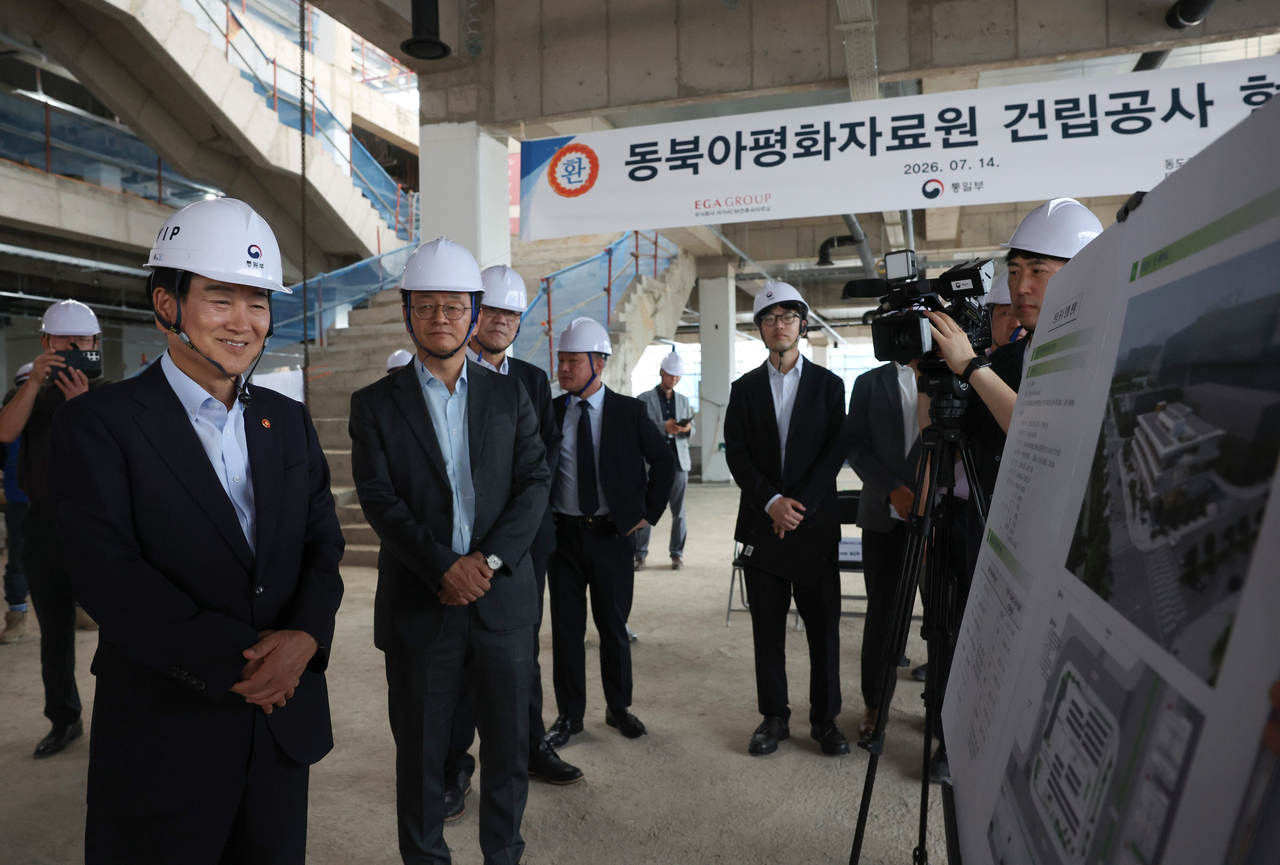
The ministry set aside 15.6 billion won — about 10 times this year's figure — for the opening of the Northeast Asia Peace Archives, now in its final construction phase in Goyang, and for expanding public access to North Korea-related materials. A director-level senior civil servant post, two divisions and a staff complement of 23 have been secured for the facility through consultations with the Ministry of Interior and Safety.
By contrast, the budget for the North Korean Human Rights Foundation — whose legal basis was established in 2016 but which has failed to launch for a decade due to disagreements between the ruling and opposition parties — was slashed by 90 percent.
The foundation received 11.76 billion won in 2017 under the Park Geun-hye administration, but after deep cuts during the Moon Jae-in government it held steady at 475 million won for six years before shrinking to just 50 million won in next year's proposal.
youknow@heraldcorp.com