
![An image related to return on assets (ROA), a measure of how efficiently a company uses its assets to generate profit. [Getty Images Bank]](https://wimg.heraldcorp.com/news/cms/2026/09/02/news-p.v1.20260902.79d432c0326d4660abc60d0b199f965a_P1.jpg)
As government bond yields surge across the United States and other major economies, companies that generate profits through efficient use of their assets are drawing fresh attention in equity markets. Analysts say investors should look beyond sectors that typically benefit from rate hikes and instead focus on companies that do not rely heavily on financial leverage.
According to the financial investment industry Wednesday, the US 10-year Treasury yield climbed as high as 4.798% during trading Tuesday (local time), its highest level since January 2025. Japan's 10-year government bond yield crossed 3% for the first time since 1996, while the UK's 10-year yield rose to 5.25%, the highest since 2008. Germany's 10-year yield also climbed to around 3.35%, its highest since 2011, as a global bond selloff gathered momentum.
Federal Reserve Chair Kevin Warsh left open the possibility of further rate hikes at the Jackson Hole meeting last month, and a resumption of hostilities between the US and Iran has pushed up global oil prices, reigniting inflation concerns. Mounting fiscal pressures in major economies are adding to upward pressure on long-term yields. "Against a backdrop of heightened rate-rise concerns following Chair Warsh's Jackson Hole remarks, the renewed US-Iran military conflict and the resulting oil price increase have weighed on investor sentiment," said Kim Yun-jeong, a researcher at LS Securities.
Kim Il-hyeok, a researcher at KB Securities, said "rising oil prices are contributing to higher inflation expectations, which in turn are pushing up interest rates, while real rates also remain elevated." He added that the US 10-year Treasury yield "has clearly broken above its medium-term downtrend line and appears to be consolidating there, making it difficult to fall back below 4.6% unless growth concerns escalate significantly."
As the burden of higher interest rates grows, how much a company depends on financial leverage becomes an increasingly important factor in assessing profitability — because rising rates raise the cost of debt-funded financing. Analysts in the brokerage industry say investors should pay closer attention to companies that consistently generate profits from their own assets rather than relying heavily on debt. Return on assets, or ROA, is frequently cited as the key metric for this purpose. ROA shows how much profit a company generates from its total asset base. While return on equity, or ROE, can be inflated by financial leverage from debt, ROA measures profitability against total assets, making it a more direct gauge of underlying earnings power.
Among domestically listed companies, 16 met all four criteria simultaneously: a market capitalization of at least 1 trillion won ($730 million), an ROA of 20% or above, cumulative operating profit in the black over the most recent four quarters, and a debt ratio of no more than 100%. SK Square topped the list with an ROA of 55.94%, followed by SK hynix (46.47%), APR (39.22%), Oscotec (37.59%), d'Alba Global (32.03%), Jeju Semiconductor (31.56%), SK Biopharm (27.62%) and Alteogen (26.73%). Hanmi Semiconductor (25.19%), HD Hyundai Marine Solution (24.03%), Sanil Electric (23.79%) and Silicon2 (22.90%) also posted ROA figures above 20%.
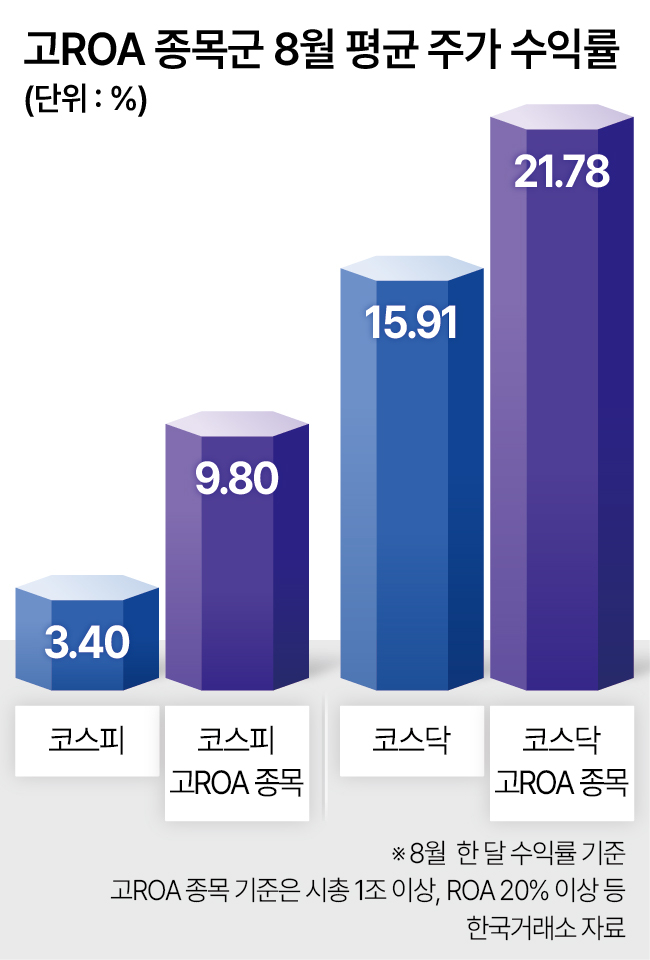
According to Korea Exchange, the 16 high-ROA companies also outperformed the broader market in recent share price performance. The nine Kospi-listed companies in the group posted an average share price return of 9.80% in August, beating the Kospi's gain of 3.40% over the same period by 6.40 percentage points. The seven Kosdaq-listed companies averaged a return of 21.78%, outpacing the Kosdaq's 15.91% advance by 5.87 percentage points.
On an individual stock basis, Silicon2 surged 59.65% in August, with APR (45.16%), HPSP (45.09%), Sanil Electric (36.94%), Alteogen (29.54%) and Jeju Semiconductor (20.12%) also rising more than 20%. Including HD Hyundai Marine Solution (12.77%) and SK Biopharm (10.51%), nine of the 16 companies posted double-digit gains. The outperformers spanned multiple sectors — cosmetics stocks such as Silicon2 and APR, semiconductor names including HPSP and Jeju Semiconductor, biotech plays such as Alteogen and SK Biopharm, and power equipment maker Sanil Electric.
"During a rate-hike cycle, financial stocks such as banks are often seen as the obvious beneficiaries, but companies with high ROE driven by debt-based financial leverage may face pressure on profitability if rising rates push up their funding costs," an official in the brokerage industry said. "Rather than judging a company's earnings power by ROE alone, investors need to identify high-ROA companies that generate profits from the productivity of their assets themselves, without relying on financial leverage."

hajun825@heraldcorp.com





